Faculty of Arts and Sciences, Holy Spirit University of Kaslik (USEK), Jounieh, Lebanon.
Faculty of Medicine and Medical Sciences, Holy Spirit University of Kaslik (USEK), Jounieh, Lebanon.
BMC Psychol. 2021 Sep 8;9(1):136. doi: 10.1186/s40359-021-00638-y.
Adults all over the world face serious issues from problematic smartphone use (PSU). It influences them negatively on a cognitive, behavioral, and emotional level, as well as on their tendencies and well-being. In Lebanon, the prevalence of PSU was shown to be 20.2% within the adult population, specifically with young adults (18-34 years old). This study investigates the validity and reliability of the Smartphone Addiction Scale (SAS) Arabic version. In addition, this study evaluates the association between PSU and affective temperaments and the mediating role of self-esteem in this association.
A cross-sectional study was carried out between August and September 2020, using a sample of community-dwelling participants aged 18 to 29 years. The Smartphone Addiction Scale-Short Version was used to evaluate smartphone addiction among adolescents and adults. The five different temperaments of the patients were assessed by using the Affective temperament Scale (TEMPS-A). The Rosenberg Self-Esteem Scale was used to evaluate self-esteem.
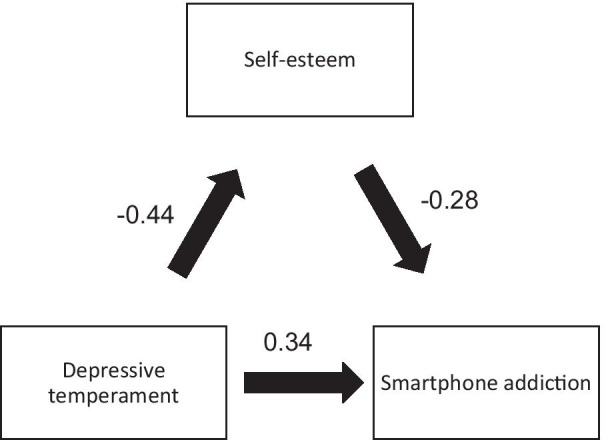
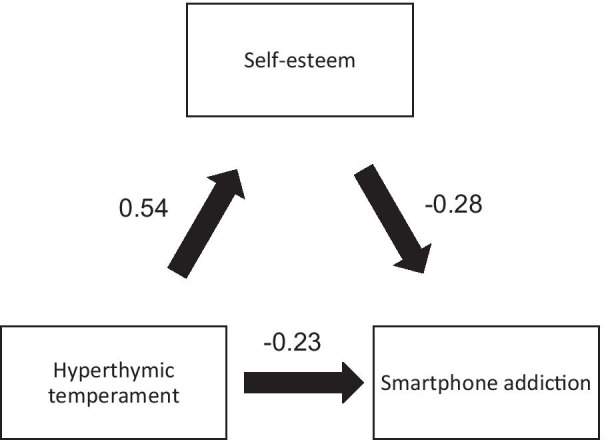
461 participants were included in this study. All items of the SAS were extracted and yielded a one-factor solution with Eigenvalues > 1 (variance explained = 49.96%; α = 0.886). The confirmatory analysis results consolidated those obtained from the factor analysis. Higher depressive temperament (B = 0.46) was significantly associated with more smartphone addiction, whereas higher self-esteem (B = - 0.28) was significantly associated with less smartphone addiction. Self-esteem was found to mediate the association between depressive and hyperthymic temperaments with smartphone addiction.
This study added a better understanding of the high smartphone addiction rate among adults in Lebanon. It confirms the association between affective temperaments and PSU through the mediating effect of self-esteem on Lebanese adults.
全世界的成年人都面临着智能手机使用问题(PSU)带来的严重问题。它对他们的认知、行为和情绪水平以及他们的倾向和幸福感产生负面影响。在黎巴嫩,成年人中 PSU 的患病率为 20.2%,尤其是在年轻人(18-34 岁)中。本研究旨在验证阿拉伯语版智能手机成瘾量表(SAS)的有效性和可靠性。此外,本研究还评估了 PSU 与情感气质之间的关系,以及自尊在这种关系中的中介作用。
本研究于 2020 年 8 月至 9 月进行,采用 18 至 29 岁社区居民样本进行横断面研究。使用智能手机成瘾量表-短版(SAS-SV)评估青少年和成年人的智能手机成瘾程度。使用情感气质量表(TEMPS-A)评估患者的五种不同气质。使用罗森伯格自尊量表(Rosenberg Self-Esteem Scale)评估自尊。
本研究共纳入 461 名参与者。SAS 的所有项目均被提取出来,得出一个特征值>1 的单因素解决方案(方差解释率为 49.96%;α=0.886)。验证性分析结果与因子分析结果一致。较高的抑郁气质(B=0.46)与更高的智能手机成瘾显著相关,而较高的自尊(B=-0.28)与较低的智能手机成瘾显著相关。自尊在抑郁和欣快气质与智能手机成瘾之间的关系中起中介作用。
本研究进一步了解了黎巴嫩成年人中较高的智能手机成瘾率。它通过自尊对黎巴嫩成年人智能手机成瘾的中介作用,证实了情感气质与 PSU 之间的关联。