Department of Dermatology, Brigham & Women's Hospital, Harvard Medical School, Boston, MA, United States.
Front Immunol. 2021 Aug 23;12:654190. doi: 10.3389/fimmu.2021.654190. eCollection 2021.
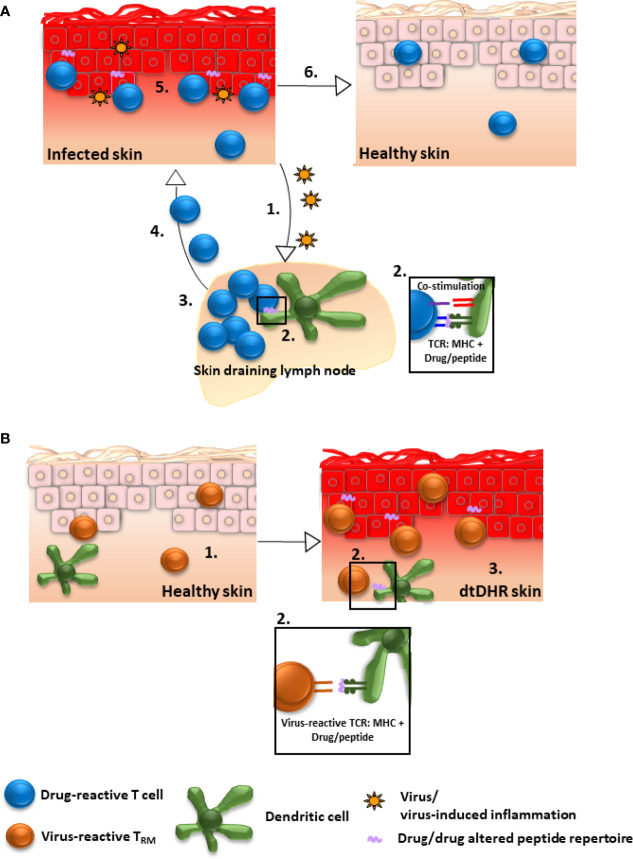
Delayed-type drug hypersensitivity reactions (dtDHR) are immune-mediated reactions with skin and visceral manifestations ranging from mild to severe. Clinical care is negatively impacted by a limited understanding of disease pathogenesis. Though T cells are believed to orchestrate disease, the type of T cell and the location and mechanism of T cell activation remain unknown. Resident memory T cells (T) are a unique T cell population potentially well situated to act as key mediators in disease pathogenesis, but significant obstacles to defining, identifying, and testing T in dtDHR preclude definitive conclusions at this time. Deeper mechanistic interrogation to address these unanswered questions is necessary, as involvement of T in disease has significant implications for prediction, diagnosis, and treatment of disease.
迟发型药物过敏反应 (dtDHR) 是一种免疫介导的反应,其皮肤和内脏表现从轻到重不等。由于对疾病发病机制的了解有限,临床护理受到负面影响。尽管 T 细胞被认为是疾病的主要调节者,但 T 细胞的类型、T 细胞的激活位置和机制仍不清楚。驻留记忆 T 细胞 (T) 是一种独特的 T 细胞群体,可能是疾病发病机制中的关键介质,但目前仍存在定义、识别和检测 T 在 dtDHR 中的重大障碍,无法得出明确的结论。为了解决这些未解决的问题,需要进行更深入的机制研究,因为 T 细胞在疾病中的参与对疾病的预测、诊断和治疗具有重要意义。