Lee Jaewoong, Cho Sungmin, Hong Seong-Eui, Kang Dain, Choi Hayoung, Lee Jong-Mi, Yoon Jae-Ho, Cho Byung-Sik, Lee Seok, Kim Hee-Je, Kim Myungshin, Kim Yonggoo
Department of Laboratory Medicine, College of Medicine, The Catholic University of Korea, Seoul, South Korea.
Catholic Genetic Laboratory Center, Seoul St. Mary's Hospital, College of Medicine, The Catholic University of Korea, Seoul, South Korea.
Front Oncol. 2021 Aug 23;11:717616. doi: 10.3389/fonc.2021.717616. eCollection 2021.
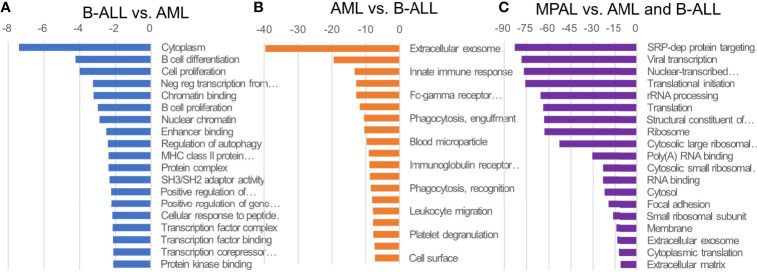
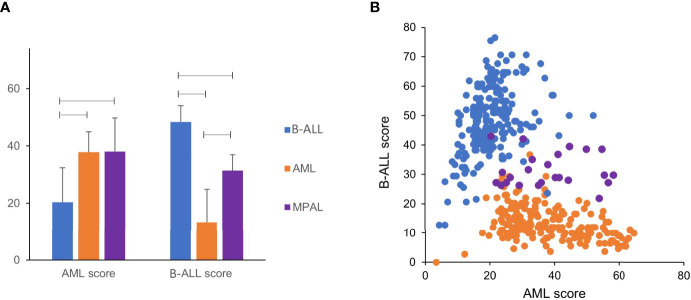
-positive acute leukemia can be classified into three disease categories: B-lymphoblastic leukemia (B-ALL), acute myeloid leukemia (AML), and mixed-phenotype acute leukemia (MPAL). We conducted an integrative analysis of RNA sequencing (RNA-seq) data obtained from 12 -positive B-ALL, AML, and MPAL samples to evaluate its diagnostic utility. RNA-seq facilitated the identification of all p190 with accurate splicing sites and a new gene fusion involving . Most of the clinically significant mutations were also identified including single-nucleotide variations, insertions, and deletions. In addition, RNA-seq yielded differential gene expression profile according to the disease category. Therefore, we selected 368 genes differentially expressed between AML and B-ALL and developed two differential diagnosis models based on the gene expression data using 1) scoring algorithm and 2) machine learning. Both models showed an excellent diagnostic accuracy not only for our 12 -positive cases but also for 427 public gene expression datasets from acute leukemias regardless of specific genetic aberration. This is the first trial to develop models of differential diagnosis using RNA-seq, especially to evaluate the potential role of machine learning in identifying the disease category of acute leukemia. The integrative analysis of gene expression data by RNA-seq facilitates the accurate differential diagnosis of acute leukemia with successful detection of significant gene fusion and/or mutations, which warrants further investigation.
B淋巴细胞白血病(B-ALL)、急性髓系白血病(AML)和混合表型急性白血病(MPAL)。我们对从12例阳性B-ALL、AML和MPAL样本中获得的RNA测序(RNA-seq)数据进行了综合分析,以评估其诊断效用。RNA-seq有助于识别所有具有准确剪接位点的p190以及涉及的一种新的基因融合。还鉴定出了大多数具有临床意义的突变,包括单核苷酸变异、插入和缺失。此外,RNA-seq根据疾病类别产生了差异基因表达谱。因此,我们选择了AML和B-ALL之间差异表达的368个基因,并基于基因表达数据开发了两种鉴别诊断模型,分别使用1)评分算法和2)机器学习。这两种模型不仅对我们的12例阳性病例,而且对来自急性白血病的427个公共基因表达数据集都显示出了出色的诊断准确性,无论其具体的基因畸变情况如何。这是首次使用RNA-seq开发鉴别诊断模型的试验,尤其是评估机器学习在识别急性白血病疾病类别中的潜在作用。通过RNA-seq对基因表达数据进行综合分析有助于急性白血病的准确鉴别诊断,能够成功检测到重要的基因融合和/或突变,这值得进一步研究。