Cernencu Alexandra I, Lungu Adriana, Dragusin Diana M, Stancu Izabela C, Dinescu Sorina, Balahura Liliana R, Mereuta Paul, Costache Marieta, Iovu Horia
Advanced Polymer Materials Group, University Politehnica of Bucharest, 011061 Bucharest, Romania.
Department of Biochemistry and Molecular Biology, University of Bucharest, 050095 Bucharest, Romania.
Materials (Basel). 2021 Aug 27;14(17):4891. doi: 10.3390/ma14174891.
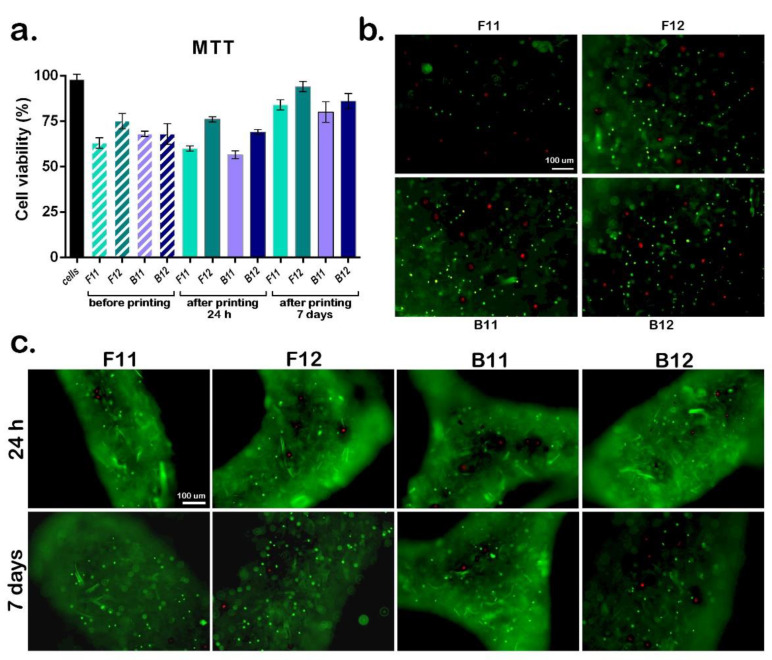
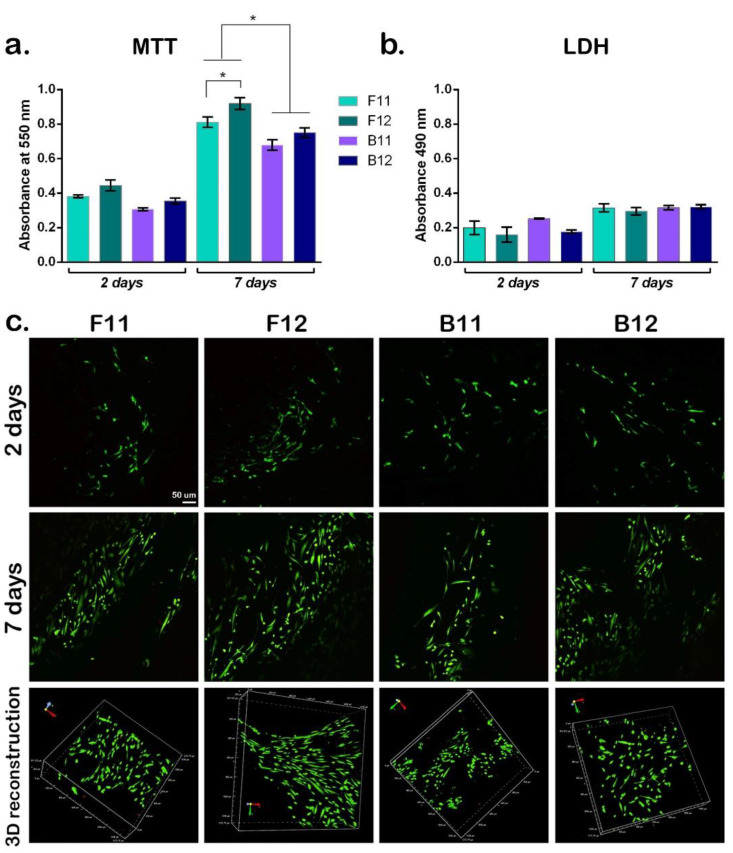
Bioink-formulations based on gelatin methacrylate combined with oxidized cellulose nanofibrils are employed in the present study. The parallel investigation of the printing performance, morphological, swelling, and biological properties of the newly developed hydrogels was performed, with inks prepared using methacrylamide-modified gelatins of fish or bovine origin. Scaffolds with versatile and well-defined internal structure and high shape fidelity were successfully printed due to the high viscosity and shear-thinning behavior of formulated inks and then photo-crosslinked. The biocompatibility of 3D-scaffolds was surveyed using human adipose stem cells (hASCs) and high viability and proliferation rates were obtained when in contact with the biomaterial. Furthermore, bioprinting tests were performed with hASCs embedded in the developed formulations. The results demonstrated that the designed inks are a versatile toolkit for 3D bioprinting and further show the benefits of using fish-derived gelatin for biofabrication.
本研究采用了基于甲基丙烯酸明胶与氧化纤维素纳米纤维相结合的生物墨水配方。对新开发水凝胶的打印性能、形态、溶胀和生物学特性进行了平行研究,所使用的墨水是用鱼源或牛源的甲基丙烯酰胺改性明胶制备的。由于配方墨水具有高粘度和剪切变稀行为,成功打印出了具有通用且明确内部结构和高形状保真度的支架,然后进行光交联。使用人脂肪干细胞(hASC)对3D支架的生物相容性进行了检测,当与生物材料接触时获得了高活力和增殖率。此外,还对嵌入已开发配方中的hASC进行了生物打印测试。结果表明,所设计的墨水是用于3D生物打印的通用工具包,并进一步显示了使用鱼源明胶进行生物制造的优势。