Vu Trung T, Koguchi-Yoshioka Hanako, Watanabe Rei
Department of Cutaneous Immunology, Immunology Frontier Research Center, Osaka University, Osaka 565-0871, Japan.
Department of Dermatology, Course of Integrated Medicine, Graduate School of Medicine/Faculty of Medicine, Osaka University, Osaka 565-0871, Japan.
J Clin Med. 2021 Aug 26;10(17):3822. doi: 10.3390/jcm10173822.
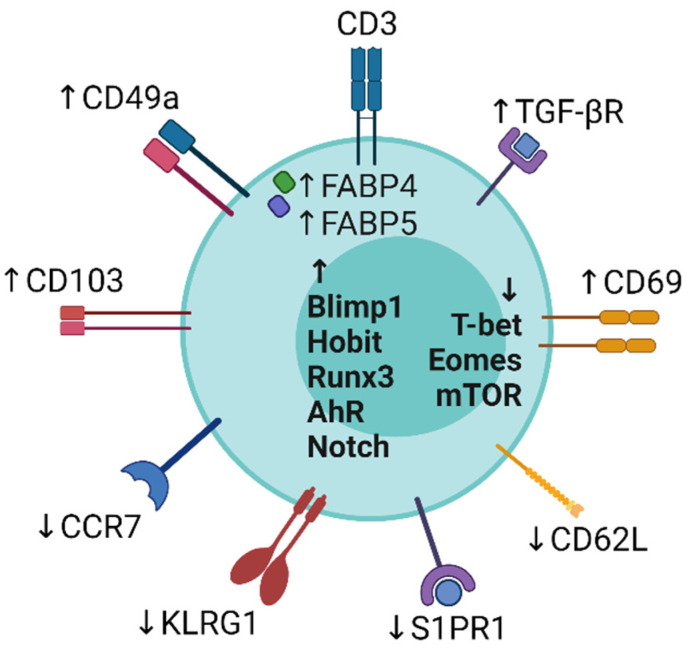
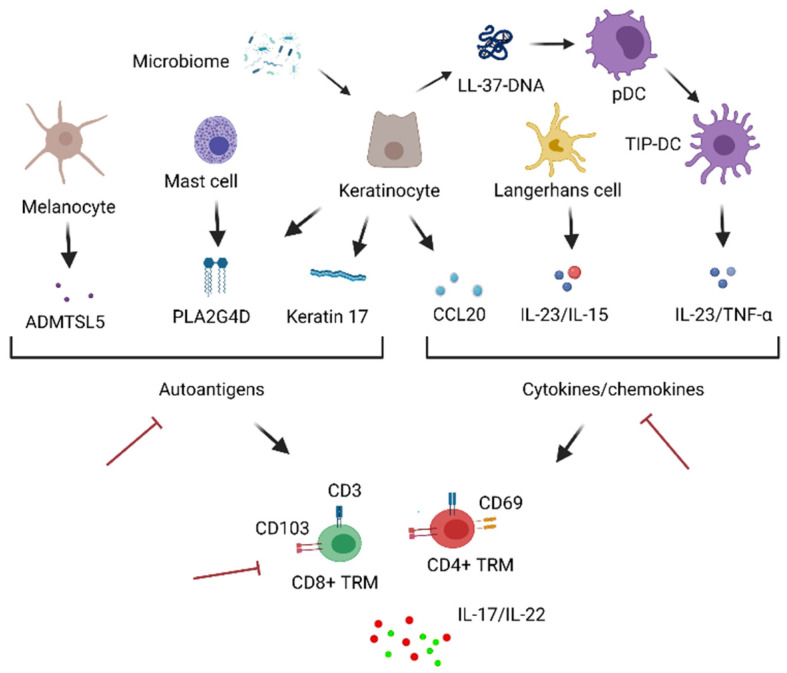
Tissue-resident memory T cells (T) stay in the peripheral tissues for long periods of time, do not recirculate, and provide the first line of adaptive immune response in the residing tissues. Although T originate from circulating T cells, T are physiologically distinct from circulating T cells with the expression of tissue-residency markers, such as CD69 and CD103, and the characteristic profile of transcription factors. Besides defense against pathogens, the functional skew of skin T is indicated in chronic skin inflammatory diseases. In psoriasis, IL-17A-producing CD8 T are regarded as one of the pathogenic populations in skin. Although no licensed drugs that directly and specifically inhibit the activity of skin T are available to date, psoriatic skin T are affected in the current treatments of psoriasis. Targeting skin T or using T as a potential index for disease severity can be an attractive strategy in psoriasis.
组织驻留记忆T细胞(T细胞)长时间驻留在外周组织中,不进行再循环,并在驻留组织中提供适应性免疫反应的第一线。尽管T细胞起源于循环T细胞,但T细胞在生理上与循环T细胞不同,具有组织驻留标志物如CD69和CD103的表达以及转录因子的特征性谱。除了抵御病原体外,皮肤T细胞的功能偏差在慢性皮肤炎症性疾病中也有体现。在银屑病中,产生白细胞介素-17A的CD8 T细胞被认为是皮肤中的致病群体之一。尽管迄今为止尚无直接特异性抑制皮肤T细胞活性的获批药物,但银屑病皮肤T细胞在目前的银屑病治疗中会受到影响。靶向皮肤T细胞或使用T细胞作为疾病严重程度的潜在指标可能是银屑病中一种有吸引力的策略。