Institute of Health Sciences, ZHAW Zurich University of Applied Sciences, Katharina-Sulzer-Platz 9, 8401 Winterthur, Switzerland.
Medical Faculty, University of Basel, Klingelbergstrasse 61, 4056 Basel, Switzerland.
Int J Environ Res Public Health. 2021 Aug 31;18(17):9210. doi: 10.3390/ijerph18179210.
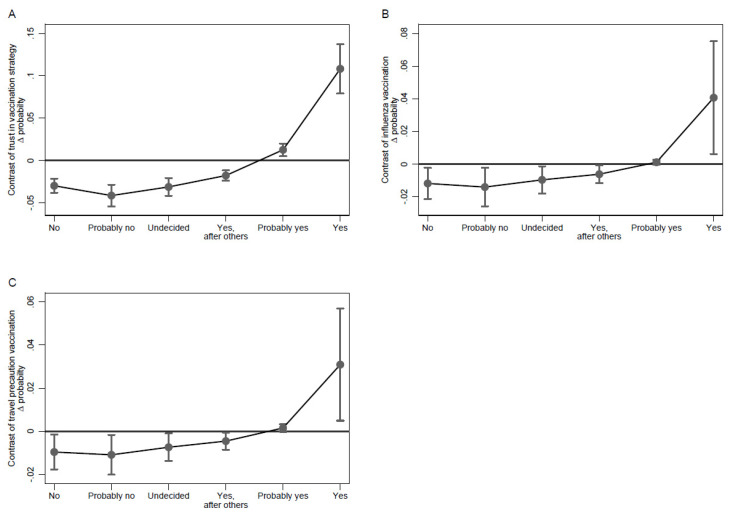
The speed and innovation of the COVID-19 vaccine development has been accompanied by insecurity and skepticism. Young adults' attitude to vaccination remains under investigation, although herd immunity cannot be reached without them. The HEalth in Students during the Corona pandemic study (HES-C) provided the opportunity to investigate vaccination intention in 1478 students in the sixth survey wave (January 2021), including vaccination intention, psychological antecedents of vaccine hesitancy, trust in government's vaccination strategy, and vaccination history. Associations with vaccination intention were analyzed with multivariate ordinal regression and predicted margins were calculated adjusting for gender, age, anxiety, health profession, and subjective health status. A third was decided (yes 25.1%, no 7.6%), and 68% were unsure about getting the COVID-19 vaccine when available. Next to demographic characteristics, vaccination history (influenza vaccination OR = 1.39; 95% CI: 1.06-1.83, travel vaccination OR = 1.29; 95% CI: 1.04-1.60), trust in vaccination strategy (OR = 2.40; 95% CI: 1.89-3.05), and 5C dimensions were associated with vaccination intention: confidence (OR = 2.52; 95% CI: 2.09-3.03), complacency (OR = 0.79; 95% CI: 0.66-0.96), calculation (OR = 0.79; 95% CI: 0.70-0.89), constraints (OR = 1.18; 95% CI: 0.99-1.41), and collective responsibility (OR = 4.47; 95% CI: 3.69-5.40). Addressing psychological antecedents and strengthening trust in official strategies through targeted campaigns and interventions may increase decisiveness and result in higher vaccination rates.
COVID-19 疫苗研发的速度和创新伴随着不安全感和怀疑。尽管没有年轻人,群体免疫就无法实现,但年轻人对疫苗接种的态度仍在调查中。HEalth in Students during the Corona pandemic 研究(HES-C)在第六次调查波(2021 年 1 月)中为 1478 名学生提供了调查疫苗接种意愿的机会,包括疫苗接种意愿、疫苗犹豫的心理前因、对政府疫苗接种策略的信任以及疫苗接种史。使用多元有序回归分析了与疫苗接种意愿的关联,并通过调整性别、年龄、焦虑、健康职业和主观健康状况来计算预测边缘。三分之一的人已经决定(是 25.1%,否 7.6%),68%的人不确定有 COVID-19 疫苗时是否接种。除了人口统计学特征外,疫苗接种史(流感疫苗接种 OR = 1.39;95%CI:1.06-1.83,旅行疫苗接种 OR = 1.29;95%CI:1.04-1.60)、对疫苗接种策略的信任(OR = 2.40;95%CI:1.89-3.05)和 5C 维度与疫苗接种意愿相关:信心(OR = 2.52;95%CI:2.09-3.03)、自满(OR = 0.79;95%CI:0.66-0.96)、计算(OR = 0.79;95%CI:0.70-0.89)、限制(OR = 1.18;95%CI:0.99-1.41)和集体责任(OR = 4.47;95%CI:3.69-5.40)。通过有针对性的宣传和干预措施解决心理前因,并增强对官方策略的信任,可能会提高决策力,并提高疫苗接种率。