College of Nursing, Chang Gung University of Science and Technology, Puzi City 61363, Taiwan.
Chiayi Chang Gung Memorial Hospital, Puzi City 61363, Taiwan.
Int J Environ Res Public Health. 2021 Sep 3;18(17):9307. doi: 10.3390/ijerph18179307.
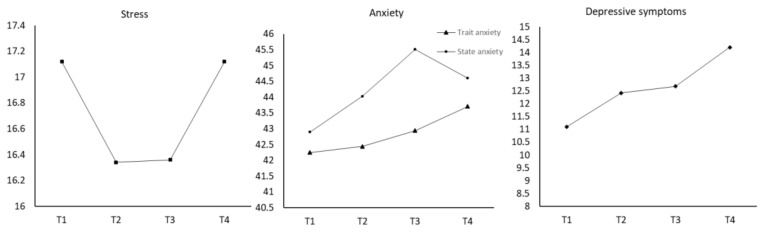
Perinatal stress, anxiety, and depression impacts not only women but also their child(ren). The purpose of this longitudinal study is to explore trends of stress, anxiety, and depressive symptoms from pregnancy to postpartum and understand predictions of stress and anxiety on postpartum depression. One-hundred-fifty-six women at 23-28 weeks gestation (T1), 147 at 32-36 weeks gestation (T2), 129 at over 36 weeks gestation (T3), and 83 at postpartum (T4) completed study surveys. The Perceived Stress Scale, Center for Epidemiologic Studies Depression scale, and State-Trait Anxiety Inventory were used to measure stress, depressive symptoms, and anxiety. Descriptive statistics, Pearson and Spearman's correlation, and Generalized Estimating Equation were applied to analyze the data. Results showed that levels of anxiety and depressive symptoms increased from 24 weeks gestation to postpartum, whereas stress levels decreased during pregnancy but increased in postpartum. Over half of women experienced anxiety symptoms, especially during late pregnancy and postpartum. Stress, anxiety, and depressive symptoms were inter-correlated. Notably, women at late pregnancy and postpartum were prone to stress, anxiety, and depression. Prenatal anxiety could predict postpartum depressive symptoms. Active assessment and management of stress, anxiety, and depression is needed and should begin from early pregnancy and continue until postpartum.
围产期压力、焦虑和抑郁不仅会影响女性,还会影响其子女。本纵向研究的目的是探讨从妊娠到产后压力、焦虑和抑郁症状的趋势,并了解压力和焦虑对产后抑郁的预测作用。156 名孕妇在 23-28 周妊娠时(T1)、147 名在 32-36 周妊娠时(T2)、129 名在 36 周以上妊娠时(T3)、83 名在产后(T4)完成了研究调查。使用感知压力量表、流行病学研究中心抑郁量表和状态-特质焦虑量表来衡量压力、抑郁症状和焦虑。采用描述性统计、Pearson 和 Spearman 相关以及广义估计方程来分析数据。结果表明,焦虑和抑郁症状水平从 24 周妊娠增加到产后,而压力水平在妊娠期间下降,但产后增加。超过一半的女性经历了焦虑症状,尤其是在妊娠晚期和产后。压力、焦虑和抑郁症状相互关联。值得注意的是,妊娠晚期和产后的女性更容易出现压力、焦虑和抑郁。产前焦虑可以预测产后抑郁症状。需要积极评估和管理压力、焦虑和抑郁,并且应从早孕开始,并持续到产后。