Center for Community-Based Research, Dana-Farber Cancer Institute, Boston, MA 02215, USA.
Department of Social and Behavioral Sciences, Harvard T.H. Chan School of Public Health, Boston, MA 02115, USA.
Int J Environ Res Public Health. 2021 Sep 6;18(17):9383. doi: 10.3390/ijerph18179383.
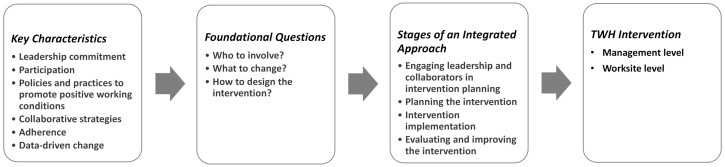
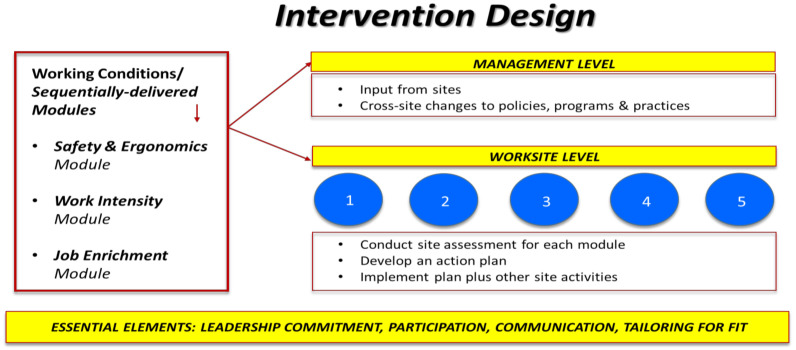
Total Worker Health (TWH) interventions that utilize integrated approaches to advance worker safety, health, and well-being can be challenging to design and implement in practice. This may be especially true for the food service industry, characterized by high levels of injury and turnover. This paper illustrates how we used TWH Implementation Guidelines to develop and implement an organizational intervention to improve pain, injury, and well-being among low-wage food service workers. We used the Guidelines to develop the intervention in two main ways: first, we used the six key characteristics of an integrated approach (leadership commitment; participation; positive working conditions; collaborative strategies; adherence; data-driven change) to create the foundation of the intervention; second, we used the four stages to guide integrated intervention planning. For each stage (engaging collaborators; planning; implementing; evaluating for improvement), the Guidelines provided a flexible and iterative process to plan the intervention to improve safety and ergonomics, work intensity, and job enrichment. This paper provides a real-world example of how the Guidelines can be used to develop a complex TWH intervention for food service workers that is responsive to organizational context and addresses targeted working conditions. Application of the Guidelines is likely transferable to other industries.
利用综合方法来促进工人安全、健康和福祉的总体工人健康 (TWH) 干预措施在实践中进行设计和实施可能具有挑战性。对于以高伤害率和高离职率为特征的餐饮服务行业来说尤其如此。本文说明了我们如何使用 TWH 实施指南来制定和实施一项组织干预措施,以改善低薪餐饮服务工人的疼痛、伤害和幸福感。我们使用指南以两种主要方式来开发干预措施:首先,我们使用综合方法的六个关键特征(领导力承诺;参与;积极的工作条件;协作策略;坚持;数据驱动的变革)来为干预措施奠定基础;其次,我们使用四个阶段来指导综合干预措施的规划。对于每个阶段(吸引合作者;规划;实施;评估改进),指南提供了一个灵活的迭代过程来规划干预措施,以改善安全和人体工程学、工作强度和工作充实度。本文提供了一个真实世界的例子,说明指南如何用于为餐饮服务工人制定复杂的 TWH 干预措施,该措施对组织背景做出响应,并解决目标工作条件。指南的应用可能适用于其他行业。