de Freitas Renata Caroline Costa, Hirata Rosario Dominguez Crespo, Hirata Mario Hiroyuki, Aikawa Elena
Center for Interdisciplinary Cardiovascular Sciences, Division of Cardiovascular Medicine, Brigham and Women's Hospital, Harvard Medical School, Boston, MA 02115, USA.
Department of Clinical and Toxicological Analyses, School of Pharmaceutical Sciences, University of Sao Paulo, Sao Paulo 05508-000, Brazil.
Biomolecules. 2021 Mar 5;11(3):388. doi: 10.3390/biom11030388.
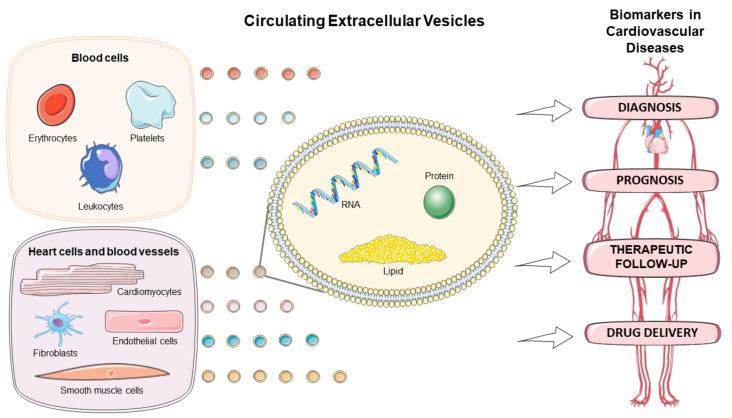
Extracellular vesicles (EVs) are composed of a lipid bilayer containing transmembrane and soluble proteins. Subtypes of EVs include ectosomes (microparticles/microvesicles), exosomes, and apoptotic bodies that can be released by various tissues into biological fluids. EV cargo can modulate physiological and pathological processes in recipient cells through near- and long-distance intercellular communication. Recent studies have shown that origin, amount, and internal cargos (nucleic acids, proteins, and lipids) of EVs are variable under different pathological conditions, including cardiovascular diseases (CVD). The early detection and management of CVD reduce premature morbidity and mortality. Circulating EVs have attracted great interest as a potential biomarker for diagnostics and follow-up of CVD. This review highlights the role of circulating EVs as biomarkers for diagnosis, prognosis, and therapeutic follow-up of CVD, and also for drug delivery. Despite the great potential of EVs as a tool to study the pathophysiology of CVD, further studies are needed to increase the spectrum of EV-associated applications.
细胞外囊泡(EVs)由包含跨膜蛋白和可溶性蛋白的脂质双层组成。EVs的亚型包括外泌体(微粒/微囊泡)、外泌体和凋亡小体,它们可由各种组织释放到生物体液中。EVs的货物可以通过近距离和远距离细胞间通讯调节受体细胞中的生理和病理过程。最近的研究表明,在包括心血管疾病(CVD)在内的不同病理条件下,EVs的来源、数量和内部货物(核酸、蛋白质和脂质)是可变的。CVD的早期检测和管理可降低过早发病和死亡率。循环EVs作为CVD诊断和随访的潜在生物标志物引起了极大兴趣。本综述强调了循环EVs作为CVD诊断、预后和治疗随访以及药物递送生物标志物的作用。尽管EVs作为研究CVD病理生理学的工具具有巨大潜力,但仍需要进一步研究以扩大EVs相关应用的范围。