Subdirección de Investigación Básica, Instituto Nacional de Cancerología, Secretaría de Salud, Ciudad de México, Mexico.
Programa de Posgrado en Ciencias Biológicas, Universidad Nacional Autónoma de México, Ciudad de México, Mexico.
Stem Cell Res Ther. 2021 Sep 9;12(1):498. doi: 10.1186/s13287-021-02562-9.
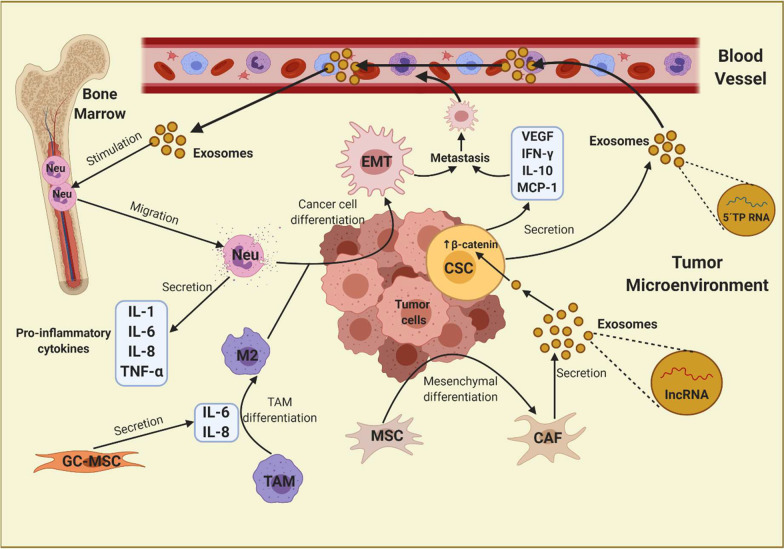
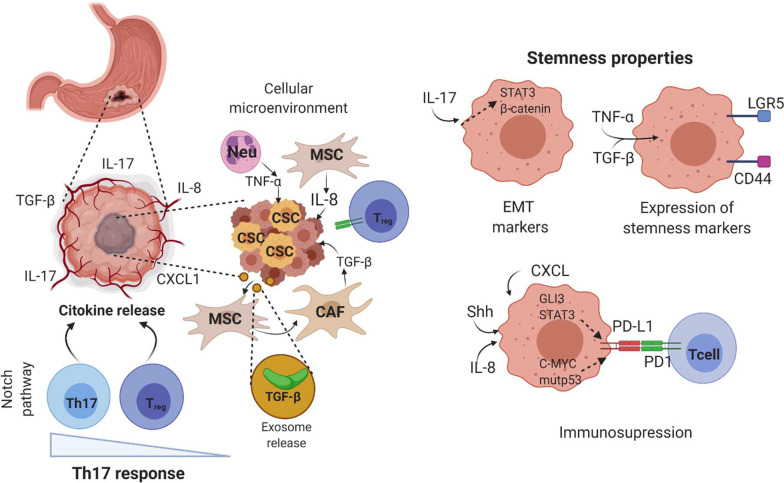
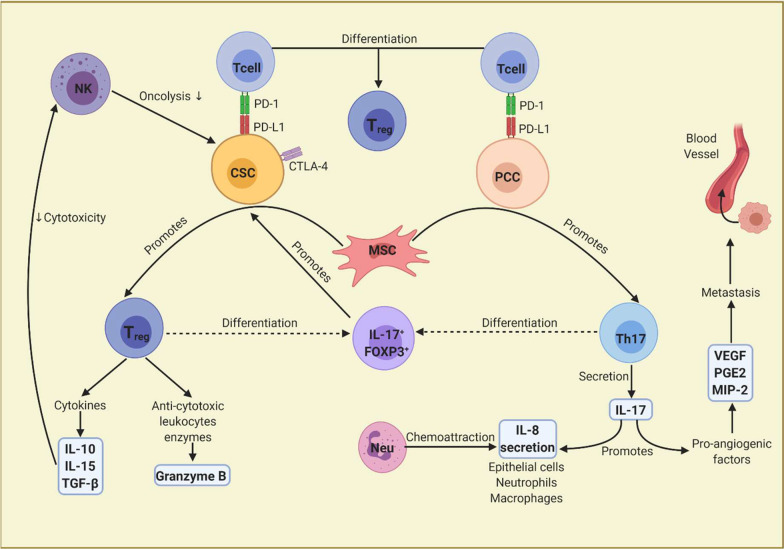
Cross talk between cancer cells and the immune system is determinant for cancer progression. Emerging evidence demonstrates that GC characteristics such as metastasis, treatment resistance, and disease recurrence are associated with a tumor subpopulation called gastric cancer stem cells (GCSCs). However, the specific interaction between GCSCs and the immune microenvironment is still under investigation. Although immune evasion has been well described for cancer stem cells (CSCs), recent studies show that GCSCs can also regulate the immune system and even benefit from it. This review will provide an overview of bidirectional interactions between CSCs and immune cells in GC, compiling relevant data about how CSCs can induce leukocyte reprogramming, resulting in pro-tumoral immune cells that orchestrate promotion of metastasis, chemoresistance, tumorigenicity, and even increase in number of cancer cells with stem properties. Some immune cells studied are tumor-associated macrophages (TAMs), neutrophils, Th17 and T regulatory (T) cells, mesenchymal stem cells (MSCs), and cancer-associated fibroblasts (CAFs), as well as the signaling pathways involved in these pro-tumoral activities. Conversely, although there are cytotoxic leukocytes that can potentially eliminate GCSCs, we describe mechanisms for immune evasion in GCSCs and their clinical implications. Furthermore, we describe current available immunotherapy targeting GCSC-related markers as possible treatment for GC, discussing how the CSC-modified immune microenvironment can mitigate or inactivate these immunotherapies, limiting their effectiveness. Finally, we summarize key concepts and relevant evidence to understand the cross talk between GCSCs and the immune microenvironment as an important process for effective design of therapies against GCSCs that improve the outcome of patients with GC.
癌细胞与免疫系统的串扰对癌症的进展起决定性作用。新出现的证据表明,GC 的一些特征,如转移、治疗抵抗和疾病复发,与一种称为胃癌干细胞(GCSC)的肿瘤亚群有关。然而,GCSC 与免疫微环境之间的具体相互作用仍在研究之中。尽管癌症干细胞(CSC)的免疫逃逸已得到很好的描述,但最近的研究表明,GCSC 也可以调节免疫系统,甚至从中受益。这篇综述将概述 GC 中 CSCs 与免疫细胞之间的双向相互作用,汇编有关 CSCs 如何诱导白细胞重编程的相关数据,导致促进转移、化疗耐药、致瘤性的促肿瘤免疫细胞,并增加具有干细胞特性的癌细胞数量。一些研究过的免疫细胞包括肿瘤相关巨噬细胞(TAMs)、中性粒细胞、Th17 和 T 调节(Treg)细胞、间充质干细胞(MSCs)和癌症相关成纤维细胞(CAFs),以及涉及这些促肿瘤活性的信号通路。相反,尽管有潜在的可以消除 GCSC 的细胞毒性白细胞,但我们描述了 GCSC 中的免疫逃逸机制及其临床意义。此外,我们描述了目前针对 GCSC 相关标志物的免疫疗法,作为治疗 GC 的可能方法,讨论了 GCSC 修饰的免疫微环境如何减轻或使这些免疫疗法失活,限制其有效性。最后,我们总结了关键概念和相关证据,以了解 GCSC 与免疫微环境之间的串扰,作为设计针对 GCSC 的有效疗法的重要过程,从而改善 GC 患者的预后。