College of Information and Computer, Taiyuan University of Technology, Taiyuan 030024, China.
Comput Intell Neurosci. 2021 Aug 31;2021:7552185. doi: 10.1155/2021/7552185. eCollection 2021.
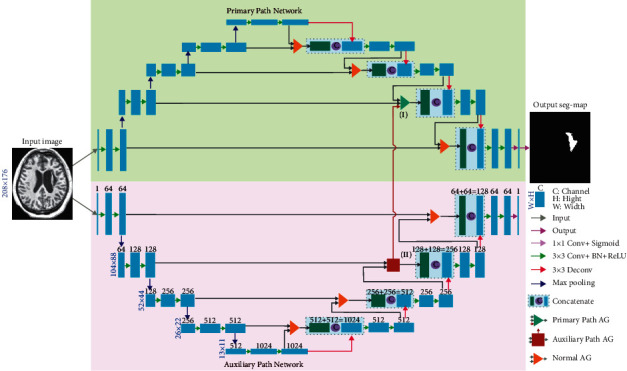
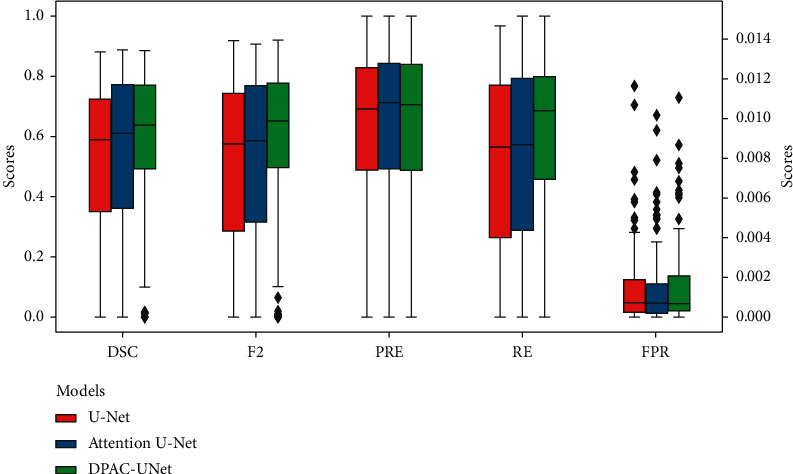
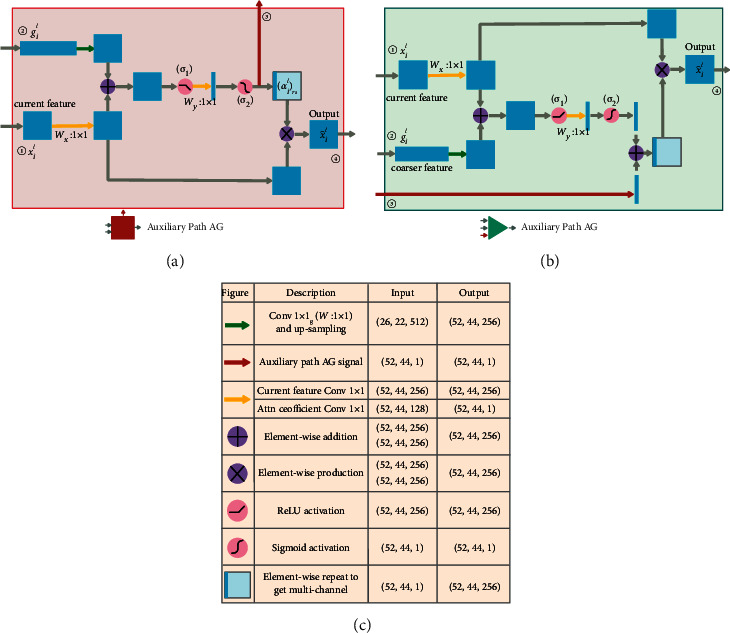
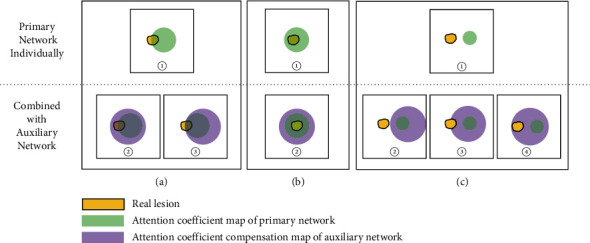
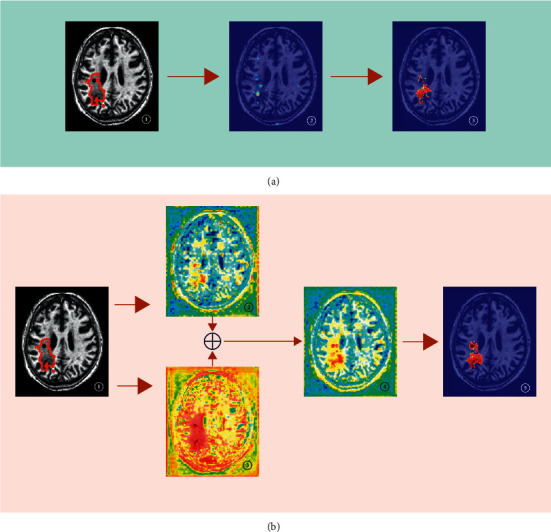
For the segmentation task of stroke lesions, using the attention U-Net model based on the self-attention mechanism can suppress irrelevant regions in an input image while highlighting salient features useful for specific tasks. However, when the lesion is small and the lesion contour is blurred, attention U-Net may generate wrong attention coefficient maps, leading to incorrect segmentation results. To cope with this issue, we propose a dual-path attention compensation U-Net (DPAC-UNet) network, which consists of a primary network and auxiliary path network. Both networks are attention U-Net models and identical in structure. The primary path network is the core network that performs accurate lesion segmentation and outputting of the final segmentation result. The auxiliary path network generates auxiliary attention compensation coefficients and sends them to the primary path network to compensate for and correct possible attention coefficient errors. To realize the compensation mechanism of DPAC-UNet, we propose a weighted binary cross-entropy Tversky (WBCE-Tversky) loss to train the primary path network to achieve accurate segmentation and propose another compound loss function called tolerance loss to train the auxiliary path network to generate auxiliary compensation attention coefficient maps with expanded coverage area to perform compensate operations. We conducted segmentation experiments using the 239 MRI scans of the anatomical tracings of lesions after stroke (ATLAS) dataset to evaluate the performance and effectiveness of our method. The experimental results show that the DSC score of the proposed DPAC-UNet network is 6% higher than the single-path attention U-Net. It is also higher than the existing segmentation methods of the related literature. Therefore, our method demonstrates powerful abilities in the application of stroke lesion segmentation.
针对脑卒中病灶的分割任务,使用基于自注意力机制的注意力 U-Net 模型可以在突出对特定任务有用的显著特征的同时抑制输入图像中的不相关区域。然而,当病灶较小时,病灶轮廓较模糊,注意力 U-Net 可能会生成错误的注意力系数图,导致分割结果不正确。为了解决这个问题,我们提出了一种双路径注意力补偿 U-Net(DPAC-UNet)网络,它由主网络和辅助路径网络组成。两个网络都是注意力 U-Net 模型,结构相同。主路径网络是执行准确病灶分割和输出最终分割结果的核心网络。辅助路径网络生成辅助注意力补偿系数,并将其发送到主路径网络,以补偿和纠正可能的注意力系数错误。为了实现 DPAC-UNet 的补偿机制,我们提出了一种加权二分类交叉熵 Tversky(WBCE-Tversky)损失来训练主路径网络以实现准确分割,并提出了另一种称为容差损失的复合损失函数来训练辅助路径网络以生成具有扩展覆盖范围的辅助补偿注意力系数图来执行补偿操作。我们使用解剖学轨迹后中风病灶(ATLAS)数据集的 239 个 MRI 扫描进行分割实验,以评估我们方法的性能和有效性。实验结果表明,所提出的 DPAC-UNet 网络的 DSC 评分比单路径注意力 U-Net 高 6%。它也高于现有文献中相关的分割方法。因此,我们的方法在脑卒中病灶分割的应用中表现出强大的能力。