Zhou Zhengsong, Wan Hongli, Zhang Haoyu, Chen Xumiao, Wang Xiaoyu, Lili Shiluo, Zhang Tao
Department of Electronic Information Engineering, Chengdu Jincheng College, Chengdu, China.
Department of Epidemiology and Health Statistics, West China School of Public Health and West China Fourth Hospital, Sichuan University, Chengdu, China.
Front Neurol. 2022 Mar 29;13:865023. doi: 10.3389/fneur.2022.865023. eCollection 2022.
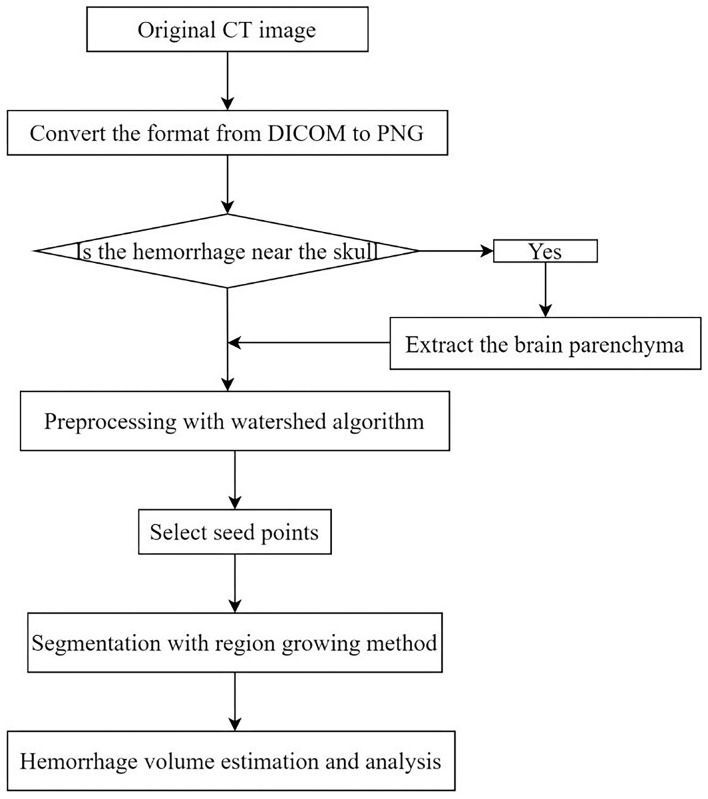
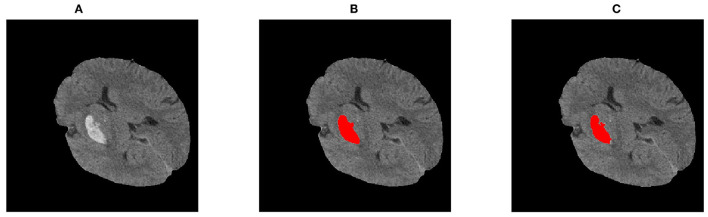
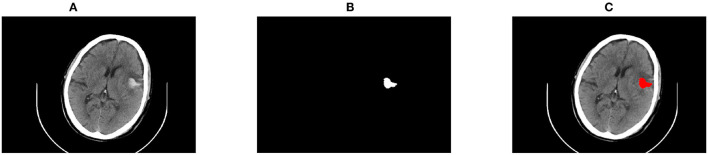
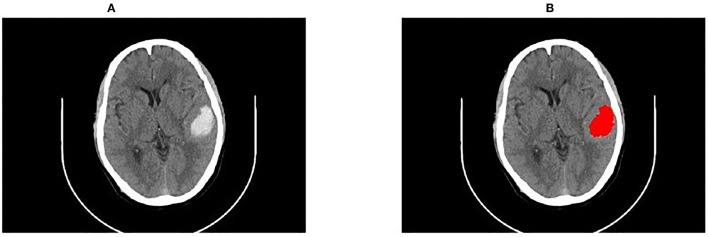
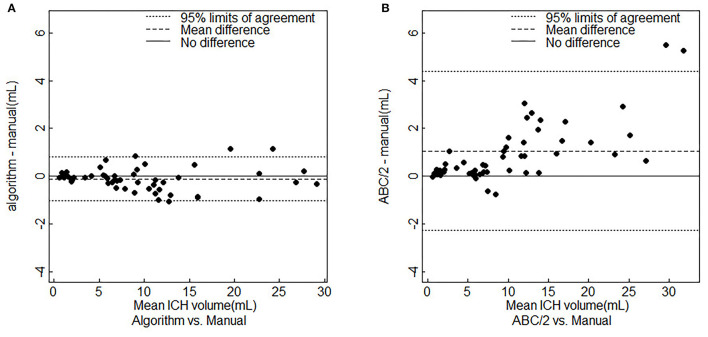
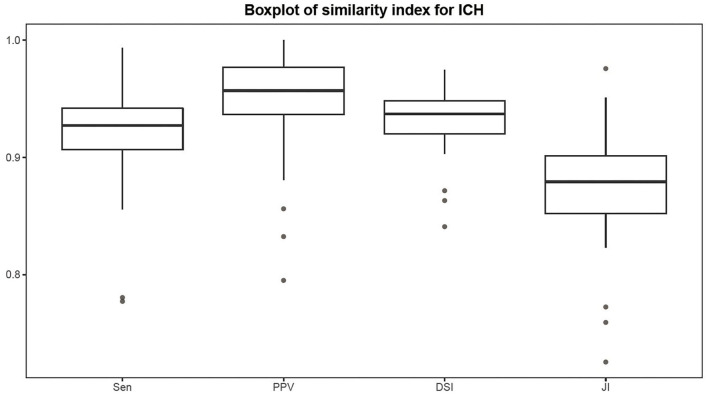
Intracerebral hemorrhage (ICH) poses a great threat to human life due to its high incidence and poor prognosis. Identification of the bleeding location and quantification of the volume based on CT images are of great significance for assisting the diagnosis and treatment of ICH. In this study, a region-growing algorithm based on watershed preprocessing (RG-WP) was proposed to segment and quantify the hemorrhage. The lowest points yielded by the watershed algorithm were used as seed points for region growing and then hemorrhage was segmented based on the region growing method. At the same time, to integrate the rich experience of clinicians with the algorithm, manual selection of seed points on the basis of watershed segmentation was performed. With the application of segmentation on CT images of 55 patients with ICH, the performance of the RG-WP algorithm was evaluated by comparing it with manual segmentations delineated by professional clinicians as well as the traditional ABC/2 method and the deep learning algorithm U-net. The mean deviation of hemorrhage volume of the RG-WP algorithm from manual segmentation was -0.12 ml (range: -1.05-1.16), while that of the ABC/2 from the manual was 1.05 ml (range: -0.77-9.57). Strong agreement of the algorithm and the manual was confirmed with a high intraclass correlation coefficient (ICC) (0.998, 95% : 0.997-0.999), which was superior to that of the ABC/2 and the manual (0.972, 95% : 0.953-0.984). The sensitivity (Sen), positive predictive value (PPV), dice similarity index (DSI), and Jaccard index (JI) of the RG-WP algorithm compared to the manual were 0.92 ± 0.04, 0.95 ± 0.04, 0.93 ± 0.02, and 0.88 ± 0.04, respectively, showing high consistency. Besides, the accuracy of the algorithm was also comparable to that of the deep learning method U-net, with Sen, PPV, DSI, and JI being 0.91 ± 0.09, 0.91 ± 0.06, 0.91 ± 0.05, and 0.91 ± 0.06, respectively.
脑出血(ICH)因其高发病率和不良预后对人类生命构成巨大威胁。基于CT图像识别出血位置并对出血量进行量化,对于辅助脑出血的诊断和治疗具有重要意义。在本研究中,提出了一种基于分水岭预处理的区域生长算法(RG-WP)来分割和量化出血区域。将分水岭算法产生的最低点用作区域生长的种子点,然后基于区域生长方法分割出血区域。同时,为了将临床医生的丰富经验与该算法相结合,在分水岭分割的基础上进行了种子点的手动选择。通过对55例脑出血患者的CT图像进行分割应用,将RG-WP算法与专业临床医生手动勾勒的分割结果、传统的ABC/2方法以及深度学习算法U-net进行比较,评估了RG-WP算法的性能。RG-WP算法与手动分割的出血量平均偏差为-0.12 ml(范围:-1.05至1.16),而ABC/2与手动分割的平均偏差为1.05 ml(范围:-0.77至9.57)。通过高组内相关系数(ICC)(0.998,95%:0.997 - 0.999)证实了该算法与手动分割有很强的一致性,优于ABC/2与手动分割的一致性(0.972,95%:0.953 - 0.984)。与手动分割相比,RG-WP算法的灵敏度(Sen)、阳性预测值(PPV)、骰子相似性指数(DSI)和杰卡德指数(JI)分别为0.92±0.04、0.95±0.04、0.93±0.02和0.88±0.04,显示出高度一致性。此外,该算法的准确性也与深度学习方法U-net相当,Sen、PPV、DSI和JI分别为0.91±0.09、0.91±0.06、0.91±0.05和0.91±0.06。