Song Wan-Mei, Zhao Jing-Yu, Zhang Qian-Yun, Liu Si-Qi, Zhu Xue-Han, An Qi-Qi, Xu Ting-Ting, Li Shi-Jin, Liu Jin-Yue, Tao Ning-Ning, Liu Yao, Li Yi-Fan, Li Huai-Chen
Department of Respiratory and Critical Care Medicine, Shandong Provincial Hospital Affiliated to Shandong University, Jinan, China.
Cheeloo College of Medicine, Shandong University, Jinan, China.
Front Med (Lausanne). 2021 Aug 24;8:657006. doi: 10.3389/fmed.2021.657006. eCollection 2021.
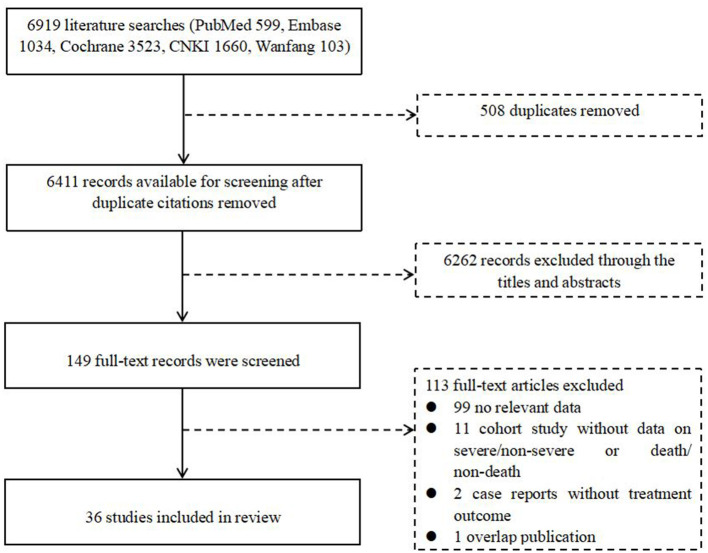
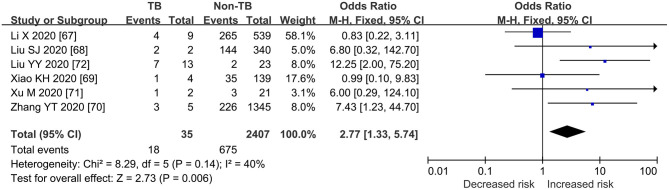
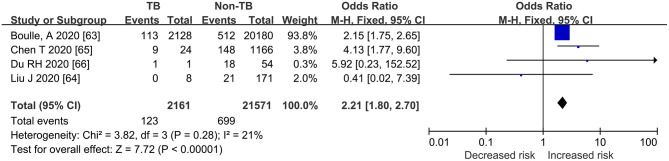
Coronavirus disease 2019 (COVID-19) and tuberculosis (TB) are two major infectious diseases posing significant public health threats, and their coinfection (aptly abbreviated COVID-TB) makes the situation worse. This study aimed to investigate the clinical features and prognosis of COVID-TB cases. The PubMed, Embase, Cochrane, CNKI, and Wanfang databases were searched for relevant studies published through December 18, 2020. An overview of COVID-TB case reports/case series was prepared that described their clinical characteristics and differences between survivors and deceased patients. Pooled odds ratios (ORs) with 95% confidence intervals (CIs) for death or severe COVID-19 were calculated. The quality of outcomes was assessed using GRADEpro. Thirty-six studies were included. Of 89 COVID-TB patients, 19 (23.46%) died, and 72 (80.90%) were male. The median age of non-survivors (53.95 ± 19.78 years) was greater than that of survivors (37.76 ± 15.54 years) ( < 0.001). Non-survivors were more likely to have hypertension (47.06 vs. 17.95%) or symptoms of dyspnea (72.73% vs. 30%) or bilateral lesions (73.68 vs. 47.14%), infiltrates (57.89 vs. 24.29%), tree in bud (10.53% vs. 0%), or a higher leucocyte count (12.9 [10.5-16.73] vs. 8.015 [4.8-8.97] × 10/L) than survivors ( < 0.05). In terms of treatment, 88.52% received anti-TB therapy, 50.82% received antibiotics, 22.95% received antiviral therapy, 26.23% received hydroxychloroquine, and 11.48% received corticosteroids. The pooled ORs of death or severe disease in the COVID-TB group and the non-TB group were 2.21 (95% CI: 1.80, 2.70) and 2.77 (95% CI: 1.33, 5.74) ( < 0.01), respectively. In summary, there appear to be some predictors of worse prognosis among COVID-TB cases. A moderate level of evidence suggests that COVID-TB patients are more likely to suffer severe disease or death than COVID-19 patients. Finally, routine screening for TB may be recommended among suspected or confirmed cases of COVID-19 in countries with high TB burden.
2019年冠状病毒病(COVID-19)和结核病(TB)是构成重大公共卫生威胁的两种主要传染病,它们的合并感染(简称为COVID-TB)使情况更加恶化。本研究旨在调查COVID-TB病例的临床特征和预后。检索了PubMed、Embase、Cochrane、中国知网(CNKI)和万方数据库,查找截至2020年12月18日发表的相关研究。编写了一份COVID-TB病例报告/病例系列概述,描述了其临床特征以及幸存者和死亡患者之间的差异。计算了死亡或重症COVID-19的合并比值比(OR)及其95%置信区间(CI)。使用GRADEpro评估结果的质量。纳入了36项研究。在89例COVID-TB患者中,19例(23.46%)死亡,72例(80.90%)为男性。非幸存者的中位年龄(53.95±19.78岁)高于幸存者(37.76±15.54岁)(P<0.001)。与幸存者相比,非幸存者更有可能患有高血压(47.06%对17.95%)、呼吸困难症状(72.73%对30%)或双侧病变(73.68%对47.14%)、浸润(57.89%对24.29%)、树芽征(10.53%对0%)或白细胞计数更高(12.9[10.5 - 16.73]对8.015[4.8 - 8.97]×10⁹/L)(P<0.05)。在治疗方面,88.52%的患者接受了抗结核治疗,50.82%接受了抗生素治疗,22.95%接受了抗病毒治疗,26.23%接受了羟氯喹,11.48%接受了皮质类固醇治疗。COVID-TB组和非TB组死亡或重症疾病的合并OR分别为2.21(95%CI:1.80,2.70)和2.77(95%CI:1.33,5.74)(P<0.01)。总之,COVID-TB病例中似乎存在一些预后较差的预测因素。中等质量的证据表明,与COVID-19患者相比,COVID-TB患者更有可能患重症疾病或死亡。最后,在结核病负担较高的国家,对于疑似或确诊的COVID-19病例,可能建议进行结核病常规筛查。