Department of Psychology, Dietrich School of Arts and Sciences, University of Pittsburgh, Pittsburgh, PA, USA.
Grossman School of Medicine, New York University, New York, NY, USA.
Clin Child Fam Psychol Rev. 2021 Dec;24(4):669-683. doi: 10.1007/s10567-021-00366-0. Epub 2021 Sep 9.
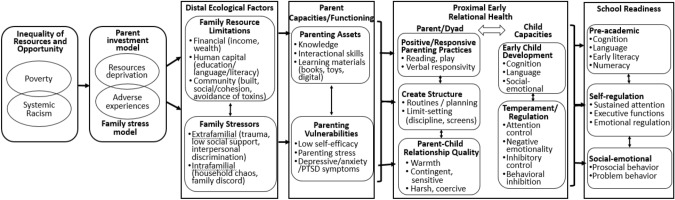
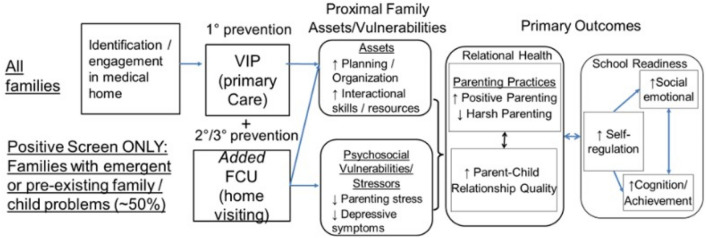
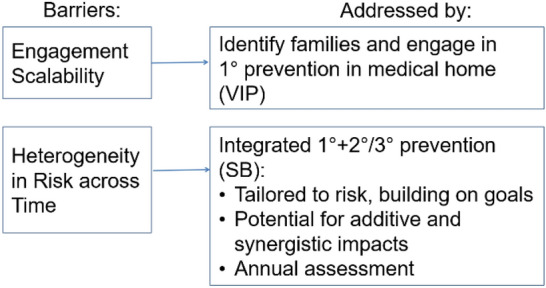
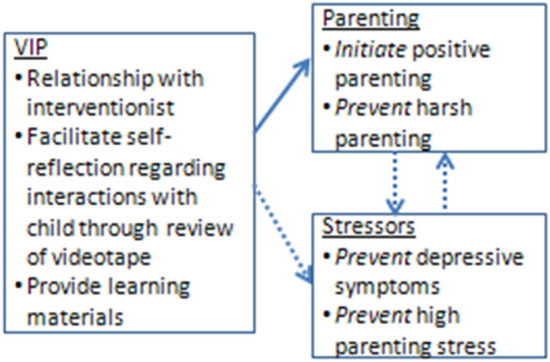
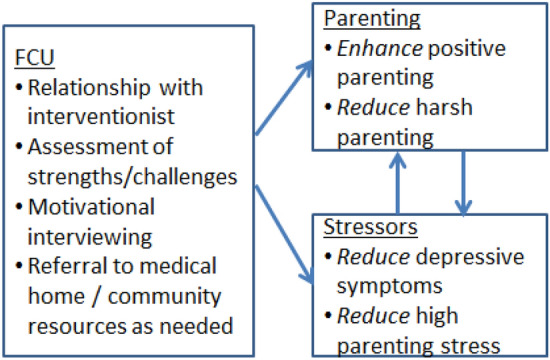
This paper describes the Smart Beginnings Integrated Model, an innovative, tiered approach for addressing school readiness disparities in low-income children from birth to age 3 in the United States through universal engagement of low-income families and primary prevention in pediatric primary care integrated with secondary/tertiary prevention in the home. We build on both public health considerations, in which engagement, cost and scalability are paramount, and a developmental psychopathology framework (Cicchetti & Toth, Journal of Child Psychology and Psychiatry, and Allied Disciplines 50:16-25, 2009), in which the child is considered within the context of the proximal caregiving environment. Whereas existing early preventive models have shown promise in promoting children's school readiness, the Smart Beginnings model addresses three important barriers that have limited impacts at the individual and/or population level: (1) identification and engagement of vulnerable families; (2) the challenges of scalability at low cost within existing service systems; and (3) tailoring interventions to address the heterogeneity of risk among low-income families. Smart Beginnings takes advantage of the existing platform of pediatric primary care to provide a universal primary prevention strategy for all families (Video Interaction Project) and a targeted secondary/tertiary prevention strategy (Family Check-Up) for families with additional contextual factors. We describe the theory underlying the Smart Beginnings model, some initial findings from its recent application in two cities, and implications for changing social policy to promote school readiness beginning during very early childhood.
本文介绍了“智能开端综合模式”,这是一种创新性的分层方法,旨在通过普遍接触美国家庭中低收入家庭,以及将儿科初级保健中的初级预防与家庭中的二级/三级预防相结合,解决 0-3 岁低收入儿童的入学准备差异问题。我们借鉴了公共卫生方面的考虑因素,其中参与度、成本和可扩展性至关重要,以及发展心理病理学框架(Cicchetti 和 Toth,《儿童心理学与精神病学杂志》及相关学科,50:16-25,2009 年),其中儿童被视为在临近的照护环境中。虽然现有的早期预防模式在促进儿童入学准备方面表现出了一定的前景,但“智能开端”模式解决了三个重要的障碍,这些障碍在个人和/或人口层面上限制了其影响:(1)弱势群体家庭的识别和参与;(2)在现有服务系统中以低成本实现可扩展性的挑战;(3)针对低收入家庭的风险异质性定制干预措施。“智能开端”利用儿科初级保健的现有平台,为所有家庭提供通用的初级预防策略(视频互动项目),以及针对具有额外背景因素的家庭的有针对性的二级/三级预防策略(家庭检查)。我们描述了“智能开端”模式背后的理论,以及其在两个城市最近应用的一些初步结果,并探讨了改变社会政策以促进从幼儿期开始的入学准备的意义。