Centre for Mental Health, Swinburne University of Technology, Melbourne, VIC, Australia; Department of Mental Health, St Vincent's Hospital, Melbourne, VIC, Australia; Department of Mental Health, Austin Hospital, Melbourne, VIC, Australia; Department of Psychiatry, The University of Melbourne, Melbourne, VIC, Australia.
Centre for Mental Health, Swinburne University of Technology, Melbourne, VIC, Australia; Department of Mental Health, St Vincent's Hospital, Melbourne, VIC, Australia.
Eat Behav. 2021 Dec;43:101564. doi: 10.1016/j.eatbeh.2021.101564. Epub 2021 Sep 7.
The COVID-19 global pandemic has resulted in a significant mental health toll, and recent findings suggest that individuals with an eating disorder (ED) history may be particularly vulnerable. The current study aimed to: (1) identify changes in the pattern of mental health symptoms over the first six months of the pandemic between individuals with an ED history, compared to a community sample without an ED history (non-ED); and (2) identify differences in mental health symptoms and concerns between two waves of the virus and associated lockdowns.
Data from 4915 respondents - 231 with an ED history - were compared across monthly time points from April to September 2020 on psychological symptoms including negative mood, quality of life, coping and hopefulness, as well as changes to eating and exercise behaviours.
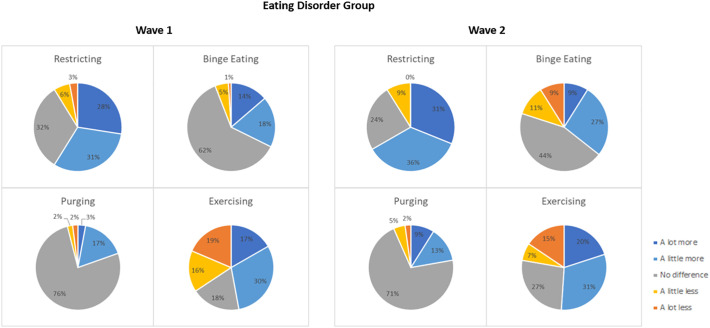
Mental health symptoms were increased in the ED group, but generally did not differ from non-ED in the pattern of symptoms reported over time. Increased depressive symptoms and restrictive eating behaviours were found across both groups in relation to the second wave/lockdown, as well as decreased hopefulness and quality of life. Respondents in both groups also reported coping worse during the second wave of the virus compared to the first wave.
Although non-ED and ED groups tended to generally show the same pattern of symptoms, the mental health status of the ED group was significantly poorer than the non-ED group throughout the pandemic, and exacerbations in some symptoms (i.e. increased food restriction and depressive symptoms) is cause for concern.
COVID-19 全球大流行对心理健康造成了重大影响,最近的研究结果表明,有饮食障碍(ED)病史的个体可能特别脆弱。本研究旨在:(1)比较有 ED 病史的个体与无 ED 病史的社区样本(非 ED),在大流行的前六个月中心理健康症状模式的变化;(2)确定两次病毒浪潮及其相关封锁期间心理健康症状和关注点的差异。
比较了 4915 名受访者(231 名有 ED 病史)在 2020 年 4 月至 9 月的每月时间点上的心理症状数据,包括负面情绪、生活质量、应对和希望,以及饮食和运动行为的变化。
ED 组的心理健康症状增加,但随着时间的推移,报告的症状模式与非 ED 组没有差异。在第二波/封锁期间,两组都发现抑郁症状和限制饮食行为增加,以及希望和生活质量下降。与第一波相比,两组的受访者在第二波病毒期间的应对能力也较差。
尽管非 ED 和 ED 组通常表现出相同的症状模式,但 ED 组的心理健康状况在整个大流行期间明显比非 ED 组差,一些症状的恶化(即增加的食物限制和抑郁症状)令人担忧。