Department of Child and Adolescent Psychiatry, University Hospital Essen, University of Duisburg-Essen, Essen, Germany.
Faculty of Natural Sciences, Institute of Nutrition, Consumption and Health, Paderborn University, Paderborn, Germany.
Eur J Nutr. 2022 Sep;61(6):3293-3306. doi: 10.1007/s00394-022-02919-7. Epub 2022 Jun 27.
The COVID-19 pandemic and public measures have a direct impact on the nutrition situation; studies show changes in food consumption, eating behavior or body weight but complex pattern analyses of changes rarely exist.
During the first German lockdown, a web-based survey was conducted among adults. It included 33 questions about changes in food intake, eating habits and physical activity, as well as anthropometrics and sociodemographic factors. Patterns of change were calculated based on changes in food intake and eating habits using two-step cluster analysis. To identify influencing factors for assignment to the patterns of change, binary logistic regression analyses were performed.
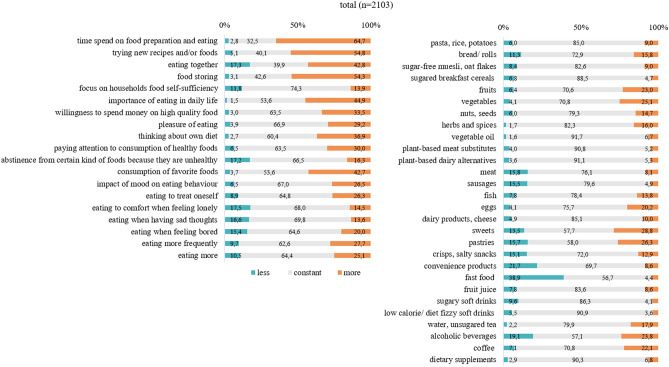
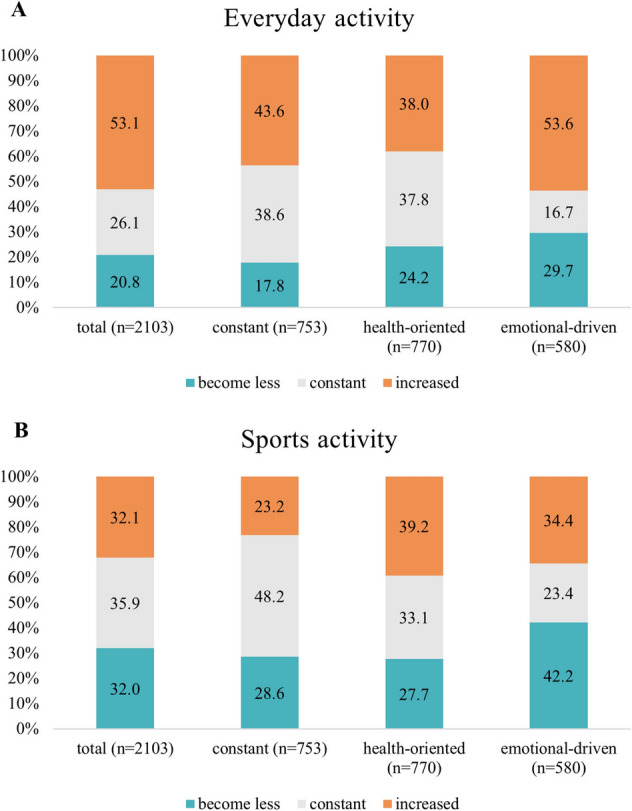
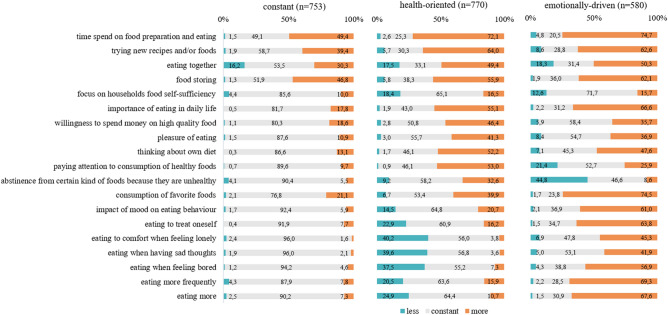
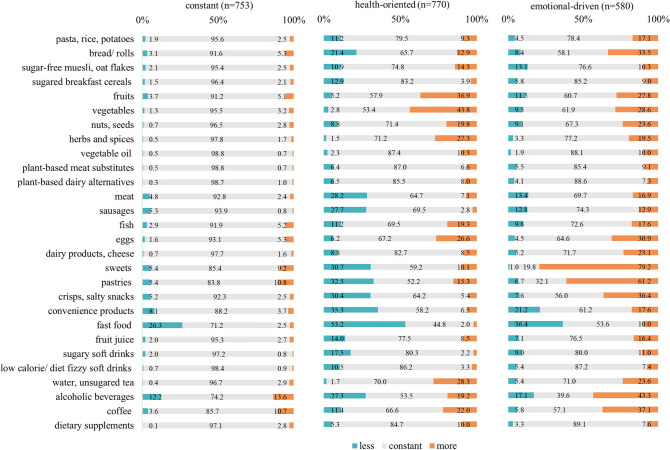
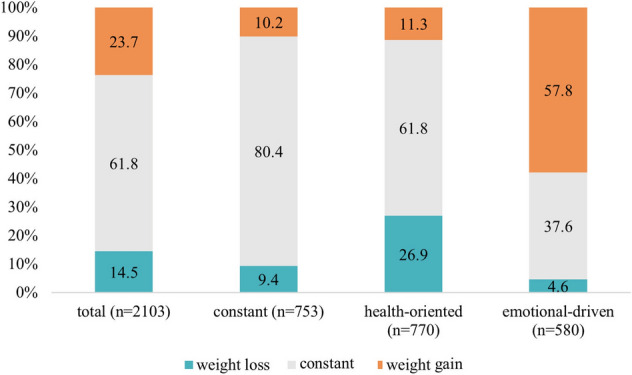
Data from 2103 participants (81% female, 40 ± 14 years) were considered for analysis. Increased stockpiling, cooking, and variation in preparation was reported by 50-70%. The constant pattern (C-P, 36%) reported little change besides the above. The health-oriented pattern (HO-P; 37%) reported eating more healthy foods, avoiding unhealthy foods, and eating less and less frequently. The emotional-driven pattern (ED-P; 28%) exhibits higher influence of emotions on eating behavior, less avoidance of unhealthy foods, and increased consumption of sweets, pastries, and alcohol. The odds of changing eating behavior either to HO-P or ED-P were higher in women, people with migration background, younger participants, and increased with BMI categories.
Both, the ED-P and HO-P, exhibit distinctive reactions in eating habits and food intake when dealing with a distressing experience. In subgroups, these may lead to disturbances in eating behavior and increase the risk for eating disorders and obesity.
COVID-19 大流行和公共措施对营养状况有直接影响;研究表明食物消费、饮食行为或体重发生了变化,但很少有复杂的变化模式分析。
在德国第一次封锁期间,对成年人进行了一项基于网络的调查。它包括 33 个关于食物摄入、饮食习惯和身体活动变化以及人体测量学和社会人口因素的问题。基于食物摄入和饮食习惯的变化,使用两步聚类分析计算变化模式。为了确定影响分配到变化模式的因素,进行了二项逻辑回归分析。
对 2103 名参与者(81%为女性,40±14 岁)的数据进行了分析。50-70%的参与者报告了增加储备、烹饪和准备方式的变化。除了上述变化外,常量模式(C-P,36%)报告的变化很少。健康导向模式(HO-P;37%)报告食用更多健康食品,避免不健康食品,且食用次数和频率减少。情绪驱动模式(ED-P;28%)表现出情绪对饮食行为更大的影响,对不健康食品的回避减少,以及甜食、糕点和酒精的消费增加。向 HO-P 或 ED-P 改变饮食行为的可能性在女性、有移民背景的人、年轻参与者中更高,并且随着 BMI 类别而增加。
在应对痛苦经历时,ED-P 和 HO-P 都表现出饮食行为和食物摄入的独特反应。在亚组中,这可能导致饮食行为紊乱,增加饮食失调和肥胖的风险。