Seguin Diane, Kuenzel Elizabeth, Morton J Bruce, Duerden Emma G
Physiology & Pharmacology, Schulich School of Medicine and Dentistry, Western University, London, Canada.
Applied Psychology, Faculty of Education, Western University, London, Canada.
J Affect Disord Rep. 2021 Dec;6:100217. doi: 10.1016/j.jadr.2021.100217. Epub 2021 Sep 8.
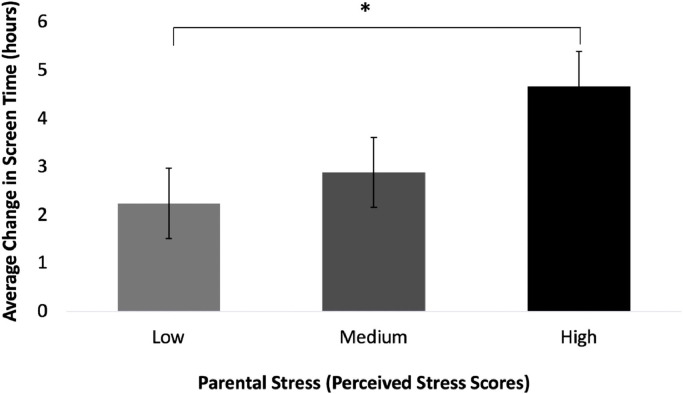
Background During the COVID-19 pandemic, millions of children abruptly moved to online schooling, which required high levels of parental involvement. Family routines were disrupted, potentially increasing parental stress, and may be reflected in greater media screen time use in children. Objectives To determine whether (1) parenting styles and (2) parenting stress were associated with children's screen time use during the pandemic compared to the pre-pandemic period. Methods Parents (> 18 years of age) were recruited to complete an online survey regarding changes in their children's (6-12 years) screen time use and daily activities before and during the pandemic. Stress and parental involvement were assessed using the Perceived Stress Scale (PSS) and Alabama Parenting Questionnaires respectively. General linear models assessed whether parenting style and parent stress were associated with children's screen time during the pandemic, adjusting for demographic variables and daily activities. Results 104 parents were enrolled, and 73 (70.2%) parents completed the surveys. Children's screen time (., watching television and playing video games) increased significantly, from 2.6 to 5.9h a day ( ) during pandemic-related school closures. Fewer changes in children's screen time use were significantly associated with greater parental involvement ( ). Parent stress ( ) significantly predicted children's screen time use. Lower household income was associated with increased hours of screen time in both models (both, ). Conclusions: Children's screen time increased significantly during the initial months of the pandemic. Parent stress and parenting styles may be modifiable risk factors to promote children's well-being during the ongoing pandemic.
在新冠疫情期间,数百万儿童突然转向在线学习,这需要家长高度参与。家庭日常被打乱,可能增加了家长的压力,并且可能体现在儿童更多地使用媒体屏幕。目的:确定(1)育儿方式和(2)育儿压力与疫情期间相比疫情前儿童的屏幕使用时间是否相关。方法:招募年龄大于18岁的家长完成一项在线调查,内容涉及他们孩子(6至12岁)在疫情前和疫情期间屏幕使用时间及日常活动的变化。分别使用感知压力量表(PSS)和阿拉巴马育儿问卷评估压力和家长参与度。一般线性模型评估育儿方式和家长压力与疫情期间儿童屏幕使用时间是否相关,并对人口统计学变量和日常活动进行调整。结果:招募了104名家长,73名(70.2%)家长完成了调查。在与疫情相关的学校关闭期间,儿童的屏幕使用时间(如看电视和玩电子游戏)显著增加,从每天2.6小时增加到5.9小时( )。儿童屏幕使用时间的较少变化与更高的家长参与度显著相关( )。家长压力( )显著预测了儿童的屏幕使用时间。在两个模型中,较低的家庭收入都与屏幕使用时间的增加相关(两者均为, )。结论:在疫情的最初几个月,儿童的屏幕使用时间显著增加。家长压力和育儿方式可能是在持续的疫情期间促进儿童福祉的可改变风险因素。