Lim Jane M, Duong Minh Cam, Cook Alex R, Hsu Li Yang, Tam Clarence C
National University Singapore Saw Swee Hock School of Public Health, Singapore.
National University Health System, Singapore.
BMJ Open. 2021 Sep 13;11(9):e048157. doi: 10.1136/bmjopen-2020-048157.
The WHO's Global Action Plan on Antimicrobial Resistance (AMR) includes increasing overall public awareness of appropriate antibiotic use and resistance as a key priority area. We aimed to measure public knowledge, attitudes and practices of antibiotics and antibiotic resistance in Singapore, as well as their healthcare-seeking behaviours relating to respiratory illnesses, providing baseline data against which to measure the progress of future interventions.
A cross-sectional study.
The general population in Singapore.
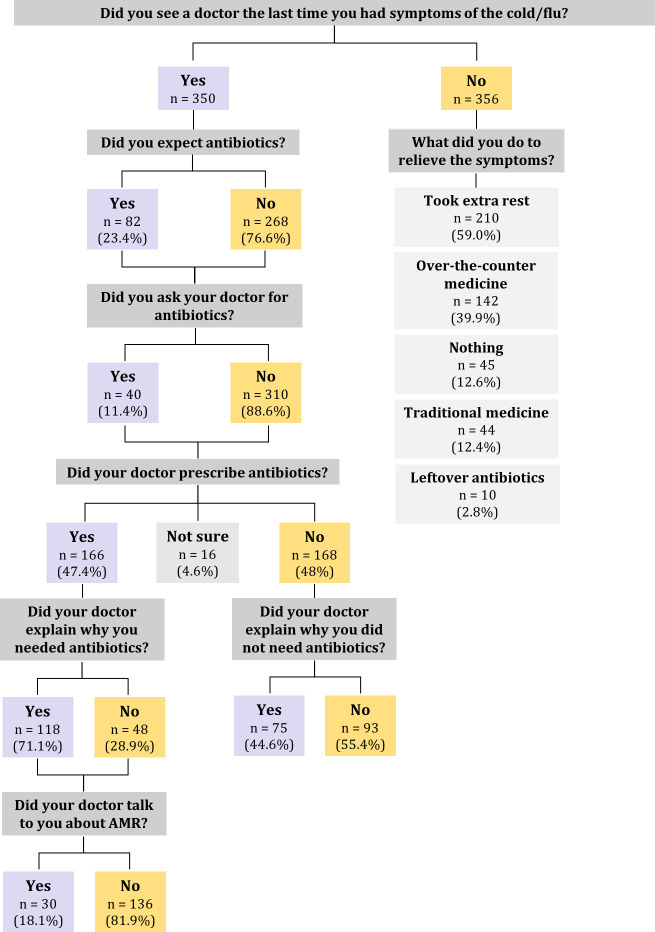
Between May and June 2019, we conducted a survey via an online panel in Singapore with 706 respondents.
Our findings indicated common misconceptions surrounding antibiotic effectiveness and mechanisms of antibiotic resistance-most participants thought that resistance occurs when our bodies become resistant to antibiotics (62.5%) or when antibiotics become less powerful (48.5%). In multivariable analyses, better knowledge scores were associated with more favourable antibiotic attitudes (β=0.29; 95% CI 0.20 to 0.37). In addition, more favourable attitude scores were associated with lower odds of both expecting (OR: 0.84, 95% CI 0.72 to 0.99) and being prescribed antibiotics by a primary care doctor (OR: 0.76, 95% CI 0.63 to 0.90).
This study presents important information about population perceptions towards antibiotics and antibiotic resistance in Singapore. Results from this study emphasise the importance of effective public communication strategies to promote responsible antibiotic use locally and should be used to inform future implementation of programmes and activities as laid out in Singapore's National Strategic Action Plan on AMR.
世界卫生组织的《抗微生物药物耐药性全球行动计划》将提高公众对合理使用抗生素及耐药性的总体认识作为关键优先领域。我们旨在衡量新加坡公众对抗生素及抗生素耐药性的知识、态度和行为,以及他们在呼吸系统疾病方面的就医行为,提供基线数据以衡量未来干预措施的进展情况。
一项横断面研究。
新加坡的普通人群。
2019年5月至6月期间,我们通过新加坡的一个在线小组对706名受访者进行了一项调查。
我们的研究结果表明,人们对抗生素有效性和抗生素耐药机制存在常见误解——大多数参与者认为,当我们的身体对抗生素产生耐药性(62.5%)或抗生素效力降低(48.5%)时就会出现耐药性。在多变量分析中,知识得分越高,抗生素态度越积极(β=0.29;95%置信区间0.20至0.37)。此外,态度得分越积极,期望从初级保健医生处获得抗生素处方(比值比:0.84,95%置信区间0.72至0.99)和实际获得抗生素处方(比值比:0.76,95%置信区间0.63至0.90)的几率就越低。
本研究提供了有关新加坡民众对抗生素及抗生素耐药性认知的重要信息。本研究结果强调了有效的公众沟通策略对于在当地促进负责任使用抗生素的重要性,应用于为新加坡《抗微生物药物耐药性国家战略行动计划》中所规划的未来项目和活动的实施提供参考。