Lim Jane Mingjie, Chhoun Pheak, Tuot Sovannary, Om Chhorvoin, Krang Sidonn, Ly Sovann, Hsu Li Yang, Yi Siyan, Tam Clarence C
Saw Swee Hock School of Public Health, National University of Singapore and National University Health System, Singapore.
KHANA Center for Population Health Research, Phnom Penh, Cambodia.
JAC Antimicrob Resist. 2021 Feb 3;3(1):dlaa115. doi: 10.1093/jacamr/dlaa115. eCollection 2021 Mar.
WHO's Global Action Plan on Antimicrobial Resistance includes as a priority to increase public education surrounding antibiotic use and resistance. Monitoring population-level antibiotic behaviours is crucial for informing intervention strategies, but data from a broad range of settings, particularly lower-resourced countries, are lacking.
We measured public knowledge, attitudes and practices regarding antibiotics and antibiotic resistance in Cambodia, providing baseline information against which to monitor the progress of future interventions.
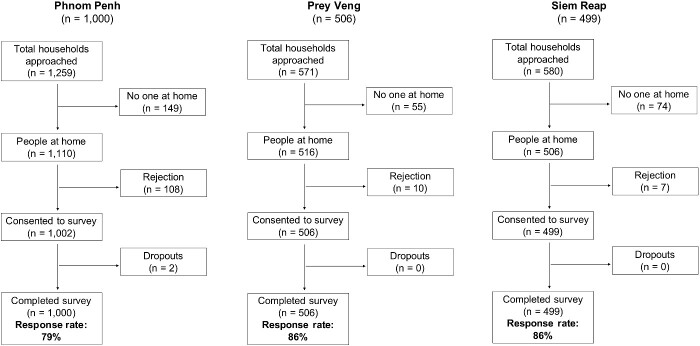
Between September and October 2018, we conducted a household survey of knowledge, attitudes and practices related to antibiotic use in urban and rural populations of three Cambodian provinces: Phnom Penh, Siem Reap and Prey Veng. Response rates were respectively 79%, 86% and 86%.
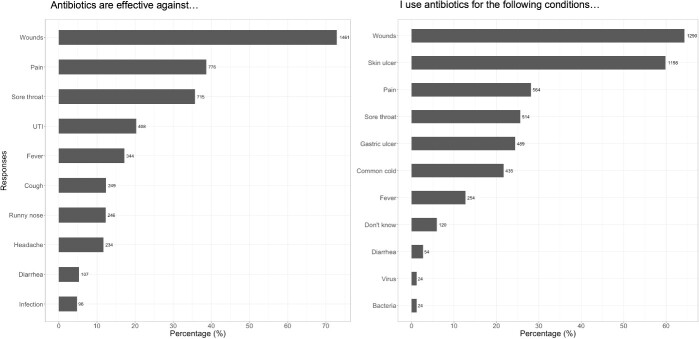
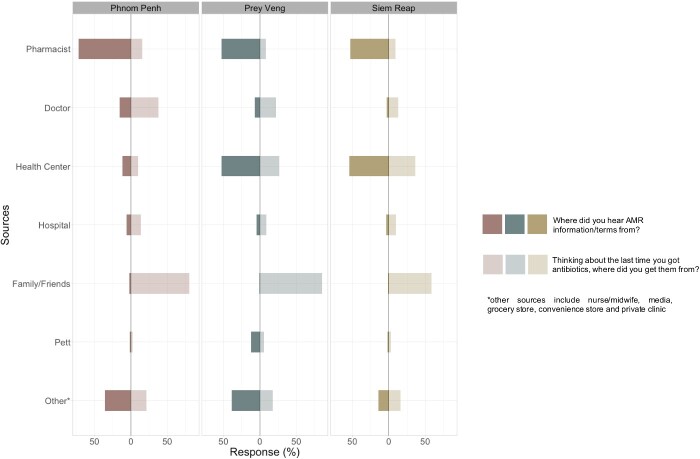
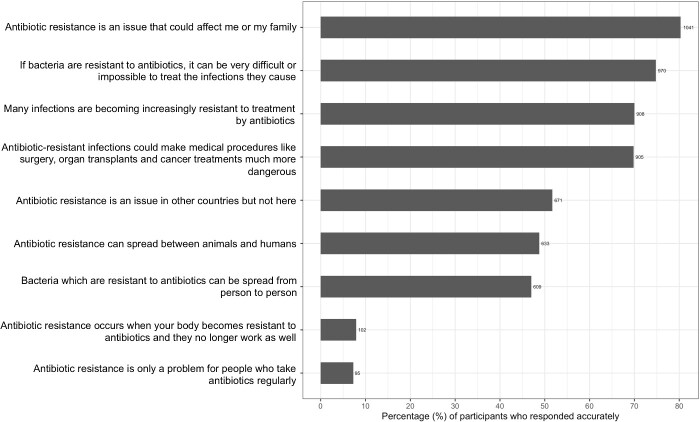
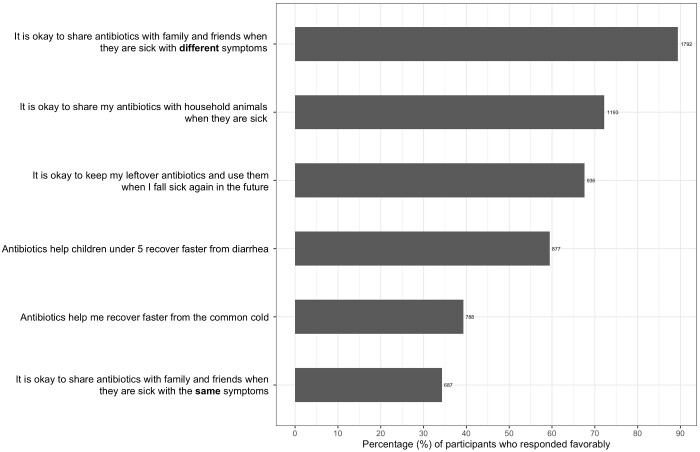
Among the 2005 participants, we found high levels of awareness of terms relating to antibiotics (86.5%) and antibiotic resistance; most participants also recognized that antibiotic resistance is a problem (58.4%). However, few understood that antibiotics are effective only against bacterial infections (1.2%). We also found province-specific differences in participants' sources of antibiotics and their sources of AMR-related information. In regression analyses, more favourable antibiotic practice scores were associated with higher knowledge (β = 0.18; 95% CI: 0.14-0.22) and attitude (β = 0.16; 95% CI: 0.11-0.22) scores, as well as trust in healthcare sources to obtain antibiotics and antibiotic information.
This study highlights the importance of interventions and public communication on antibiotic use and resistance that is effectively targeted to the local context through trusted healthcare providers.
世界卫生组织的《抗菌药物耐药性全球行动计划》将加强围绕抗生素使用和耐药性的公众教育列为优先事项。监测人群层面的抗生素使用行为对于制定干预策略至关重要,但目前缺乏来自广泛环境的数据,尤其是资源匮乏国家的数据。
我们测量了柬埔寨公众对抗生素及抗生素耐药性的知识、态度和行为,提供基线信息以监测未来干预措施的进展情况。
2018年9月至10月期间,我们对柬埔寨三个省份(金边、暹粒和实居)城乡居民进行了一项关于抗生素使用相关知识、态度和行为的家庭调查。应答率分别为79%、86%和86%。
在2005名参与者中,我们发现对与抗生素(86.5%)和抗生素耐药性相关术语的知晓率很高;大多数参与者也认识到抗生素耐药性是一个问题(58.4%)。然而,很少有人明白抗生素仅对细菌感染有效(1.2%)。我们还发现参与者获取抗生素的来源及其抗微生物药物耐药性相关信息来源存在省份差异。在回归分析中,更有利的抗生素使用行为得分与更高的知识得分(β = 0.18;95%置信区间:0.14 - 0.22)和态度得分(β = 0.16;95%置信区间:0.11 - 0.22)以及信任医疗保健机构获取抗生素和抗生素信息有关。
本研究强调了通过可信赖的医疗保健提供者针对当地情况有效开展抗生素使用和耐药性干预及公众宣传的重要性。