G0 Cell Unit, Okinawa Institute of Science and Technology Graduate University, Onna-son, Okinawa, 904-0495, Japan.
Forensic Laboratory, Department of Criminal Investigation, Okinawa Prefectural Police HQ, Okinawa, Japan.
Sci Rep. 2021 Sep 13;11(1):18135. doi: 10.1038/s41598-021-97623-7.
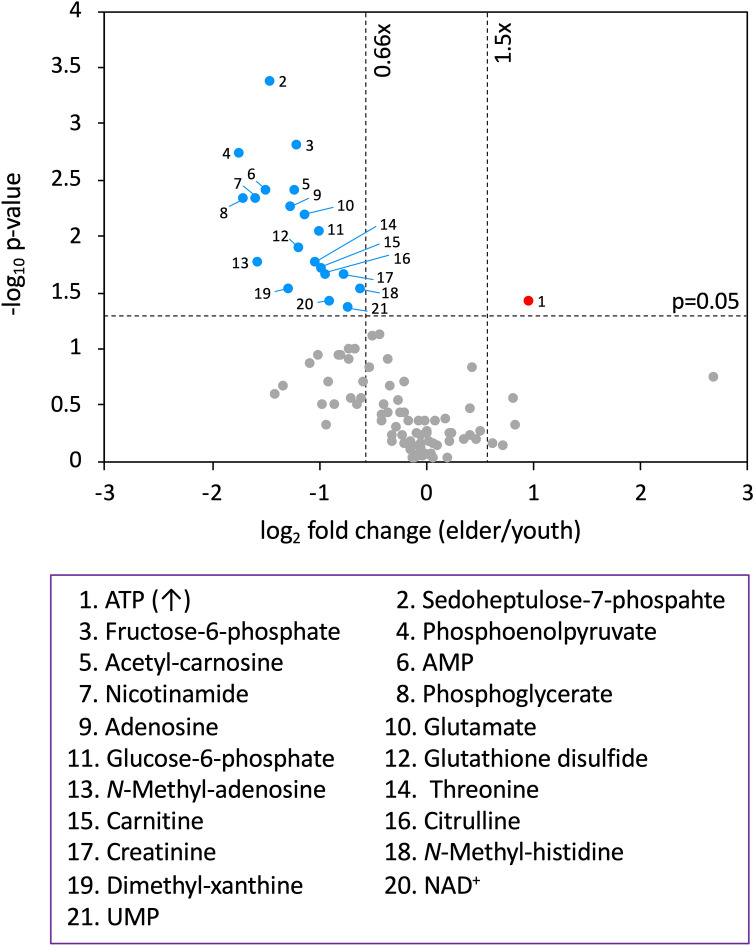
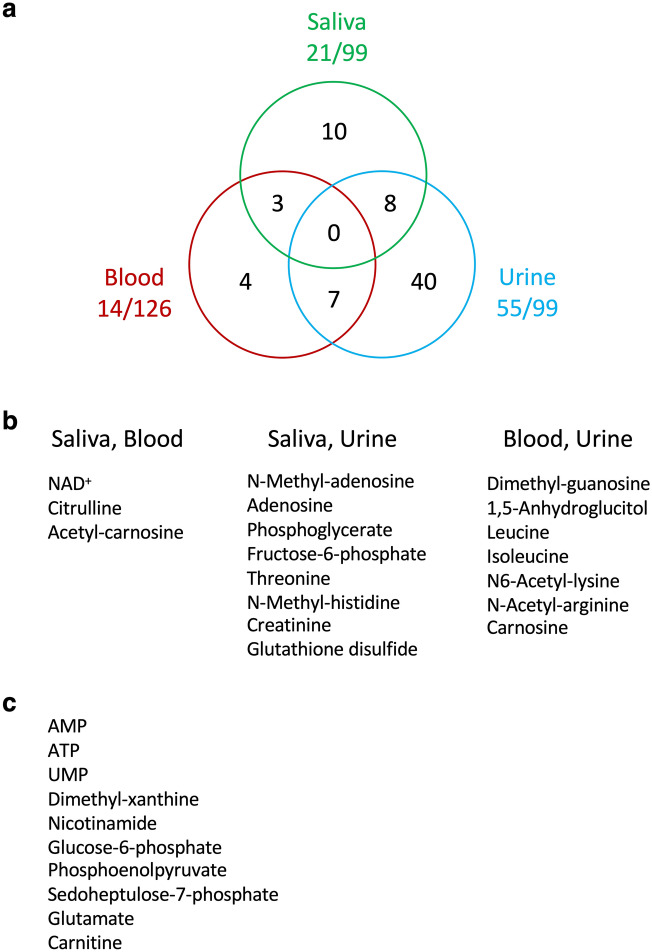
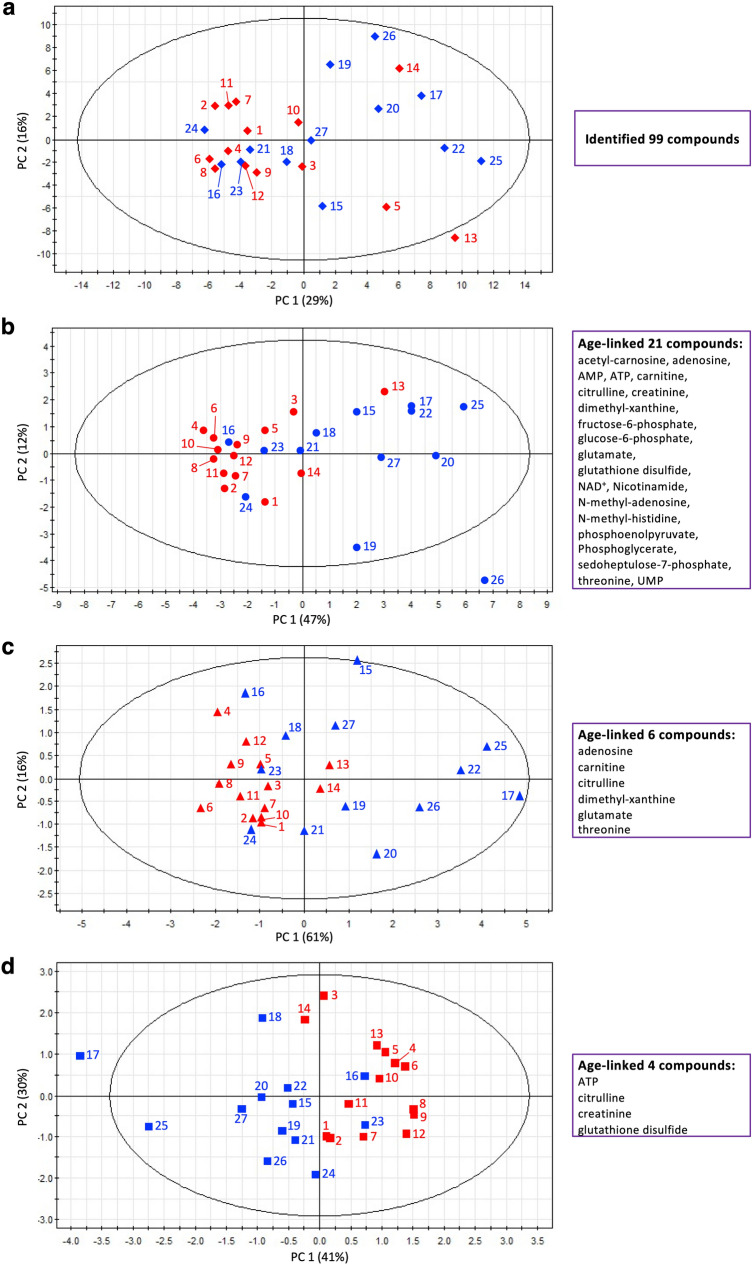
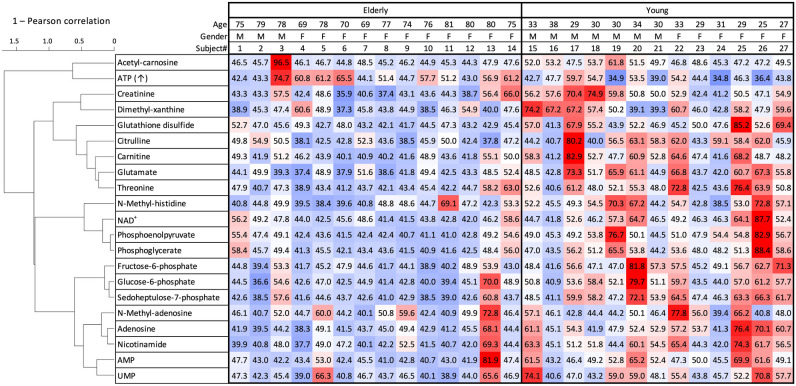
Metabolites in human biofluids reflect individual physiological states influenced by various factors. Using liquid chromatography-mass spectrometry (LC-MS), we conducted non-targeted, non-invasive metabolomics using saliva of 27 healthy volunteers in Okinawa, comprising 13 young (30 ± 3 year) and 14 elderly (76 ± 4 year) subjects. Few studies have comprehensively identified age-dependent changes in salivary metabolites. Among 99 salivary metabolites, 21 were statistically age-related. All of the latter decline in abundance with advancing age, except ATP, which increased 1.96-fold in the elderly, possibly due to reduced ATP consumption. Fourteen age-linked and highly correlated compounds function in a metabolic network involving the pentose-phosphate pathway, glycolysis/gluconeogenesis, amino acids, and purines/pyrimidines nucleobases. The remaining seven less strongly correlated metabolites, include ATP, anti-oxidation-related glutathione disulfide, muscle-related acetyl-carnosine, N-methyl-histidine, creatinine, RNA-related dimethyl-xanthine and N-methyl-adenosine. In addition, glutamate and N-methyl-histidine are related to taste, so their decline suggests that the elderly lose some ability to taste. Reduced redox metabolism and muscle activity are suggested by changes in glutathione and acetyl-carnosine. These age-linked salivary metabolites together illuminate a metabolic network that reflects a decline of oral functions during human aging.
人体生物液中的代谢物反映了受多种因素影响的个体生理状态。我们使用液相色谱-质谱联用仪(LC-MS)对来自冲绳的 27 名健康志愿者(包括 13 名年轻志愿者(30±3 岁)和 14 名老年志愿者(76±4 岁))的唾液进行了非靶向、非侵入性的代谢组学研究。很少有研究全面鉴定出唾液代谢物随年龄变化的情况。在 99 种唾液代谢物中,有 21 种与年龄有关。除了 ATP(老年人中增加了 1.96 倍)外,这些代谢物的含量均随年龄的增长而降低,可能是由于 ATP 消耗减少。14 种与年龄相关且高度相关的化合物参与涉及戊糖磷酸途径、糖酵解/糖异生、氨基酸和嘌呤/嘧啶核苷碱基的代谢网络。其余七个相关性较弱的代谢物包括 ATP、抗氧化相关的谷胱甘肽二硫化物、肌肉相关的乙酰肉碱、N-甲基组氨酸、肌酸、与 RNA 相关的二甲基黄嘌呤和 N-甲基腺苷。此外,谷氨酸和 N-甲基组氨酸与味觉有关,因此它们的减少表明老年人的味觉能力有所下降。谷胱甘肽和乙酰肉碱的变化表明氧化还原代谢和肌肉活动减少。这些与年龄相关的唾液代谢物共同阐明了一个代谢网络,反映了人类衰老过程中口腔功能的下降。