School of Pharmacy, Faculty of Health Sciences, University of Eastern Finland, Kuopio, Finland.
Department of Veterinary Biosciences, and Department of Medical and Clinical Genetics, University of Helsinki, Helsinki, Finland.
Metabolomics. 2020 Aug 25;16(9):90. doi: 10.1007/s11306-020-01711-0.
Saliva metabolites are suggested to reflect the health status of an individual in humans. The same could be true with the dog (Canis lupus familiaris), an important animal model of human disease, but its saliva metabolome is unknown. As a non-invasive sample, canine saliva could offer a new alternative material for research to reveal molecular mechanisms of different (patho)physiological stages, and for veterinary medicine to monitor dogs' health trajectories.
To investigate and characterize the metabolite composition of dog and human saliva in a non-targeted manner.
Stimulated saliva was collected from 13 privately-owned dogs and from 14 human individuals. We used a non-targeted ultra-high-performance liquid chromatography-quadrupole time-of-flight mass spectrometry (UHPLC-qTOF-MS) method to measure metabolite profiles from saliva samples.
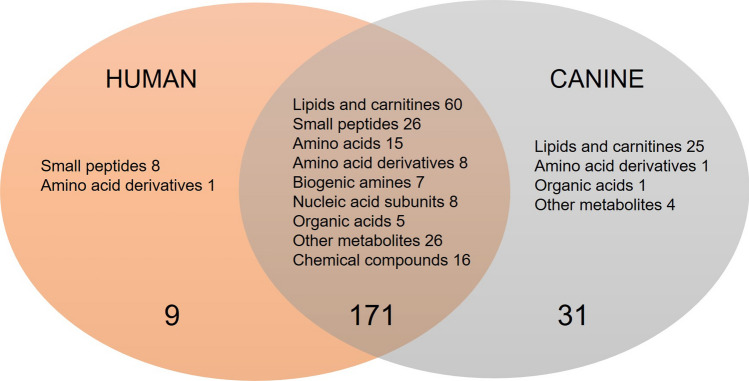
We identified and classified a total of 211 endogenous and exogenous salivary metabolites. The compounds included amino acids, amino acid derivatives, biogenic amines, nucleic acid subunits, lipids, organic acids, small peptides as well as other metabolites, like metabolic waste molecules and other chemicals. Our results reveal a distinct metabolite profile of dog and human saliva as 25 lipid compounds were identified only in canine saliva and eight dipeptides only in human saliva. In addition, we observed large variation in ion abundance within and between the identified saliva metabolites in dog and human.
The results suggest that non-targeted metabolomics approach utilizing UHPLC-qTOF-MS can detect a wide range of small compounds in dog and human saliva with partially overlapping metabolite composition. The identified metabolites indicate that canine saliva is potentially a versatile material for the discovery of biomarkers for dog welfare. However, this profile is not complete, and dog saliva needs to be investigated in the future with other analytical platforms to characterize the whole canine saliva metabolome. Furthermore, the detailed comparison of human and dog saliva composition needs to be conducted with harmonized study design.
唾液代谢物被认为可以反映人类的个体健康状况。这种情况在犬(Canis lupus familiaris)中也可能如此,犬是人类疾病的重要动物模型,但犬的唾液代谢组尚未可知。作为一种非侵入性样本,犬唾液可能为揭示不同(病理)生理阶段的分子机制提供新的替代研究材料,并为兽医监测犬健康轨迹提供新的替代研究材料。
以非靶向方式研究和描述犬和人唾液中的代谢物组成。
从 13 只私人拥有的犬和 14 名人类个体中采集刺激唾液。我们使用非靶向超高效液相色谱-四极杆飞行时间质谱(UHPLC-qTOF-MS)方法测量唾液样本中的代谢物图谱。
我们共鉴定和分类了 211 种内源性和外源性唾液代谢物。这些化合物包括氨基酸、氨基酸衍生物、生物胺、核酸亚单位、脂质、有机酸、小肽以及其他代谢物,如代谢废物分子和其他化学物质。我们的结果揭示了犬和人唾液的独特代谢物谱,因为仅在犬唾液中鉴定出 25 种脂质化合物,仅在人唾液中鉴定出 8 种二肽。此外,我们还观察到犬和人唾液中鉴定出的唾液代谢物的离子丰度在内部和之间存在很大差异。
结果表明,利用 UHPLC-qTOF-MS 的非靶向代谢组学方法可以检测到犬和人唾液中广泛的小分子化合物,其代谢物组成部分重叠。鉴定出的代谢物表明,犬唾液可能是发现犬福利生物标志物的多功能材料。然而,这种图谱并不完整,未来需要使用其他分析平台进一步研究犬唾液以表征整个犬唾液代谢组。此外,需要使用协调一致的研究设计详细比较人和犬唾液的组成。