Eshetu Gebrekidan Gebresilassie, Zhang Heng, Judez Xabier, Adenusi Henry, Armand Michel, Passerini Stefano, Figgemeier Egbert
Institute of Power Electronics and Electric Drives, ISEA, RWTH Aachen, Aachen, Germany.
Department of Material Science and Engineering, Mekelle Institute of Technology-Mekelle University, Tigray, Ethiopia.
Nat Commun. 2021 Sep 15;12(1):5459. doi: 10.1038/s41467-021-25334-8.
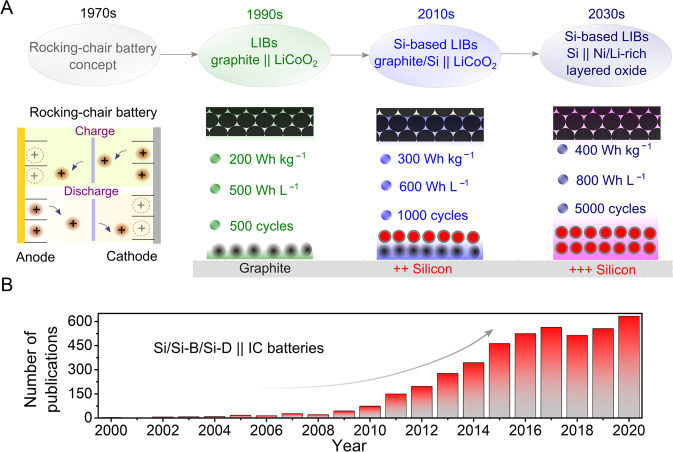
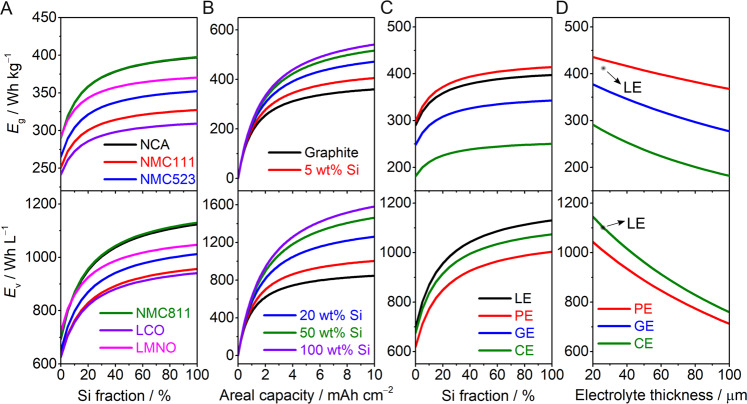
Rechargeable Li-based battery technologies utilising silicon, silicon-based, and Si-derivative anodes coupled with high-capacity/high-voltage insertion-type cathodes have reaped significant interest from both academic and industrial sectors. This stems from their practically achievable energy density, offering a new avenue towards the mass-market adoption of electric vehicles and renewable energy sources. Nevertheless, such high-energy systems are limited by their complex chemistry and intrinsic drawbacks. From this perspective, we present the progress, current status, prevailing challenges and mitigating strategies of Li-based battery systems comprising silicon-containing anodes and insertion-type cathodes. This is accompanied by an assessment of their potential to meet the targets for evolving volume- and weight-sensitive applications such as electro-mobility.
利用硅、硅基和硅衍生物阳极以及高容量/高电压插入式阴极的可充电锂基电池技术,已引起学术界和工业界的极大关注。这源于它们切实可行的能量密度,为电动汽车和可再生能源在大众市场的应用开辟了一条新途径。然而,这种高能量系统受到其复杂化学性质和固有缺点的限制。从这个角度出发,我们介绍了包含含硅阳极和插入式阴极的锂基电池系统的进展、现状、主要挑战和缓解策略。同时还评估了它们满足诸如电动出行等对体积和重量敏感的不断发展的应用目标的潜力。