Rouillard Megan E, Sutter Pearl A, Durham Olivia R, Willis Cory M, Crocker Stephen J
1Department of Neuroscience, University of Connecticut School of Medicine, Farmington, CT 06030, USA.
2Department of Clinical Neurosciences and NIHR Biomedical Research Centre, University of Cambridge, Cambridge, UK.
Aging Dis. 2021 Sep 1;12(6):1462-1475. doi: 10.14336/AD.2021.0608. eCollection 2021 Sep.
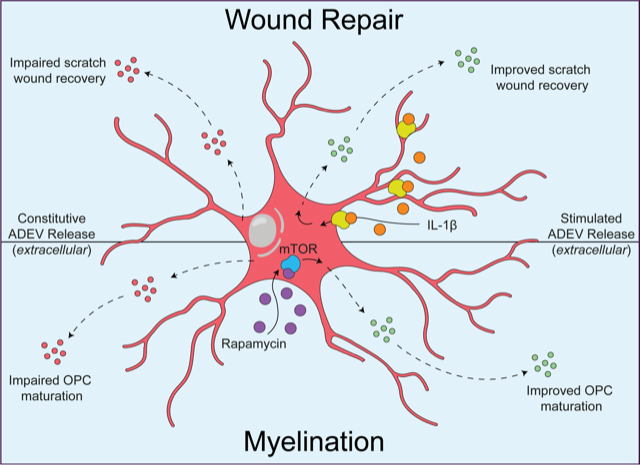
Astrocytes are an abundant and dynamic glial cell exclusive to the central nervous system (CNS). In the context of injury, inflammation, and/or diseases of the nervous system, astrocyte responses, termed reactive astrogliosis, are a recognized pathological feature across a range of conditions and diseases. However, the impact of reactive astrogliosis is not uniform and varies by context and duration (time). In recent years, extracellular communication between glial cells via extracellular vesicles (EVs) has garnered interest as a process connected with reactive astrogliosis. In this review, we relate recent findings on astrocyte-derived extracellular vesicles (ADEVs) with a focus on factors that can influence the effects of ADEVs and identified age related changes in the function of ADEVs. Additionally, we will discuss the current limitations of existing experimental approaches and identify questions that highlight areas for growth in this field, which will continue to enhance our understanding of ADEVs in age-associated processes.
星形胶质细胞是中枢神经系统(CNS)特有的一种丰富且动态的神经胶质细胞。在神经系统损伤、炎症和/或疾病的情况下,星形胶质细胞的反应,即反应性星形胶质细胞增生,是一系列病症和疾病中公认的病理特征。然而,反应性星形胶质细胞增生的影响并不一致,会因情况和持续时间(时间)而异。近年来,神经胶质细胞之间通过细胞外囊泡(EVs)进行的细胞外通讯作为一个与反应性星形胶质细胞增生相关的过程而受到关注。在这篇综述中,我们阐述了关于星形胶质细胞衍生的细胞外囊泡(ADEVs)的最新发现,重点关注可能影响ADEVs作用的因素,并确定了ADEVs功能中与年龄相关的变化。此外,我们将讨论现有实验方法的当前局限性,并找出突出该领域发展方向的问题,这将不断增进我们对年龄相关过程中ADEVs的理解。