Department of Nutrition, Food Safety, and Toxicology, West China School of Public Health and West China Fourth Hospital, Sichuan University, Chengdu, China.
Department of Pharmacy, Evidence-Based Pharmacy Center, Key Laboratory of Birth Defects and Related Diseases of Women and Children (Sichuan University), West China Second University Hospital, Sichuan University, Chengdu, China.
Transl Psychiatry. 2021 Sep 16;11(1):478. doi: 10.1038/s41398-021-01590-6.
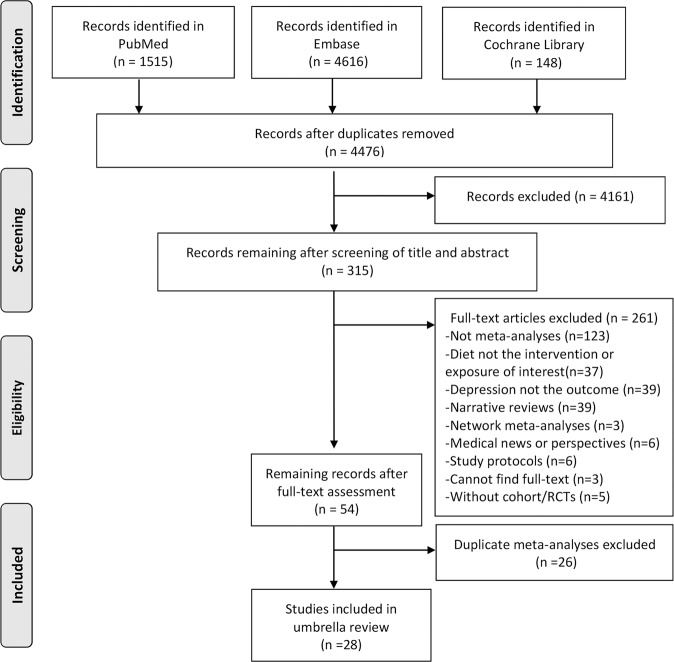
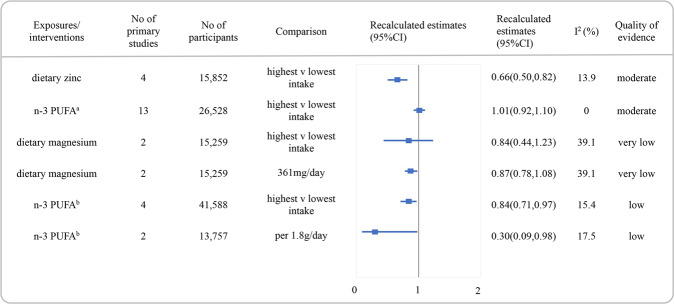
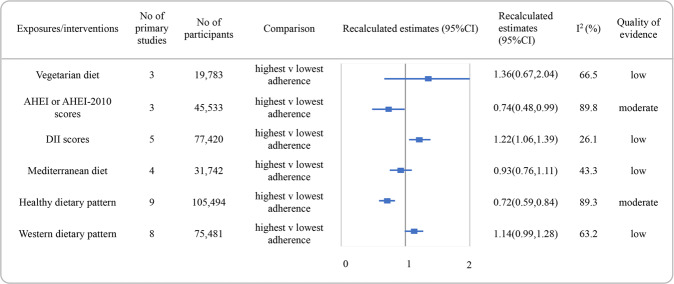
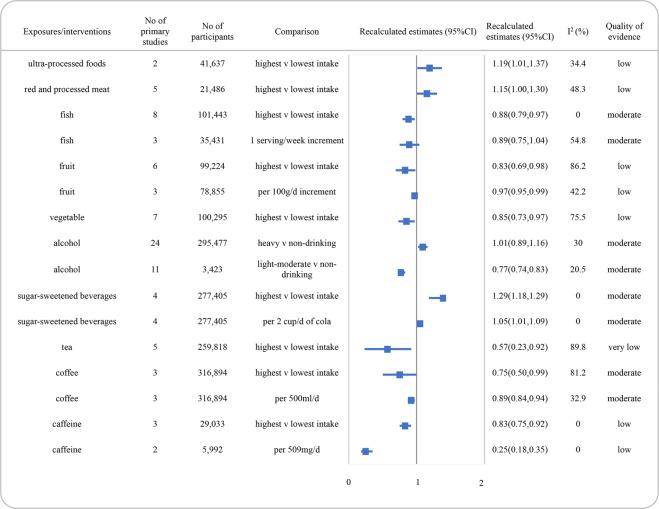
The role of diet in depression is becoming increasingly acknowledged. This umbrella review aimed to summarize comprehensively the current evidence reporting the effects of dietary factors on the prevention and treatment of depression. PubMed, Embase, and the Cochrane Library were searched up to June 2021 to identify relevant meta-analyses of prospective studies. Twenty-eight meta-analyses, with 40 summary estimates on dietary patterns (n = 8), food and beverages (n = 19), and nutrients (n = 13) were eligible. The methodological quality of most meta-analyses was low (50.0%) or very low (25.0%). Quality of evidence was moderate for inverse associations for depression incidence with healthy diet [risk ratio (RR): 0.74, 95% confidential interval (CI), 0.48-0.99, I = 89.8%], fish (RR: 0.88, 95% CI, 0.79-0.97, I= 0.0%), coffee (RR: 0.89, 95% CI, 0.84-0.94, I= 32.9%), dietary zinc (RR: 0.66, 95% CI 0.50-0.82, I= 13.9%), light to moderate alcohol (<40 g/day, RR: 0.77, 95% CI, 0.74-0.83, I= 20.5%), as well as for positive association with sugar-sweetened beverages (RR: 1.05, 95% CI, 1.01-1.09, I= 0.0%). For depression treatment, moderate-quality evidence was identified for the effects of probiotic [standardized mean difference (SMD): -0.31, 95% CI, -0.56 to -0.07, I= 48.2%], omega-3 polyunsaturated fatty acid (SMD: -0.28, 95% CI, -0.47 to -0.09, I = 75.0%) and acetyl-L-carnitine (SMD: -1.10, 95% CI, -1.65 to -0.56, I = 86.0%) supplementations. Overall, the associations between dietary factors and depression had been extensively evaluated, but none of them were rated as high quality of evidence, suggesting further studies are likely to change the summary estimates. Thus, more well-designed research investigating more detailed dietary factors in association with depression is warranted.
饮食在抑郁症中的作用正日益受到关注。本综述旨在全面总结饮食因素对抑郁症预防和治疗影响的现有证据。检索了 PubMed、Embase 和 Cochrane 图书馆,以确定前瞻性研究的相关荟萃分析,截至 2021 年 6 月。共有 28 项荟萃分析,涉及 40 个饮食模式(n=8)、食物和饮料(n=19)和营养素(n=13)的汇总估计值符合条件。大多数荟萃分析的方法学质量较低(50.0%)或非常低(25.0%)。健康饮食与抑郁症发病率呈负相关的证据质量为中度[风险比(RR):0.74,95%置信区间(CI),0.48-0.99,I=89.8%]、鱼(RR:0.88,95% CI,0.79-0.97,I=0.0%)、咖啡(RR:0.89,95% CI,0.84-0.94,I=32.9%)、膳食锌(RR:0.66,95% CI 0.50-0.82,I=13.9%)、低至中度酒精(<40 g/天,RR:0.77,95% CI,0.74-0.83,I=20.5%)以及与含糖饮料呈正相关(RR:1.05,95% CI,1.01-1.09,I=0.0%)。对于抑郁症的治疗,益生菌[标准化均数差(SMD):-0.31,95% CI,-0.56 至-0.07,I=48.2%]、ω-3 多不饱和脂肪酸(SMD:-0.28,95% CI,-0.47 至-0.09,I=75.0%)和乙酰左旋肉碱(SMD:-1.10,95% CI,-1.65 至-0.56,I=86.0%)补充剂的疗效有中等质量证据。总的来说,饮食因素与抑郁症之间的关联已经得到了广泛的评估,但没有一个被评为高质量的证据,这表明进一步的研究可能会改变汇总估计值。因此,需要更多设计良好的研究来调查与抑郁症相关的更详细的饮食因素。