Department of Neurology, First Affiliated Hospital of China Medical University, No. 155 North Nanjing Street, Shenyang, 110001, Liaoning, China.
BMC Med. 2022 May 24;20(1):194. doi: 10.1186/s12916-022-02381-6.
Stroke is one of the major challenges for the global healthcare system, which makes it necessary to explore the relationship between various modifiable factors and stroke risk. Recently, numerous meta-analyses of prospective observational studies have reported that dietary factors played a key role in the occurrence of stroke. However, the conclusions of previous studies have remained controversial and unclear. Accordingly, we conducted an umbrella review synthesizing and recalculating available evidence to assess the certainty of the associations between dietary factors and stroke.
Relevant meta-analyses examining the associations between dietary factors and stroke were searched in PubMed and Embase databases up to September 1, 2021. For each eligible meta-analysis, two independent reviewers appraised the methodologic quality using the AMSTAR 2 criteria and estimated the summary effect size, 95% confidence intervals, 95% prediction intervals, heterogeneity between studies, and small-study effects. Moreover, we further assessed the associations between dietary factors and ischemic stroke as well as hemorrhagic stroke. Lastly, a set of pre-specified criteria was applied to qualitatively evaluate the epidemiological credibility of each dietary factor.
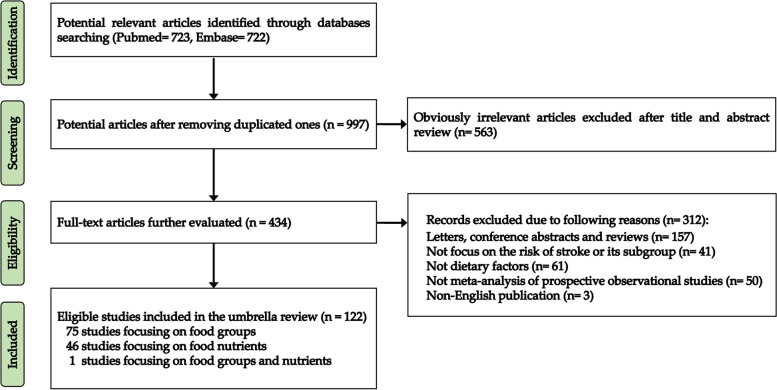
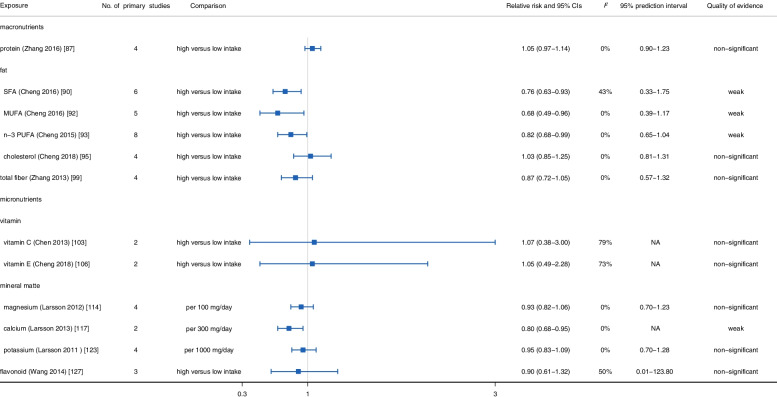
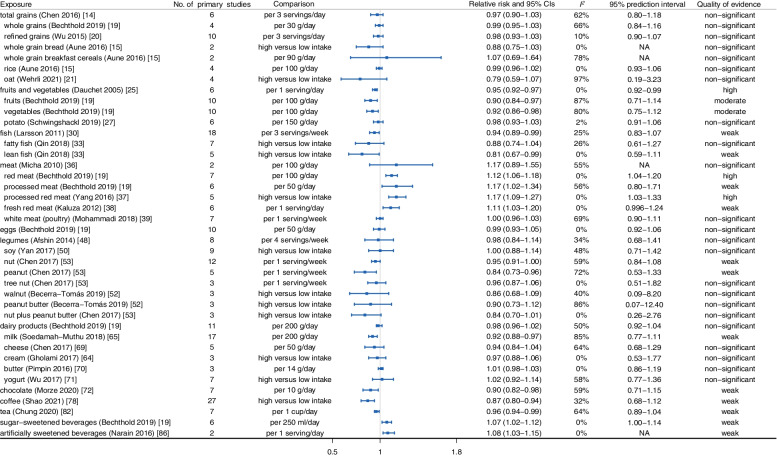
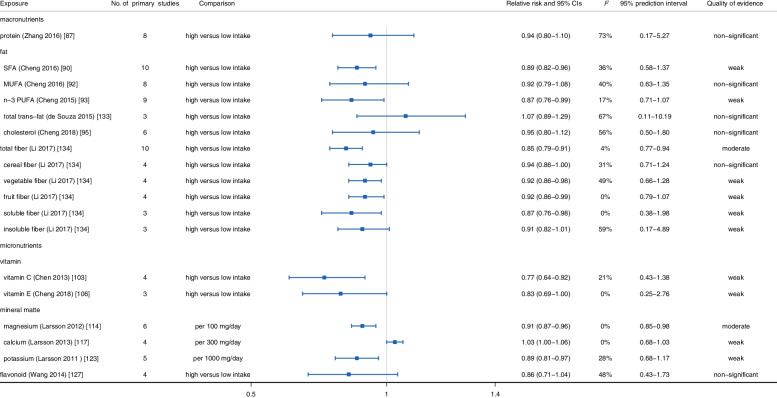
Overall, our umbrella review included 122 qualified meta-analyses for qualitative synthesis, involving 71 dietary factors related to food groups, foods, macronutrients, and micronutrients. Using the AMSTAR 2 criteria, 5 studies were assessed as high quality, 4 studies as moderate quality, and 113 studies as low or critically low quality. We identified 34 dietary factors associated with stroke occurrence, 25 dietary factors related to ischemic stroke, and 11 factors related to hemorrhagic stroke. Among them, high/moderate certainty epidemiological evidence demonstrated an inverse association between intake of fruits (RR: 0.90) and vegetables (RR: 0.92) and stroke incidence, but a detrimental association between red meat (RR: 1.12), especially processed red meat consumption (RR:1.17), and stroke incidence. Besides, the evidence of high/moderate certainty suggested that the intake of processed meat, fruits, coffee, tea, magnesium, and dietary fiber was associated with ischemic stroke risk, while consumption of tea, fruits, and vegetables was relevant to hemorrhagic stroke susceptibility.
Our study has reported that several dietary factors have a significant impact on stroke risk and offered a new insight into the relationship between dietary modification and stroke occurrence. Our results may provide an effective strategy for stroke prevention.
中风是全球医疗保健系统面临的主要挑战之一,因此有必要探索各种可改变因素与中风风险之间的关系。最近,大量前瞻性观察性研究的荟萃分析报告称,饮食因素在中风发生中起着关键作用。然而,先前研究的结论仍然存在争议和不明确。因此,我们进行了一项伞式综述,综合和重新计算现有证据,以评估饮食因素与中风之间关联的确定性。
在 2021 年 9 月 1 日之前,我们在 PubMed 和 Embase 数据库中搜索了检查饮食因素与中风之间关联的相关荟萃分析。对于每项合格的荟萃分析,两位独立的审查员使用 AMSTAR 2 标准评估方法学质量,并估计汇总效应大小、95%置信区间、95%预测区间、研究之间的异质性和小样本研究效应。此外,我们还进一步评估了饮食因素与缺血性中风和出血性中风之间的关联。最后,应用一套预先确定的标准对每个饮食因素的流行病学可信度进行定性评估。
总的来说,我们的伞式综述包括 122 项定性综合合格的荟萃分析,涉及 71 种与食物组、食物、宏量营养素和微量营养素相关的饮食因素。使用 AMSTAR 2 标准,5 项研究被评估为高质量,4 项研究为中质量,113 项研究为低质量或极低质量。我们确定了 34 种与中风发生相关的饮食因素、25 种与缺血性中风相关的饮食因素和 11 种与出血性中风相关的饮食因素。其中,高/中确定性的流行病学证据表明,摄入水果(RR:0.90)和蔬菜(RR:0.92)与中风发生率呈负相关,但摄入红肉(RR:1.12),特别是加工红肉(RR:1.17)与中风发生率呈正相关。此外,高/中确定性的证据表明,摄入加工肉类、水果、咖啡、茶、镁和膳食纤维与缺血性中风风险相关,而摄入茶、水果和蔬菜与出血性中风易感性相关。
我们的研究报告称,一些饮食因素对中风风险有显著影响,并为饮食改变与中风发生之间的关系提供了新的见解。我们的结果可能为中风预防提供有效的策略。