Taverniti Valentina, Cesari Valentina, Gargari Giorgio, Rossi Umberto, Biddau Cristina, Lecchi Cristina, Fiore Walter, Arioli Stefania, Toschi Ivan, Guglielmetti Simone
Department of Food, Environmental and Nutritional Sciences, Università degli Studi di Milano, Milan, Italy.
Department of Agricultural and Environmental Sciences, Università degli Studi di Milano, Milan, Italy.
Front Microbiol. 2021 Sep 1;12:706135. doi: 10.3389/fmicb.2021.706135. eCollection 2021.
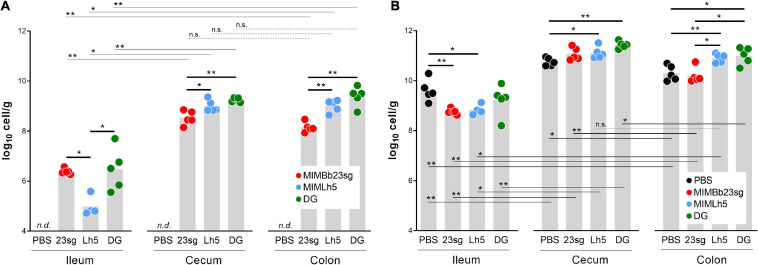
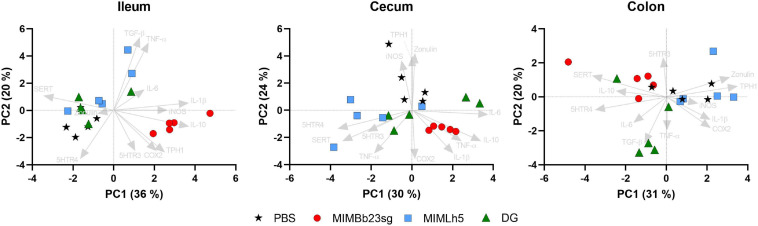
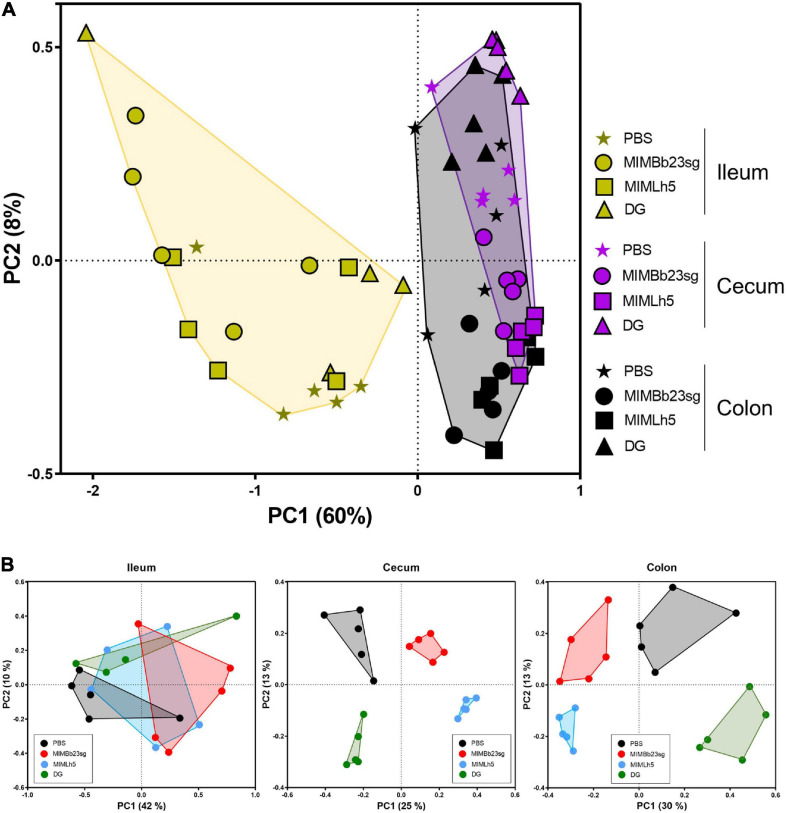
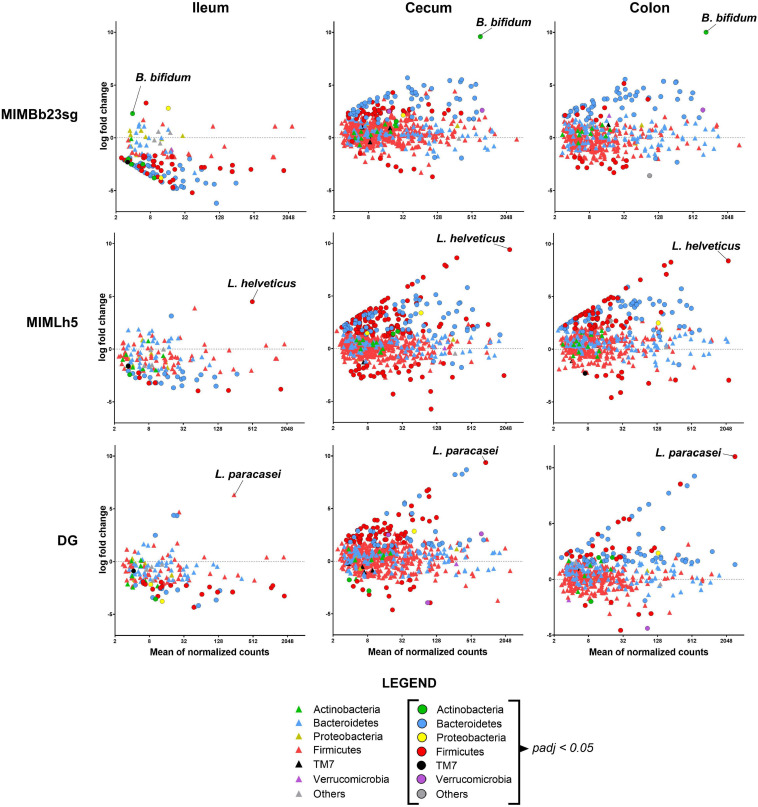
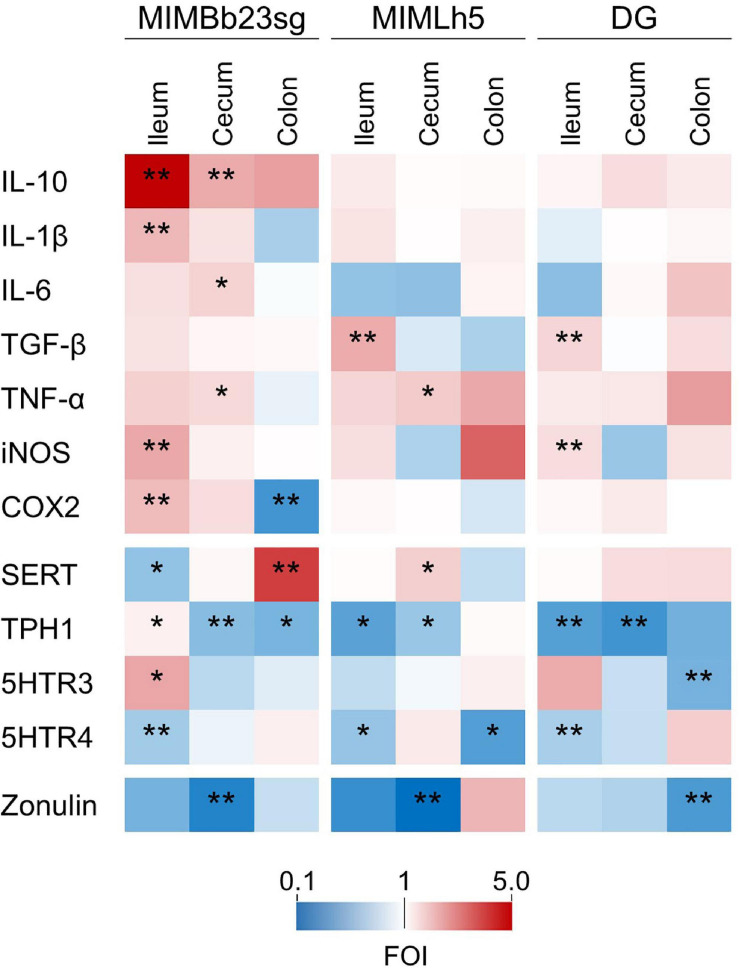
Probiotic microorganisms may benefit the host by influencing diverse physiological processes, whose nature and underlying mechanisms are still largely unexplored. Animal models are a unique tool to understand the complexity of the interactions between probiotic microorganisms, the intestinal microbiota, and the host. In this regard, in this pilot study, we compared the effects of 5-day administration of three different probiotic bacterial strains ( MIMBb23sg, MIMLh5, and DG) on three distinct murine intestinal sites (ileum, cecum, and colon). All probiotics preferentially colonized the cecum and colon. In addition, probiotics reduced in the ileum and increased in the cecum and colon the relative abundance of numerous bacterial taxonomic units. MIMBb23sg and DG increased the inducible nitric oxide synthase (iNOS) in the ileum, which is involved in epithelial homeostasis. In addition, MIMBb23sg upregulated cytokine IL-10 in the ileum and downregulated the cyclooxygenase COX-2 in the colon, suggesting an anti-inflammatory/regulatory activity. MIMBb23sg significantly affected the expression of the main gene involved in serotonin synthesis (TPH1) and the gene coding for the serotonin reuptake protein (SERT) in the ileum and colon, suggesting a potential propulsive effect toward the distal part of the gut, whereas the impact of MIMLh5 and DG on serotonergic genes suggested an effect toward motility control. The three probiotics decreased the expression of the permeability marker zonulin in gut distal sites. This preliminary study demonstrated the safety of the tested probiotic strains and their common ability to modulate the intestinal microbiota. The probiotics affected host gene expression in a strain-specific manner. Notably, the observed effects in the gut were site dependent. This study provides a rationale for investigating the effects of probiotics on the serotonergic system, which is a topic still widely unexplored.
益生菌微生物可能通过影响多种生理过程而使宿主受益,但其性质和潜在机制仍在很大程度上未被探索。动物模型是理解益生菌微生物、肠道微生物群和宿主之间相互作用复杂性的独特工具。在这方面,在本初步研究中,我们比较了三种不同益生菌菌株(MIMBb23sg、MIMLh5和DG)连续5天给药对三个不同小鼠肠道部位(回肠、盲肠和结肠)的影响。所有益生菌都优先定殖于盲肠和结肠。此外,益生菌降低了回肠中许多细菌分类单元的相对丰度,并增加了盲肠和结肠中的相对丰度。MIMBb23sg和DG增加了回肠中参与上皮稳态的诱导型一氧化氮合酶(iNOS)。此外,MIMBb23sg上调了回肠中的细胞因子IL-10,并下调了结肠中的环氧化酶COX-2,表明其具有抗炎/调节活性。MIMBb23sg显著影响回肠和结肠中参与血清素合成的主要基因(TPH1)以及编码血清素再摄取蛋白(SERT)的基因的表达,表明对肠道远端部分有潜在的推进作用,而MIMLh5和DG对血清素能基因的影响表明对运动控制有作用。这三种益生菌降低了肠道远端部位通透性标志物闭合蛋白的表达。这项初步研究证明了所测试益生菌菌株的安全性及其调节肠道微生物群的共同能力。益生菌以菌株特异性方式影响宿主基因表达。值得注意的是,在肠道中观察到的影响是部位依赖性的。本研究为研究益生菌对血清素能系统的影响提供了理论依据,这是一个仍未被广泛探索的课题。