Genomic Epidemiology Branch, International Agency for Research on Cancer (IARC/WHO), Lyon, France.
MRC Integrative Epidemiology Unit, University of Bristol, Bristol, United Kingdom.
PLoS Med. 2021 Sep 20;18(9):e1003786. doi: 10.1371/journal.pmed.1003786. eCollection 2021 Sep.
Excess bodyweight and related metabolic perturbations have been implicated in kidney cancer aetiology, but the specific molecular mechanisms underlying these relationships are poorly understood. In this study, we sought to identify circulating metabolites that predispose kidney cancer and to evaluate the extent to which they are influenced by body mass index (BMI).
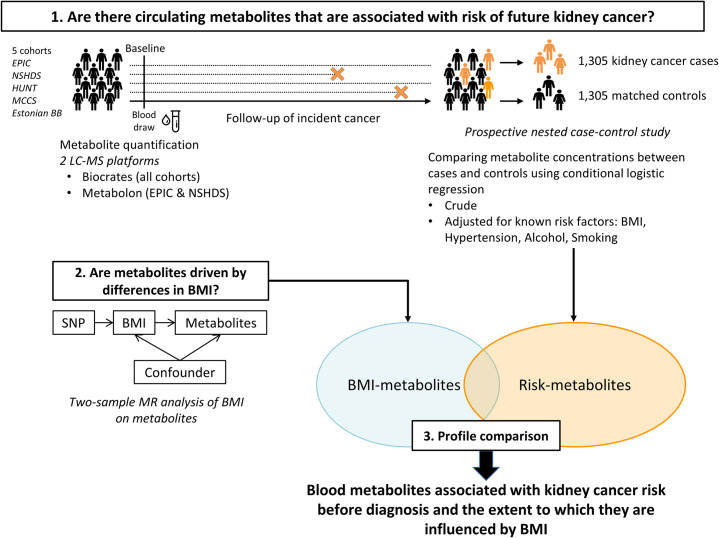
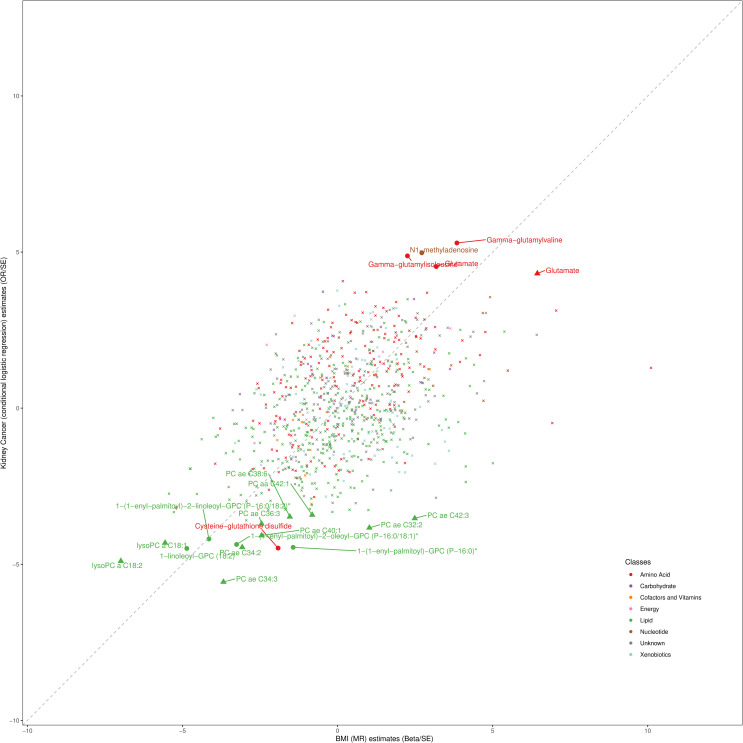
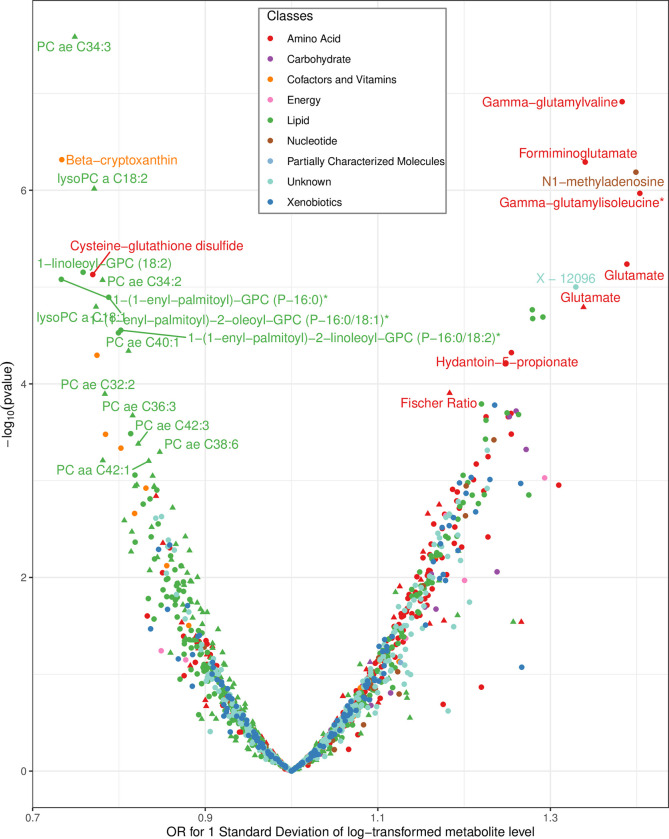
We assessed the association between circulating levels of 1,416 metabolites and incident kidney cancer using pre-diagnostic blood samples from up to 1,305 kidney cancer case-control pairs from 5 prospective cohort studies. Cases were diagnosed on average 8 years after blood collection. We found 25 metabolites robustly associated with kidney cancer risk. In particular, 14 glycerophospholipids (GPLs) were inversely associated with risk, including 8 phosphatidylcholines (PCs) and 2 plasmalogens. The PC with the strongest association was PC ae C34:3 with an odds ratio (OR) for 1 standard deviation (SD) increment of 0.75 (95% confidence interval [CI]: 0.68 to 0.83, p = 2.6 × 10⁻⁸). In contrast, 4 amino acids, including glutamate (OR for 1 SD = 1.39, 95% CI: 1.20 to 1.60, p = 1.6 × 10⁻⁵), were positively associated with risk. Adjusting for BMI partly attenuated the risk association for some-but not all-metabolites, whereas other known risk factors of kidney cancer, such as smoking and alcohol consumption, had minimal impact on the observed associations. A mendelian randomisation (MR) analysis of the influence of BMI on the blood metabolome highlighted that some metabolites associated with kidney cancer risk are influenced by BMI. Specifically, elevated BMI appeared to decrease levels of several GPLs that were also found inversely associated with kidney cancer risk (e.g., -0.17 SD change [ßBMI] in 1-(1-enyl-palmitoyl)-2-linoleoyl-GPC (P-16:0/18:2) levels per SD change in BMI, p = 3.4 × 10⁻⁵). BMI was also associated with increased levels of glutamate (ßBMI: 0.12, p = 1.5 × 10⁻³). While our results were robust across the participating studies, they were limited to study participants of European descent, and it will, therefore, be important to evaluate if our findings can be generalised to populations with different genetic backgrounds.
This study suggests a potentially important role of the blood metabolome in kidney cancer aetiology by highlighting a wide range of metabolites associated with the risk of developing kidney cancer and the extent to which changes in levels of these metabolites are driven by BMI-the principal modifiable risk factor of kidney cancer.
超重和相关代谢紊乱与肾癌的发病机制有关,但这些关系背后的具体分子机制尚不清楚。在这项研究中,我们试图确定易患肾癌的循环代谢物,并评估其受体重指数(BMI)影响的程度。
我们使用来自 5 项前瞻性队列研究的多达 1305 对肾癌病例对照的前瞻性血液样本,评估了 1416 种循环代谢物与肾癌发病风险之间的关联。病例平均在采血后 8 年被诊断出。我们发现 25 种代谢物与肾癌风险呈显著相关性。特别是,14 种甘油磷脂(GPLs)与风险呈负相关,包括 8 种磷脂酰胆碱(PCs)和 2 种溶血磷脂。与最强关联的 PC 是 PCaeC34:3,其 1 个标准差(SD)增量的比值比(OR)为 0.75(95%置信区间 [CI]:0.68 至 0.83,p = 2.6×10⁻⁸)。相比之下,4 种氨基酸,包括谷氨酸(OR 为 1 SD = 1.39,95%CI:1.20 至 1.60,p = 1.6×10⁻⁵),与风险呈正相关。调整 BMI 后,部分代谢物的风险关联减弱,但其他一些已知的肾癌风险因素,如吸烟和饮酒,对观察到的关联影响很小。BMI 对血液代谢组影响的孟德尔随机化(MR)分析突出表明,与肾癌风险相关的一些代谢物受 BMI 影响。具体而言,BMI 升高似乎降低了与肾癌风险呈负相关的几种 GPL 水平(例如,每 SD 体重指数变化,1-(1-烯基-棕榈酰基)-2-亚油酰基-GPC(P-16:0/18:2)水平变化 0.17 SD[ßBMI],p = 3.4×10⁻⁵)。BMI 也与谷氨酸水平升高有关(ßBMI:0.12,p = 1.5×10⁻³)。虽然我们的研究结果在参与的研究中是稳健的,但它们仅限于欧洲血统的研究参与者,因此,评估我们的发现是否可以推广到具有不同遗传背景的人群将非常重要。
本研究通过强调与肾癌风险相关的广泛代谢物范围以及这些代谢物水平变化受 BMI(肾癌的主要可改变风险因素)驱动的程度,提示血液代谢组在肾癌发病机制中可能发挥重要作用。