Department of Health Statistics and the Ministry of Education Key Lab of Hazard Assessment and Control in Special Operational Environment, School of Public Health, Fourth Military Medical University, Xi'an, 710032, Shaanxi, China.
Department of Pediatrics, Tangdu Hospital, Fourth Military Medical University, Xi'an, 710038, Shaanxi, China.
J Health Popul Nutr. 2021 Sep 20;40(1):41. doi: 10.1186/s41043-021-00265-8.
The objective of this study was to develop a scale to assess eating behaviors of school-aged children (6-12 years old) in China.
To develop the scale, a literature review and qualitative interviews were conducted. The draft scale contained 115 items and went through three evaluations among three groups of caregivers (n = 140, 400, 700) selected from suburban and urban kindergartens in Xi'an, Hanzhong, and Yanan, China, from March 2017 to October 2018. The psychometric properties of the scale were assessed using exploratory, confirmatory factor analysis, and variability analysis.
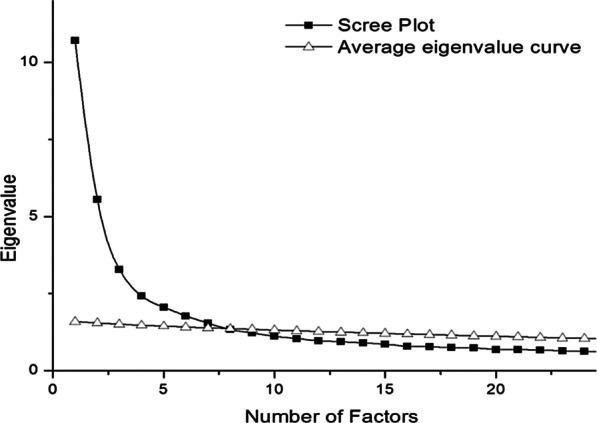
The final scale consisted of 46 items across eight dimensions including food fussiness, satiety responsiveness, food responsiveness, bad eating habits, susceptible diet, restrained eating, enjoyment of food, and junk food addiction. The total cumulative variance contribution rate was 52.16%. The scale and dimensions' Cronbach's α coefficients, Guttman split-half reliability, and test- retest reliability were all above 0.65. The fitting indices for the confirmatory factor analysis were all close to 1. The scores for education of caregiver, family structure, and the body mass index of children were different among dimensions and groups, thus suggesting good discriminative utility.
All of the results indicated that the scale has good reliability and construct validity for evaluating the eating behaviors of school-aged children in China.
本研究旨在开发一个用于评估中国学龄儿童(6-12 岁)饮食行为的量表。
为了开发该量表,我们进行了文献回顾和定性访谈。该量表草案包含 115 个项目,并在中国西安、汉中、延安的郊区和城市幼儿园的三组照顾者(n=140、400、700)中进行了三轮评估。该量表的心理测量学性质采用探索性、验证性因子分析和变异性分析进行评估。
最终量表由 46 个项目组成,涵盖八个维度,包括食物挑剔、饱腹感反应、食物反应性、不良饮食习惯、易受饮食影响、抑制性进食、享受食物和垃圾食品成瘾。总累积方差贡献率为 52.16%。量表和维度的克朗巴赫 α系数、Guttman 分半信度和测试-重测信度均大于 0.65。验证性因子分析的拟合指数均接近 1。照顾者的教育程度、家庭结构和儿童的体重指数在维度和群体之间存在差异,因此具有良好的区分度。
所有结果表明,该量表在中国评估学龄儿童饮食行为时具有良好的信度和结构效度。