Norwegian Social Research, Oslo Metropolitan University, Oslo, Norway.
Department of Alcohol, Tobacco and Drugs, Norwegian Institute of Public Health, Oslo, Norway.
Nicotine Tob Res. 2022 Feb 14;24(3):400-407. doi: 10.1093/ntr/ntab192.
Although adolescents' nicotine addiction from e-cigarettes is a concern, few studies differentiate between vaping with and without nicotine. This study examines the prevalence of nicotine and nicotine-free vaping, maps transitions between vaping behaviors, and assesses differences in the personal characteristics of vapers in a sample of Norwegian adolescents.
Data came from a nationwide longitudinal study of adolescents (n = 2018) conducted in 2017 (T1), 2018 (T2), and 2019 (T3) (mean age: 14.2, 15.0, and 16.2). Using an online questionnaire, we measured vaping with and without nicotine, snus use, smoking, sensation-seeking, conduct problems, and levels of depression.
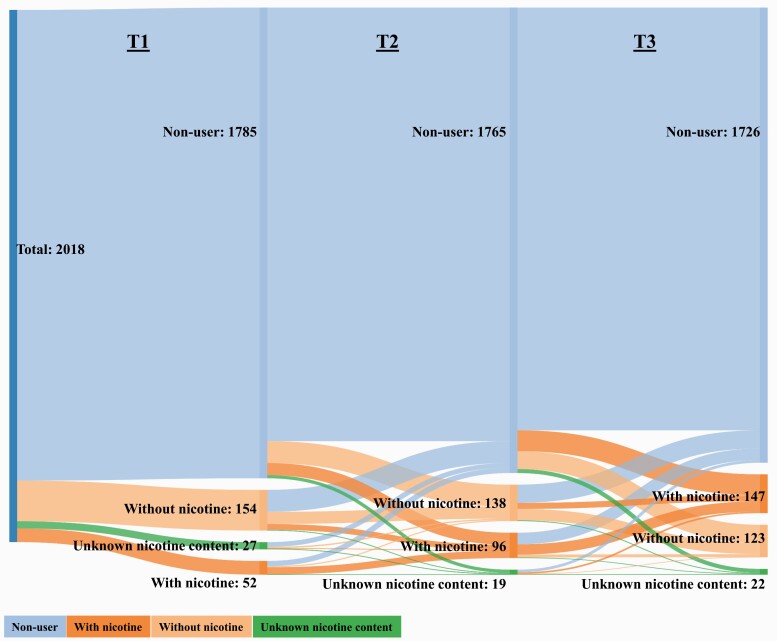
Past 12-month vaping prevalence was stable (12%, 13%, and 15%). Among adolescents reporting vaping at T1, 66% had used e-cigarettes without nicotine, 22% with nicotine, and 12% were unsure of nicotine content. Individual vaping trajectories were unstable: of nicotine-free vapers, 54% became non-users, while 14% became nicotine vapers from T1 to T2. From T2 to T3, 50% became non-users, while 17% became nicotine vapers. Of nicotine vapers, 39% became non-users from T1 to T2, while 46% became non-users from T2 to T3. Compared to nicotine-free vapers, nicotine vapers had more conduct problems (mean = 3.67 vs 2.17), had more symptoms of depression (mean = 11.38 vs 6.95), and comprised more past 30-day snus users (33% vs 14%) and cigarette users (33% vs 9%).
Adolescent vapers most commonly used e-cigarettes without nicotine, few of these transitioned into nicotine vaping, and a majority became non-users. Nicotine vapers were more likely to use other tobacco products and have more conduct problems and symptoms of depression compared to nicotine-free vapers.
Reporting the prevalence of nicotine-free vaping is critical for assessing nicotine exposure and subsequent risks of nicotine addiction. This multi-cohort longitudinal study showed that use of nicotine-free e-cigarettes is common among young vapers in Norway. Adolescents' vaping patterns-both with and without nicotine-are generally temporal and experimental. Despite the majority of nicotine vapers becoming non-users, they are characterized by having more conduct problems and poorer mental health, and they more often used other tobacco products.
尽管青少年吸食电子烟产生的尼古丁成瘾令人担忧,但很少有研究对有尼古丁和无尼古丁的电子烟使用进行区分。本研究在挪威青少年样本中,检查了尼古丁和无尼古丁电子烟的使用流行率,绘制了电子烟使用行为的转变情况,并评估了电子烟使用者个体特征的差异。
数据来自于 2017 年(T1)、2018 年(T2)和 2019 年(T3)进行的一项全国性青少年纵向研究(n=2018)(平均年龄:14.2、15.0 和 16.2)。使用在线问卷,我们测量了有和无尼古丁的电子烟使用、鼻烟使用、吸烟、寻求刺激、行为问题和抑郁程度。
过去 12 个月的电子烟使用流行率保持稳定(12%、13%和 15%)。在 T1 报告使用电子烟的青少年中,66%使用过无尼古丁的电子烟,22%使用过尼古丁电子烟,12%不确定电子烟的尼古丁含量。个体电子烟使用轨迹不稳定:无尼古丁电子烟使用者中,54%成为非使用者,而 14%从 T1 到 T2 成为尼古丁电子烟使用者。从 T2 到 T3,50%成为非使用者,而 17%成为尼古丁电子烟使用者。尼古丁电子烟使用者中,39%从 T1 到 T2 成为非使用者,而 46%从 T2 到 T3 成为非使用者。与无尼古丁电子烟使用者相比,尼古丁电子烟使用者的行为问题更多(平均=3.67 与 2.17),抑郁症状更多(平均=11.38 与 6.95),且过去 30 天鼻烟使用者(33%与 14%)和香烟使用者(33%与 9%)更多。
青少年电子烟使用者最常使用无尼古丁电子烟,其中很少有人过渡到尼古丁电子烟使用,而大多数人成为非使用者。与无尼古丁电子烟使用者相比,尼古丁电子烟使用者更有可能使用其他烟草制品,且行为问题更多,抑郁症状更严重。
报告无尼古丁电子烟的使用流行率对于评估尼古丁暴露和随后的尼古丁成瘾风险至关重要。这项多队列纵向研究表明,在挪威的年轻电子烟使用者中,使用无尼古丁电子烟很常见。青少年的电子烟使用模式——包括有和无尼古丁——通常是暂时的和实验性的。尽管大多数尼古丁电子烟使用者成为非使用者,但他们的特点是行为问题更多,心理健康更差,并且更常使用其他烟草制品。