Institute of Cognitive Neuroscience, Faculty of Education, Huaibei Normal University, Huaibei, China.
Faculty of Psychology, SWPS University of Social Sciences and Humanities, Katowice, Poland.
Sci Rep. 2021 Mar 19;11(1):6481. doi: 10.1038/s41598-021-85943-7.
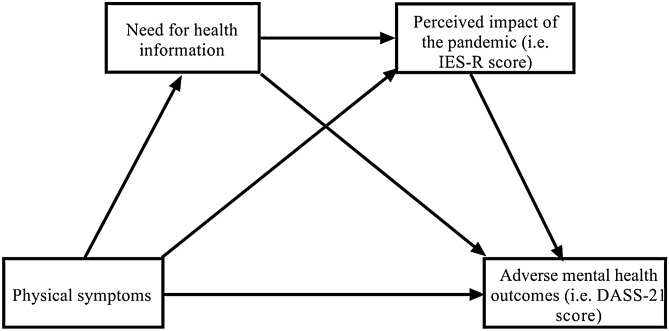
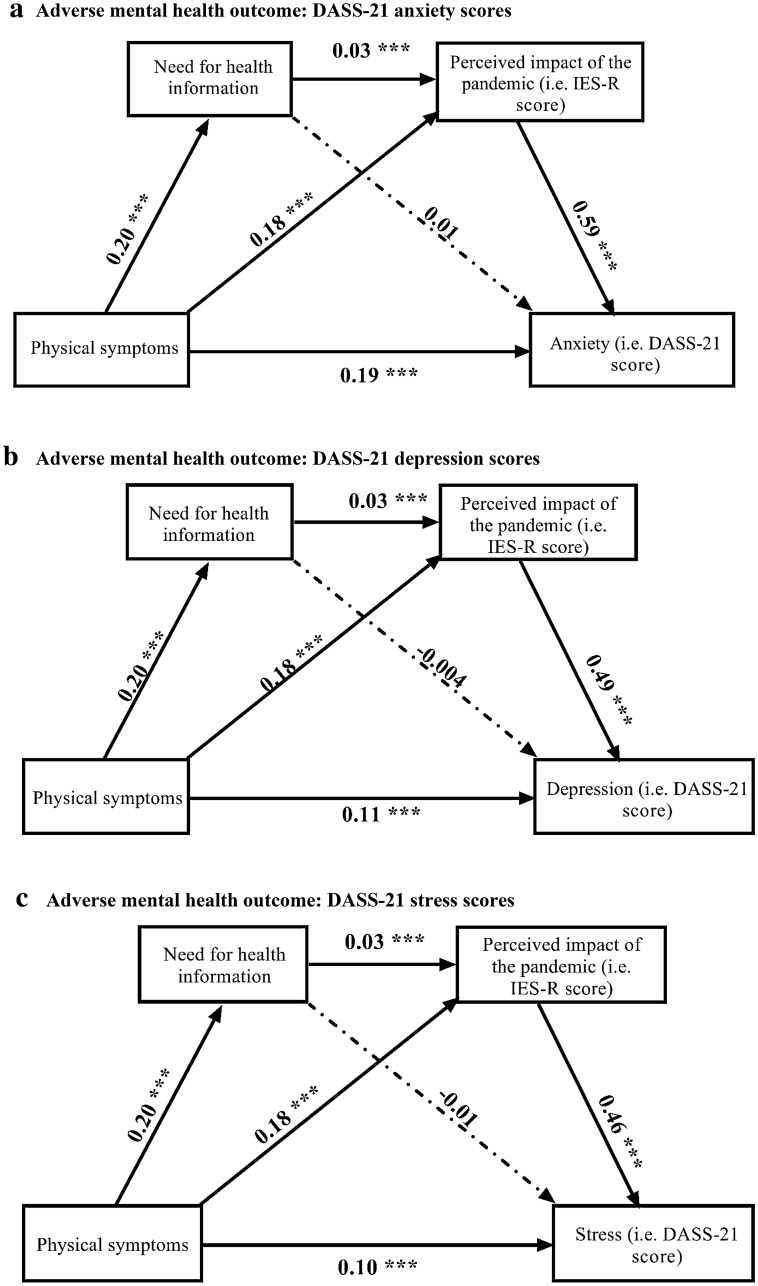
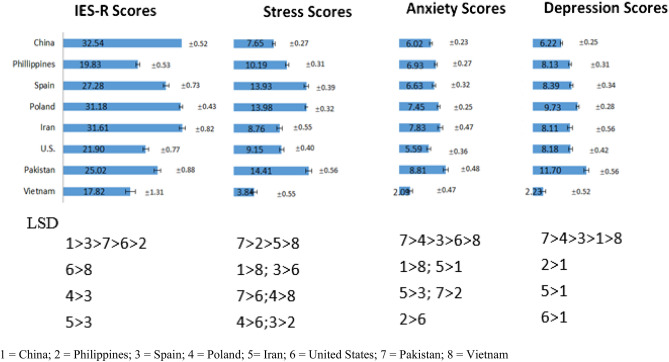
The novel Coronavirus-2019 (COVID-19) was declared a pandemic by the World Health Organization (WHO) in March 2020, impacting the lifestyles, economy, physical and mental health of individuals globally. This study aimed to test the model triggered by physical symptoms resembling COVID-19 infection, in which the need for health information and perceived impact of the pandemic mediated the path sequentially, leading to adverse mental health outcomes. A cross-sectional research design with chain mediation model involving 4612 participants from participating 8 countries selected via a respondent-driven sampling strategy was used. Participants completed online questionnaires on physical symptoms, the need for health information, the Impact of Event Scale-Revised (IES-R) questionnaire and Depression, Anxiety and Stress Scale (DASS-21). The results showed that Poland and the Philippines were the two countries with the highest levels of anxiety, depression and stress; conversely, Vietnam had the lowest mean scores in these areas. Chain mediation model showed the need for health information, and the perceived impact of the pandemic were sequential mediators between physical symptoms resembling COVID-19 infection (predictor) and consequent mental health status (outcome). Excessive and contradictory health information might increase the perceived impact of the pandemic. Rapid COVID-19 testing should be implemented to minimize the psychological burden associated with physical symptoms, whilst public mental health interventions could target adverse mental outcomes associated with the pandemic.
新型冠状病毒-2019(COVID-19)于 2020 年 3 月被世界卫生组织(WHO)宣布为大流行,对全球个人的生活方式、经济、身心健康产生了影响。本研究旨在测试由类似于 COVID-19 感染的身体症状引发的模型,其中对健康信息的需求和对大流行的感知影响依次介导,导致不良的心理健康结果。使用涉及通过应答者驱动抽样策略从参与的 8 个国家中选择的 4612 名参与者的横断面研究设计和链式中介模型。参与者在线填写身体症状、对健康信息的需求、事件影响量表修订版(IES-R)问卷和抑郁、焦虑和压力量表(DASS-21)。结果表明,波兰和菲律宾是焦虑、抑郁和压力水平最高的两个国家;相比之下,越南在这些领域的平均得分最低。链式中介模型显示,对健康信息的需求以及对大流行的感知影响是类似于 COVID-19 感染的身体症状(预测因子)与随后的心理健康状况(结果)之间的顺序中介。过多和矛盾的健康信息可能会增加对大流行的感知影响。应实施快速 COVID-19 检测,以减轻与身体症状相关的心理负担,而公众心理健康干预措施可以针对大流行相关的不良心理健康结果。