Department of Economics, Johannes Kepler University Linz, Linz, Austria.
Center for Macroeconomic Research, University of Cologne, Cologne, Germany.
PLoS One. 2021 Sep 22;16(9):e0257363. doi: 10.1371/journal.pone.0257363. eCollection 2021.
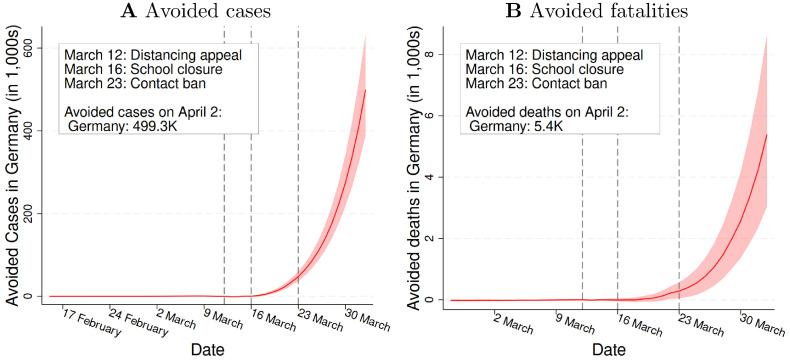
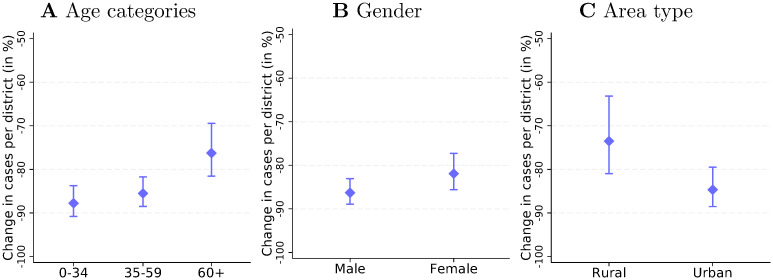
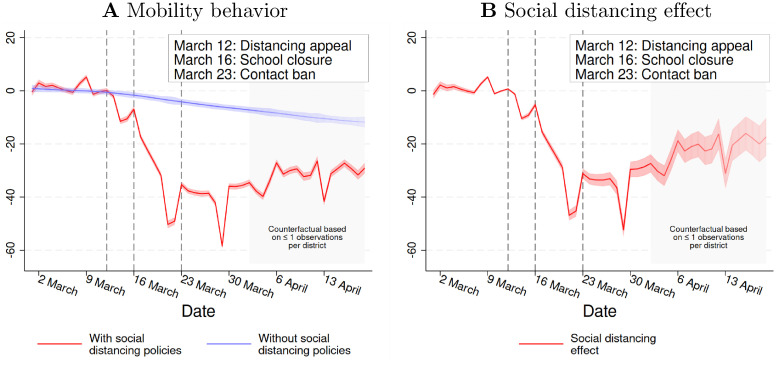
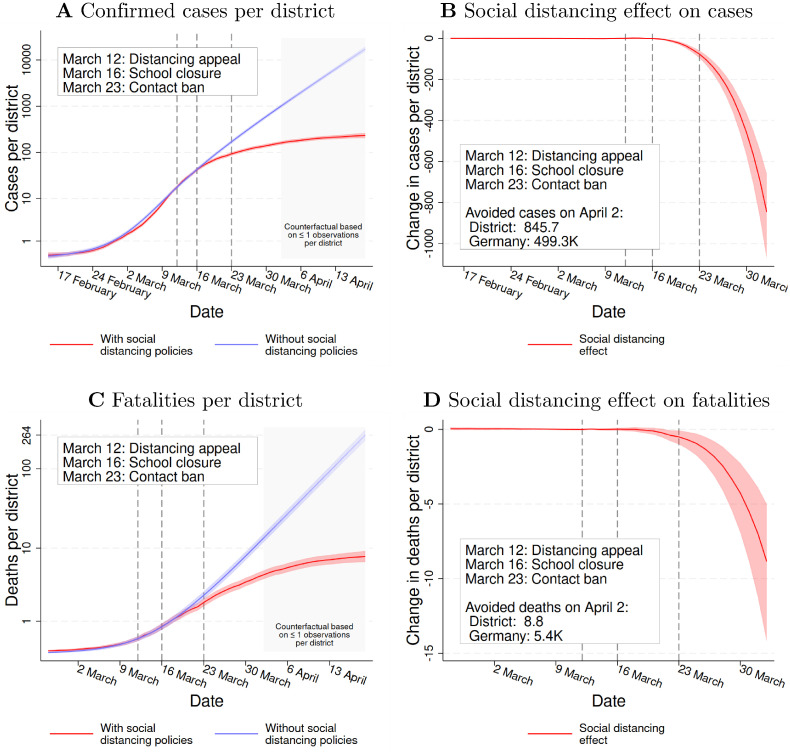
To fight the spread of COVID-19, many countries implemented social distancing policies. This is the first paper that examines the effects of the German social distancing policies on behavior and the epidemic's spread. Exploiting the staggered timing of COVID-19 outbreaks in extended event-study models, we find that the policies heavily reduced mobility and contagion. In comparison to a no-social-distancing benchmark, within three weeks, the policies avoided 84% of the potential COVID-19 cases (point estimate: 499.3K) and 66% of the potential fatalities (5.4K). The policies' relative effects were smaller for individuals above 60 and in rural areas.
为了抗击 COVID-19 的传播,许多国家实施了社交隔离政策。本文首次考察了德国社交隔离政策对行为和疫情传播的影响。利用 COVID-19 爆发的交错时间,我们发现这些政策大大降低了流动性和传染率。与不实施社交隔离政策的基准相比,在三周内,这些政策避免了 84%的潜在 COVID-19 病例(点估计:499.3 万)和 66%的潜在死亡人数(5400 人)。对于 60 岁以上的人和农村地区的人来说,这些政策的相对效果较小。