Ray Logan C, Collins Jennifer P, Griffin Patricia M, Shah Hazel J, Boyle Michelle M, Cieslak Paul R, Dunn John, Lathrop Sarah, McGuire Suzanne, Rissman Tamara, Scallan Walter Elaine J, Smith Kirk, Tobin-D'Angelo Melissa, Wymore Katie, Kufel Joanna Zablotsky, Wolpert Beverly J, Tauxe Robert, Payne Daniel C
MMWR Morb Mortal Wkly Rep. 2021 Sep 24;70(38):1332-1336. doi: 10.15585/mmwr.mm7038a4.
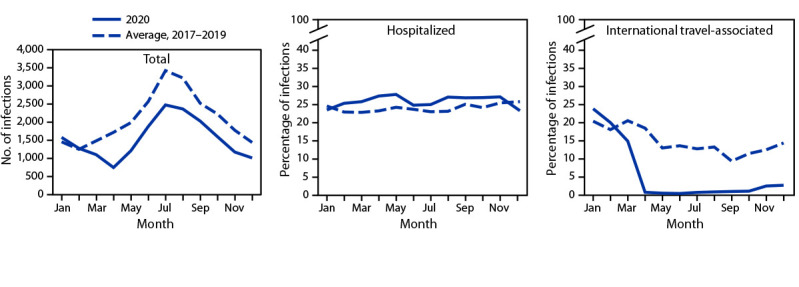
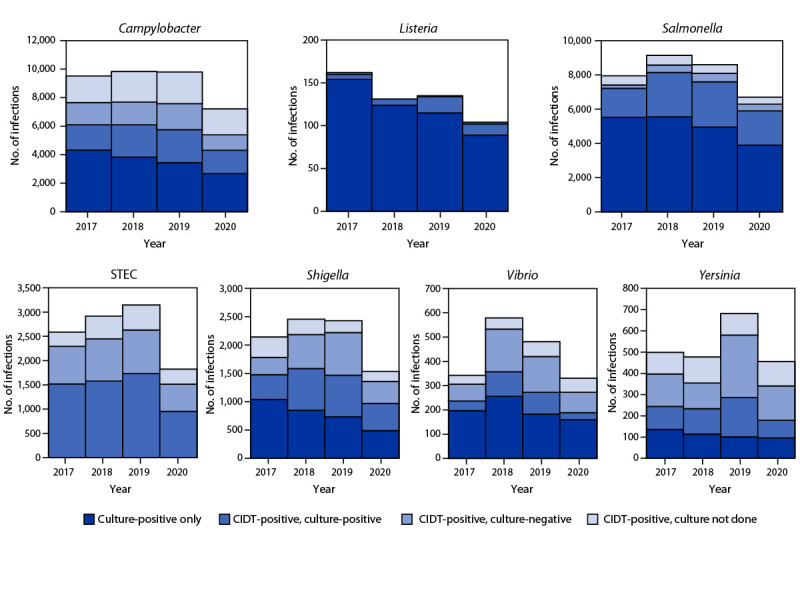
Foodborne illnesses are a substantial and largely preventable public health problem; before 2020 the incidence of most infections transmitted commonly through food had not declined for many years. To evaluate progress toward prevention of foodborne illnesses in the United States, the Foodborne Diseases Active Surveillance Network (FoodNet) of CDC's Emerging Infections Program monitors the incidence of laboratory-diagnosed infections caused by eight pathogens transmitted commonly through food reported by 10 U.S. sites.* FoodNet is a collaboration among CDC, 10 state health departments, the U.S. Department of Agriculture's Food Safety and Inspection Service (USDA-FSIS), and the Food and Drug Administration. This report summarizes preliminary 2020 data and describes changes in incidence with those during 2017-2019. During 2020, observed incidences of infections caused by enteric pathogens decreased 26% compared with 2017-2019; infections associated with international travel decreased markedly. The extent to which these reductions reflect actual decreases in illness or decreases in case detection is unknown. On March 13, 2020, the United States declared a national emergency in response to the COVID-19 pandemic. After the declaration, state and local officials implemented stay-at-home orders, restaurant closures, school and child care center closures, and other public health interventions to slow the spread of SARS-CoV-2, the virus that causes COVID-19 (1). Federal travel restrictions were declared (1). These widespread interventions as well as other changes to daily life and hygiene behaviors, including increased handwashing, have likely changed exposures to foodborne pathogens. Other factors, such as changes in health care delivery, health care-seeking behaviors, and laboratory testing practices, might have decreased the detection of enteric infections. As the pandemic continues, surveillance of illness combined with data from other sources might help to elucidate the factors that led to the large changes in 2020; this understanding could lead to improved strategies to prevent illness. To reduce the incidence of these infections concerted efforts are needed, from farm to processing plant to restaurants and homes. Consumers can reduce their risk of foodborne illness by following safe food-handling and preparation recommendations.
食源性疾病是一个严重且在很大程度上可预防的公共卫生问题;在2020年之前,大多数常见通过食物传播的感染发病率多年来并未下降。为评估美国在预防食源性疾病方面取得的进展,美国疾病控制与预防中心新兴感染项目的食源性疾病主动监测网络(FoodNet)监测了美国10个地点报告的由8种常见通过食物传播的病原体引起的实验室确诊感染的发病率。*FoodNet是美国疾病控制与预防中心、10个州卫生部门、美国农业部食品安全与检验局(USDA - FSIS)以及美国食品药品监督管理局之间的合作项目。本报告总结了2020年的初步数据,并描述了发病率与2017 - 2019年期间相比的变化情况。2020年期间,肠道病原体引起的感染的观察发病率与2017 - 2019年相比下降了26%;与国际旅行相关的感染显著减少。这些下降在多大程度上反映了实际疾病的减少或病例检测的减少尚不清楚。2020年3月13日,美国宣布因新冠疫情进入国家紧急状态。宣布之后,州和地方官员实施了居家令、关闭餐馆、关闭学校和儿童保育中心以及其他公共卫生干预措施,以减缓导致新冠疫情的病毒SARS-CoV-2的传播(1)。宣布了联邦旅行限制(1)。这些广泛的干预措施以及日常生活和卫生行为的其他变化,包括增加洗手频率,可能改变了人们接触食源性病原体的情况。其他因素,如医疗服务提供、就医行为和实验室检测做法的变化,可能减少了肠道感染的检测。随着疫情的持续,对疾病的监测以及来自其他来源的数据可能有助于阐明导致2020年出现巨大变化的因素;这种认识可能会带来改进的疾病预防策略。为降低这些感染的发病率,需要从农场到加工厂再到餐馆和家庭共同努力。消费者可以通过遵循安全的食品处理和制备建议来降低食源性疾病的风险。