General Practice Department, Peking University First Hospital, Beijing, People's Republic of China.
Pulmonary and Critical Care Medicine, Peking University Third Hospital, Beijing, People's Republic of China.
BMJ Open. 2021 Sep 23;11(9):e051811. doi: 10.1136/bmjopen-2021-051811.
To examine the accuracy and cost-effectiveness of various chronic obstructive pulmonary disease (COPD) screening tests and combinations within a Chinese primary care population.
Screening test accuracy study.
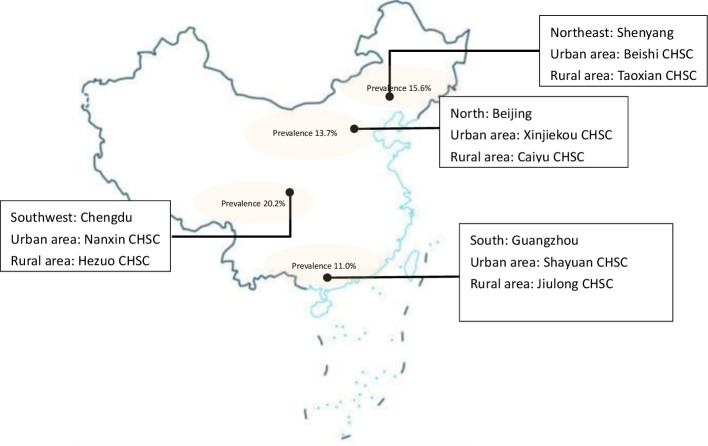
Urban and rural community health centres in four municipalities of China: Beijing (north), Chengdu (southwest), Guangzhou (south) and Shenyang (northeast).
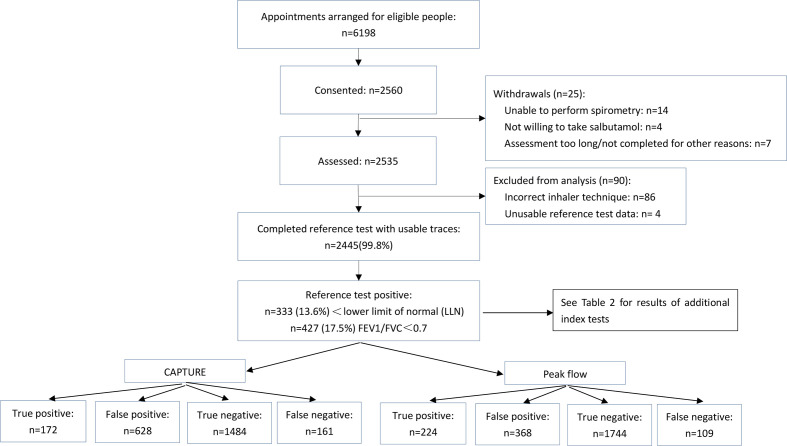
Community residents aged 40 years and above who attended community health centres for any reason were invited to participate. 2445 participants (mean age 59.8 (SD 9.6) years, 39.1% (n=956) male) completed the study (February-December 2019), 68.9% (n=1684) were never-smokers and 3.6% (n=88) had an existing COPD diagnosis. 13.7% (n=333) of participants had spirometry-confirmed airflow obstruction.
Participants completed six index tests (screening questionnaires (COPD Diagnostic Questionnaire, COPD Assessment in Primary Care To Identify Undiagnosed Respiratory Disease and Exacerbation Risk (CAPTURE), Chinese Symptom-Based Questionnaire (C-SBQ), COPD-SQ), microspirometry (COPD-6), peak flow (model of peak flow meters used in the study (USPE)) and the reference test (ndd Easy On-PC).
Cases were defined as those with forced expiratory volume in one second (FEV)/forced vital capacity (FVC) below the lower limit of normal (LLN-GLI) on the reference test. Performance of individual screening tests and their combinations was evaluated, with cost-effectiveness analyses providing cost per additional true case detected.
Airflow measurement devices (sensitivities 64.9% (95% CI 59.5% to 70.0%) and 67.3% (95% CI 61.9% to 72.3%), specificities 89.7% (95% CI 88.4% to 91.0%) and 82.6% (95% CI 80.9% to 84.2%) for microspirometry and peak flow, respectively) generally performed better than questionnaires, the most accurate of which was C-SBQ (sensitivity 63.1% (95% CI 57.6% to 68.3%) specificity 74.2% (95% CI 72.3% to 76.1%)). The combination of C-SBQ and microspirometry used in parallel maximised sensitivity (81.4%) (95% CI 76.8% to 85.4%) and had specificity of 68.0% (95% CI 66.0% to 70.0%), with an incremental cost-effectiveness ratio of £64.20 (CNY385) per additional case detected compared with peak flow.
Simple screening tests to identify undiagnosed COPD within the primary care setting in China is possible, and a combination of C-SBQ and microspirometry is the most sensitive and cost-effective. Further work is required to explore optimal cut-points and effectiveness of programme implementation.
ISRCTN13357135.
在中国基层医疗人群中,评估各种慢性阻塞性肺疾病(COPD)筛查试验及其组合的准确性和成本效益。
筛查试验准确性研究。
中国四个直辖市的城乡社区卫生中心:北京(北部)、成都(西南部)、广州(南部)和沈阳(东北部)。
任何原因到社区卫生中心就诊的 40 岁及以上的社区居民受邀参加。2445 名参与者(平均年龄 59.8(SD 9.6)岁,39.1%(n=956)为男性)完成了研究(2019 年 2 月至 12 月),68.9%(n=1684)为从不吸烟者,3.6%(n=88)患有现有 COPD 诊断。13.7%(n=333)的参与者进行了有明确气流受限的肺量测定。
参与者完成了六项指标测试(筛查问卷(COPD 诊断问卷、COPD 初级保健评估以识别未诊断的呼吸道疾病和加重风险(CAPTURE)、基于症状的中国问卷(C-SBQ)、COPD-SQ)、微肺量计(COPD-6)、峰值流量(研究中使用的峰值流量计模型(USPE))和参考测试(ndd Easy On-PC))。
将用力呼气量/用力肺活量(FEV/FVC)低于参考测试的下限时定义为病例(LLN-GLI)。评估了各个筛查试验及其组合的性能,并进行了成本效益分析,以提供每检测到一个额外真病例的成本。
气流测量设备(灵敏度分别为 64.9%(95%置信区间 59.5%至 70.0%)和 67.3%(95%置信区间 61.9%至 72.3%),特异性分别为 89.7%(95%置信区间 88.4%至 91.0%)和 82.6%(95%置信区间 80.9%至 84.2%))一般优于问卷,其中最准确的是 C-SBQ(灵敏度 63.1%(95%置信区间 57.6%至 68.3%),特异性 74.2%(95%置信区间 72.3%至 76.1%))。平行使用的 C-SBQ 和微肺量计组合可最大程度提高敏感性(81.4%)(95%置信区间 76.8%至 85.4%),特异性为 68.0%(95%置信区间 66.0%至 70.0%),与峰值流量相比,每检测到一个额外病例的增量成本效益比为 64.20 英镑(385 元人民币)。
在中国基层医疗环境中,使用简单的筛查试验来识别未确诊的 COPD 是可行的,并且 C-SBQ 和微肺量计的组合具有最高的敏感性和成本效益。需要进一步研究来探索最佳切点和实施计划的效果。
ISRCTN86216415。