Department of Hygiene, Epidemiology and Ergonomics, Medical University of Bialystok, 2C Adama Mickiewicza Street, 15-022 Bialystok, Poland.
Students Scientific Club "Biochemistry of Civilization Diseases" at the Department of Hygiene, Epidemiology and Ergonomics, Medical University of Bialystok, 2c Mickiewicza Street, 15-233 Bialystok, Poland.
Oxid Med Cell Longev. 2021 Sep 9;2021:3734252. doi: 10.1155/2021/3734252. eCollection 2021.
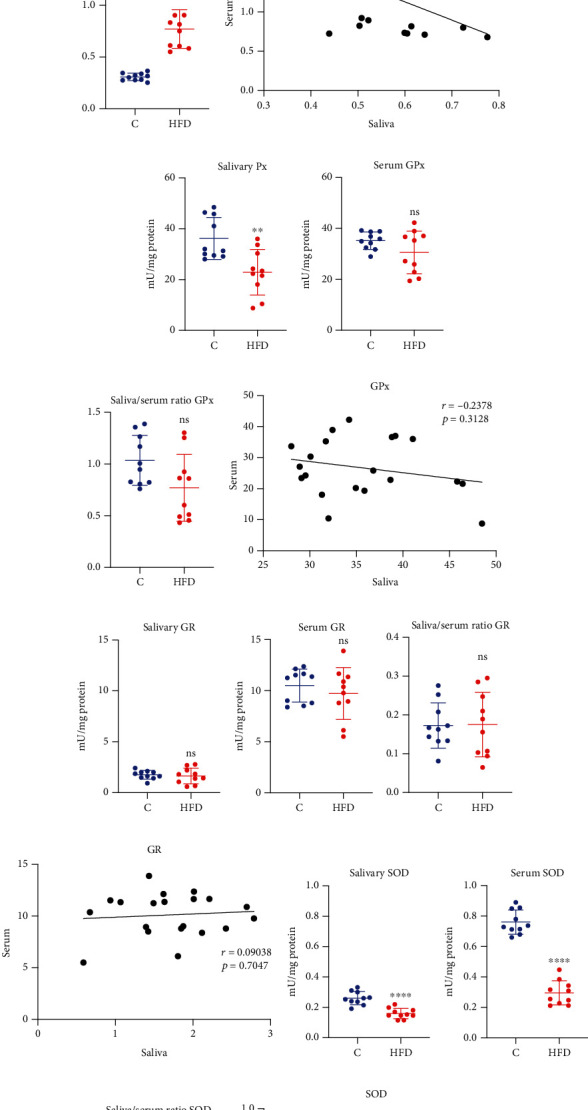
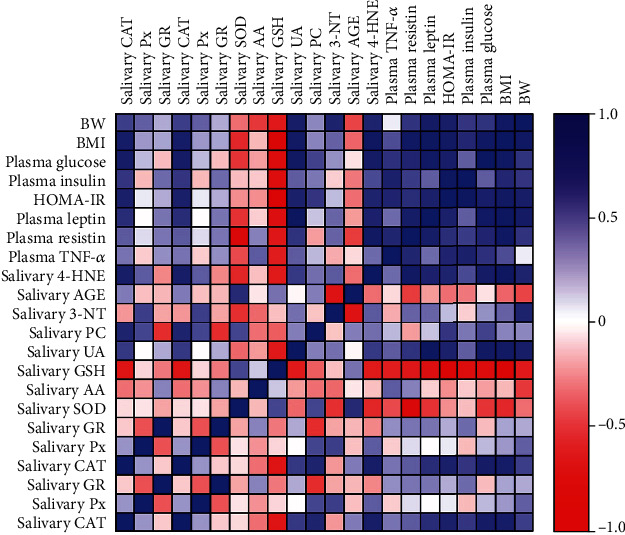
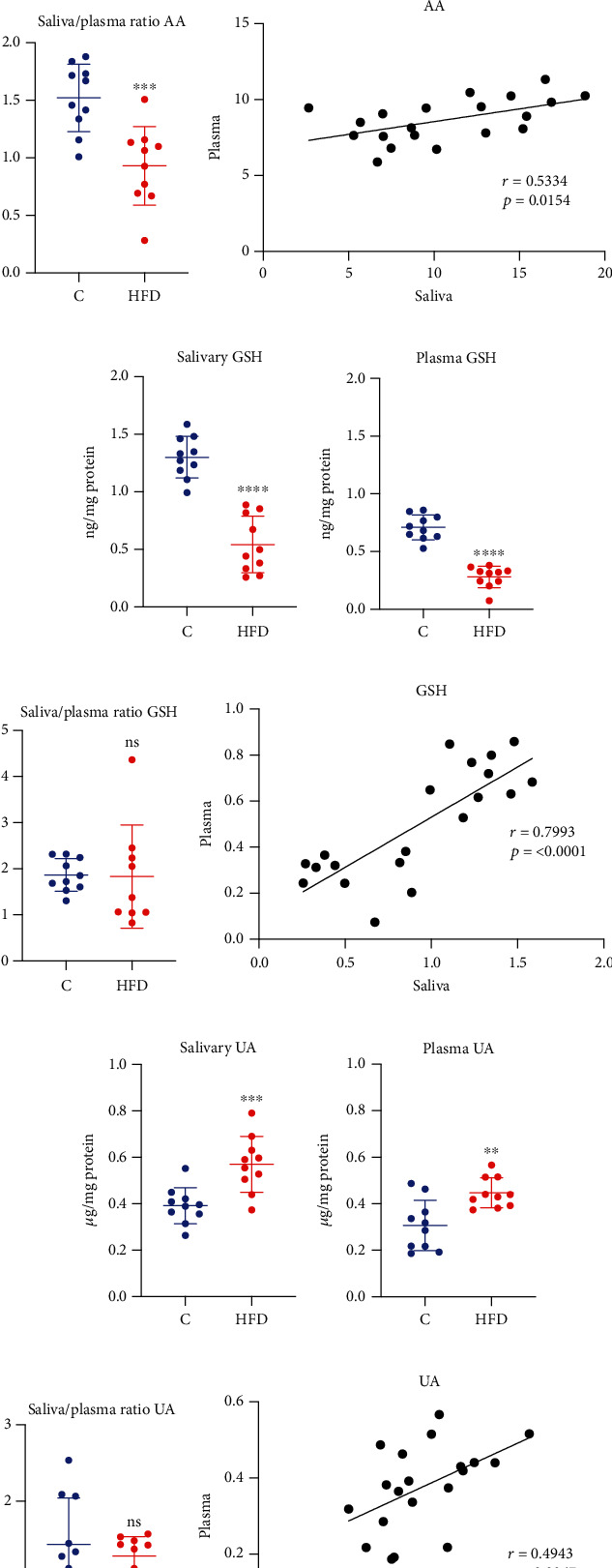
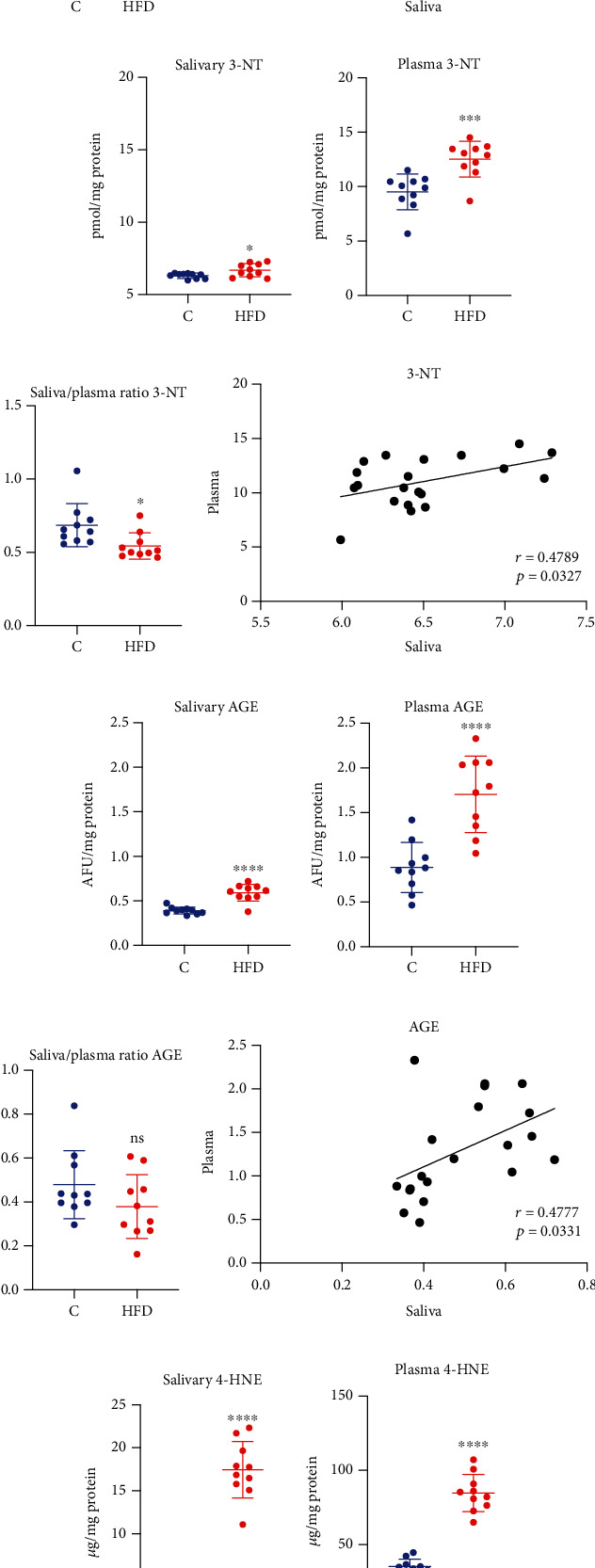
Insulin resistance (IR) is a condition of impaired tissue response to insulin. Although there are many methods to diagnose IR, new biomarkers are still being sought for early and noninvasive diagnosis of the disease. Of particular interest in laboratory diagnostics is saliva collected in a stress-free, noninvasive, and straightforward manner. The purpose of the study was to evaluate the diagnostic utility of salivary redox biomarkers in preclinical studies in an animal model. The study was conducted on 20 male Wistar rats divided into two equal groups: a standard diet and a high-fat diet (HFD). In all rats fed the HFD, IR was confirmed by an elevated homeostasis model assessment (HOMA-IR) index. We have shown that IR is responsible for the depletion of the enzymatic (↓superoxide dismutase) and nonenzymatic (↓ascorbic acid, ↓reduced glutathione (GSH)) antioxidant barrier at both the central (serum/plasma) and salivary gland (saliva) levels. In IR rats, we also demonstrated significantly higher concentrations of protein/lipid oxidation (↑protein carbonyls, ↑4-hydroxynoneal (4-HNE)), glycation (↑advanced glycation end products), and nitration (↑3-nitrotyrosine) products in both saliva and blood plasma. Salivary nonenzymatic antioxidants and oxidative stress products generally correlate with their blood levels, while GSH and 4-HNE have the highest correlation coefficient. Salivary GSH and 4-HNE correlate with body weight and BMI and indices of carbohydrate metabolism (glucose, insulin, HOMA-IR) and proinflammatory adipokines (leptin, resistin, TNF-). These biomarkers differentiate IR from healthy controls with very high sensitivity (100%) and specificity (100%). The high diagnostic utility of salivary GSH and 4-HNE is also confirmed by multivariate regression analysis. Summarizing, saliva can be used to assess the systemic antioxidant status and the intensity of systemic oxidative stress. Salivary GSH and 4-HNE may be potential biomarkers of IR progression. There is a need for human clinical trials to evaluate the diagnostic utility of salivary redox biomarkers in IR conditions.
胰岛素抵抗(IR)是一种组织对胰岛素反应受损的情况。虽然有许多方法可以诊断 IR,但仍在寻找新的生物标志物来对疾病进行早期和非侵入性诊断。在实验室诊断中,特别感兴趣的是通过无压力、非侵入性和简单的方式收集的唾液。本研究的目的是评估唾液氧化还原生物标志物在动物模型的临床前研究中的诊断效用。该研究在 20 只雄性 Wistar 大鼠中进行,分为两组:标准饮食组和高脂肪饮食(HFD)组。在所有接受 HFD 喂养的大鼠中,通过升高的稳态模型评估(HOMA-IR)指数确认存在 IR。我们已经表明,IR 导致中央(血清/血浆)和唾液腺(唾液)水平的酶(↓超氧化物歧化酶)和非酶(↓抗坏血酸、↓还原型谷胱甘肽(GSH))抗氧化屏障耗尽。在 IR 大鼠中,我们还证明了在唾液和血浆中,蛋白质/脂质氧化(↑蛋白质羰基、↑4-羟基壬醛(4-HNE))、糖化(↑晚期糖基化终产物)和硝化(↑3-硝基酪氨酸)产物的浓度显著升高。唾液中非酶抗氧化剂和氧化应激产物通常与它们的血液水平相关,而 GSH 和 4-HNE 具有最高的相关系数。唾液 GSH 和 4-HNE 与体重和 BMI 以及碳水化合物代谢(葡萄糖、胰岛素、HOMA-IR)和促炎脂肪因子(瘦素、抵抗素、TNF-α)的指数相关。这些生物标志物对 IR 与健康对照的区分具有非常高的灵敏度(100%)和特异性(100%)。多元回归分析也证实了唾液 GSH 和 4-HNE 的高诊断效用。综上所述,唾液可用于评估全身抗氧化状态和全身氧化应激强度。唾液 GSH 和 4-HNE 可能是 IR 进展的潜在生物标志物。需要进行人体临床试验来评估唾液氧化还原生物标志物在 IR 情况下的诊断效用。