Institute for Agro-Food Standards and Testing Technology, Shanghai Key Laboratory of Protected Horticultural Technology, Shanghai Academy of Agricultural Sciences, Shanghai 201403, China.
Organic Contaminants and Additives, Sciensano, 3080 Tervuren, Belgium.
Toxins (Basel). 2021 Sep 15;13(9):656. doi: 10.3390/toxins13090656.
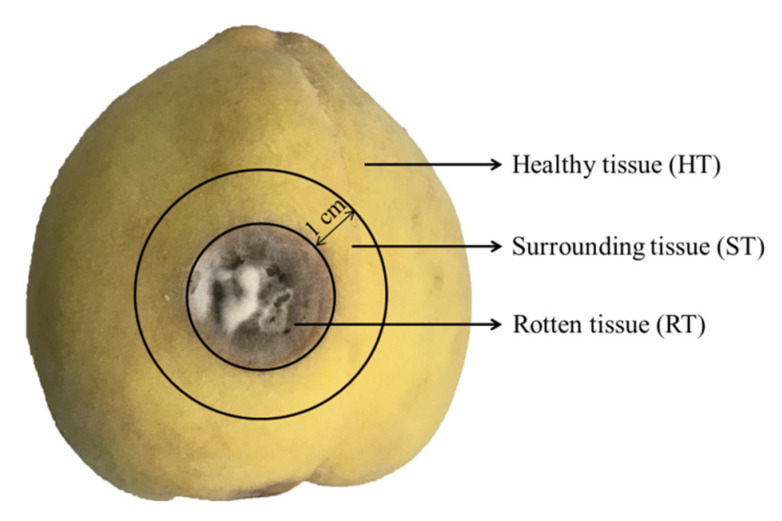
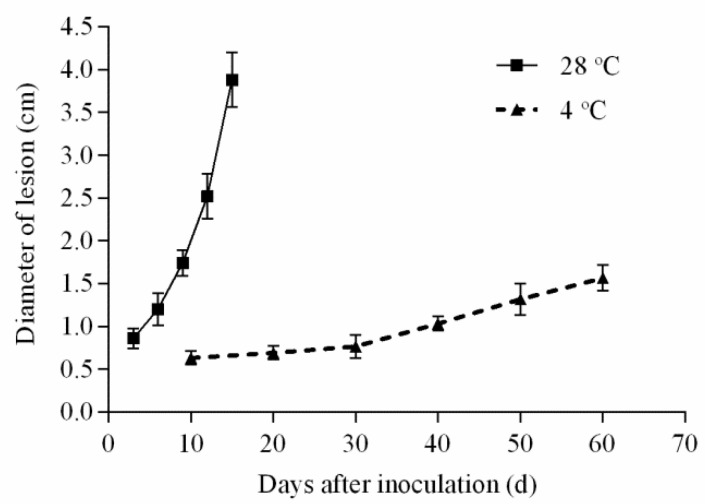
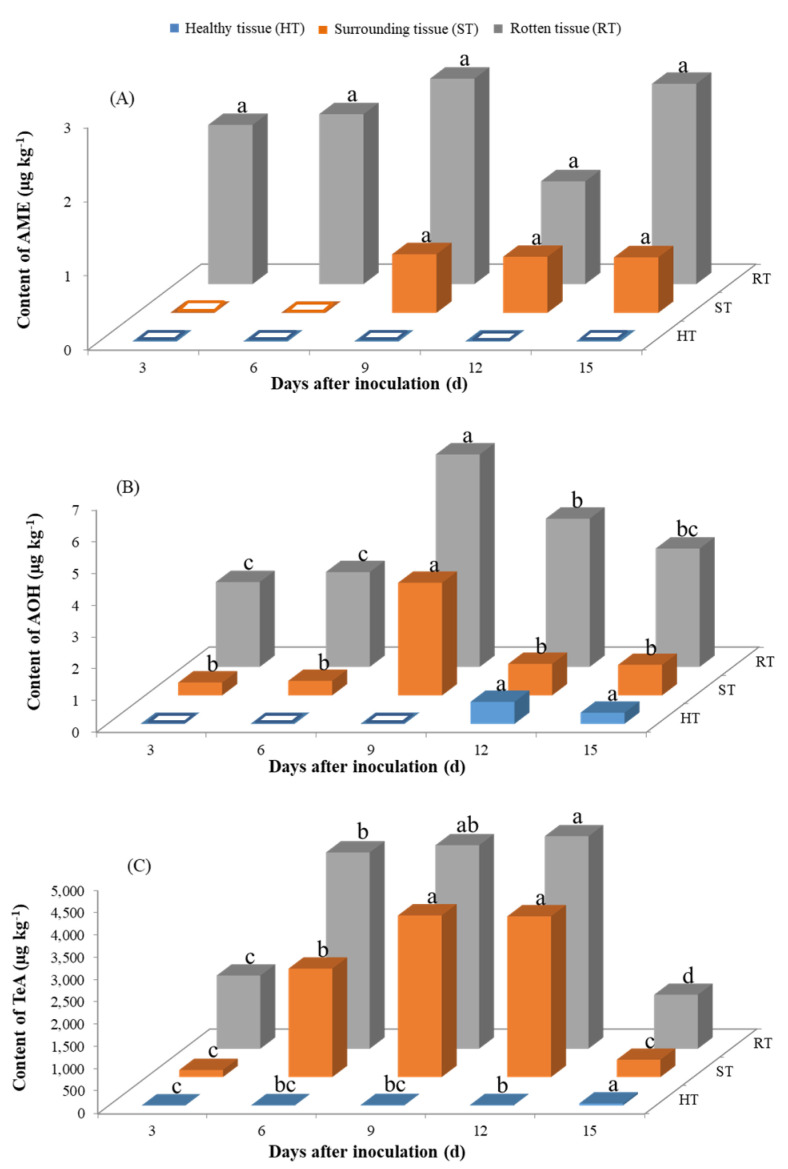
The yellow peach (), an important fruit in China, is highly susceptible to infection by sp., leading to potential health risks and economic losses. In the current study, firstly, yellow peaches were artificially inoculated with . Then, the fruits were stored at 4 °C and 28 °C to simulate the current storage conditions that consumers use, and the toxins (ATs) contents from different parts of the fruits were analyzed via ultra-high-performance liquid chromatography-tandem mass spectrometry (UHPLC-MS/MS). The results showed that the growth of . and the ATs production were dramatically affected by the storage temperature. At 28 °C, the fungi grew rapidly and the lesion diameter reached about 4.0 cm within 15 days of inoculation, while, at 4 °C, the fungal growth was noticeably inhibited, with no significant change in the lesion diameter. To our surprise, high contents of ATs were produced under both storage conditions even though the fungal growth was suppressed. With an increase in the incubation time, the amounts of ATs showed a steady tendency to increase in most cases. Remarkably, alternariol monomethyl ether (AME), alternariol (AOH), and tenuazonic acid (TeA) were detected in the rotten tissue and also in the surrounding tissue, while a large amount of TeA could also be found in the healthy tissue. To the best of our knowledge, this is the first report regarding the production of ATs by the infection of sp. in yellow peach fruits via artificial inoculation under regulated conditions, and, based on the evidence herein, it is recommended that ATs be included in monitoring and control programs of yellow peach management and food safety administration.
黄桃()是中国重要的水果之一,极易感染交链孢菌(),从而对人体健康造成潜在威胁,并导致巨大的经济损失。在本研究中,首先,人工接种交链孢菌()于黄桃果实。然后,将果实分别置于 4°C 和 28°C 下贮藏,以模拟消费者常用的贮藏条件,利用超高效液相色谱-串联质谱法(UHPLC-MS/MS)分析果实不同部位的交链孢菌毒素(ATs)含量。结果表明,贮藏温度显著影响交链孢菌的生长和 ATs 的产生。在 28°C 下,真菌迅速生长,接种后 15 天,病斑直径约为 4.0cm;而在 4°C 下,真菌生长明显受到抑制,病斑直径无明显变化。更令人惊讶的是,尽管真菌生长受到抑制,但在两种贮藏条件下均产生了高含量的 ATs。随着培养时间的延长,在大多数情况下,ATs 的含量呈稳定增加趋势。值得注意的是,AME、AOH 和 TeA 在腐烂组织和周围组织中均有检出,而大量的 TeA 也存在于健康组织中。据我们所知,这是首次在受控条件下通过人工接种黄桃果实感染交链孢菌()产生 ATs 的报道,根据本研究结果,建议将 ATs 纳入黄桃管理和食品安全管理的监测和控制计划中。