Food Quality and Microbiology, School of Agricultural Engineering, University of Extremadura, Avda. de Adolfo Suárez, s/n, 06007 Badajoz, Spain.
University Institute for Research in Agri-Food Resources (INURA), University of Extremadura, Avda. de la Investigación, s/n, 06006 Badajoz, Spain.
Toxins (Basel). 2021 Sep 17;13(9):663. doi: 10.3390/toxins13090663.
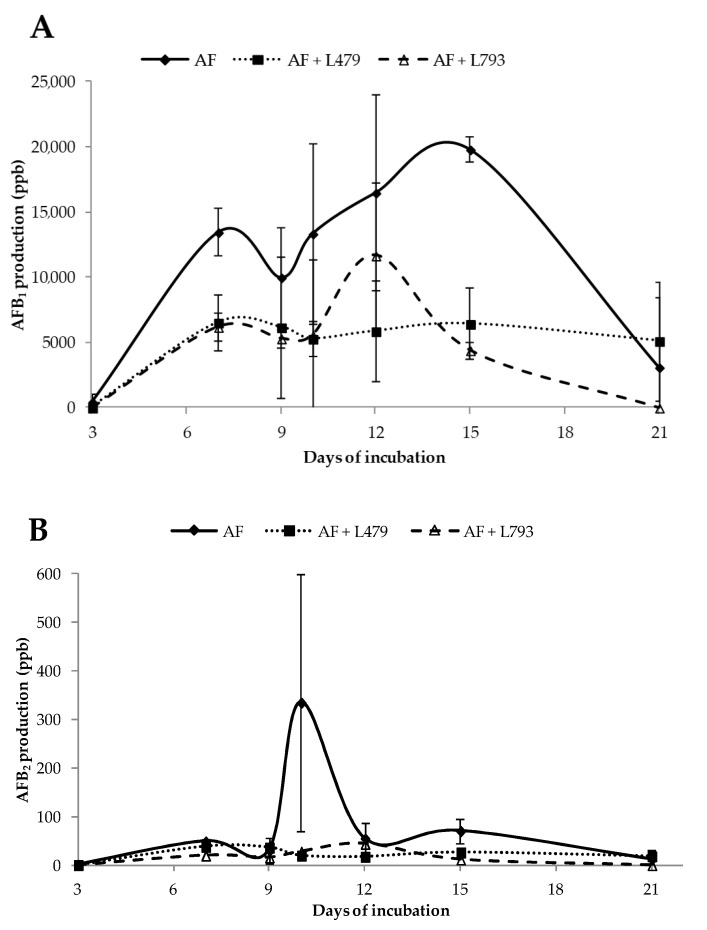
is a toxigenic fungal colonizer of fruits and cereals and may produce one of the most important mycotoxins from a food safety perspective, aflatoxins. Therefore, its growth and mycotoxin production should be effectively avoided to protect consumers' health. Among the safe and green antifungal strategies that can be applied in the field, biocontrol is a recent and emerging strategy that needs to be explored. Yeasts are normally good biocontrol candidates to minimize mold-related hazards and their modes of action are numerous, one of them being the production of volatile organic compounds (VOCs). To this end, the influence of VOCs produced by L479 and L793 on growth, expression of the regulatory gene of the aflatoxin pathway ( and mycotoxin production by for 21 days was assessed. The results showed that both yeasts, despite producing different kinds of VOCs, had a similar effect on inhibiting growth, mycotoxin biosynthetic gene expression and phenotypic toxin production overall at the mid-incubation period when their synthesis was the greatest. Based on the results, both yeast strains, L479 and L793, are potentially suitable as a biopreservative agents for inhibiting the growth of and reducing aflatoxin accumulation.
是一种能产生毒素的真菌,它能在水果和谷物上生长,并可能产生一种最重要的真菌毒素,即黄曲霉毒素。因此,为了保护消费者的健康,应该有效避免其生长和产生真菌毒素。在可应用于实际生产的安全且环保的抗真菌策略中,生物防治是一种新兴策略,需要进一步探索。酵母通常是很好的生物防治候选物,可以最大限度地减少与霉菌有关的危害,并且其作用模式多种多样,其中之一是产生挥发性有机化合物(VOC)。为此,研究了 L479 和 L793 产生的 VOC 对 生长、黄曲霉毒素途径调控基因( )表达和真菌毒素产生的影响,为期 21 天。结果表明,尽管这两种酵母产生的 VOC 种类不同,但在中期培养时,当它们的合成达到最大时,两种酵母都能以相似的方式抑制生长、抑制真菌毒素生物合成基因的表达和表型毒素的产生。基于这些结果,L479 和 L793 这两种酵母菌株都有可能被用作生物防腐剂,以抑制 的生长并减少黄曲霉毒素的积累。