Brunyé Tad T, Yau Kenny, Okano Kana, Elliott Grace, Olenich Sara, Giles Grace E, Navarro Ester, Elkin-Frankston Seth, Young Alexander L, Miller Eric L
Cognitive Science Team, US Army DEVCOM Soldier Center, Natick, MA, United States.
Center for Applied Brain and Cognitive Sciences, Tufts University, Medford, MA, United States.
Front Physiol. 2021 Sep 9;12:738973. doi: 10.3389/fphys.2021.738973. eCollection 2021.
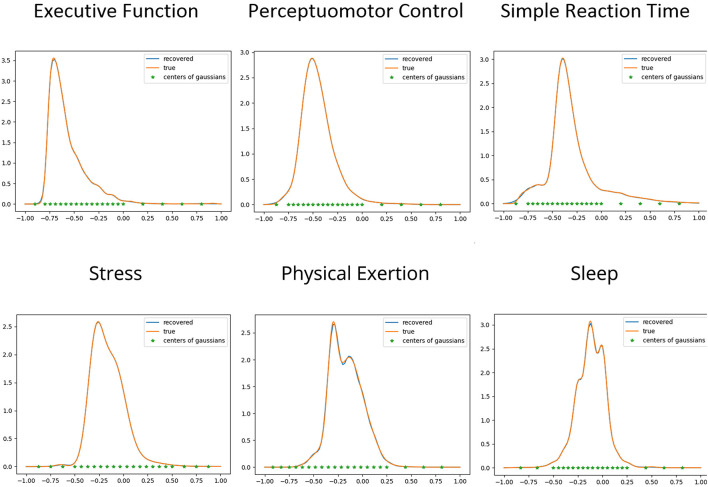
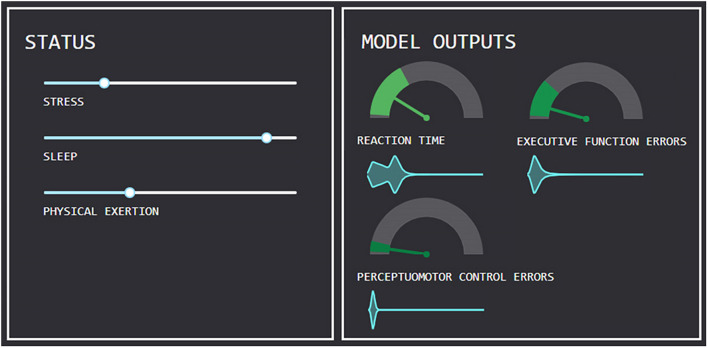
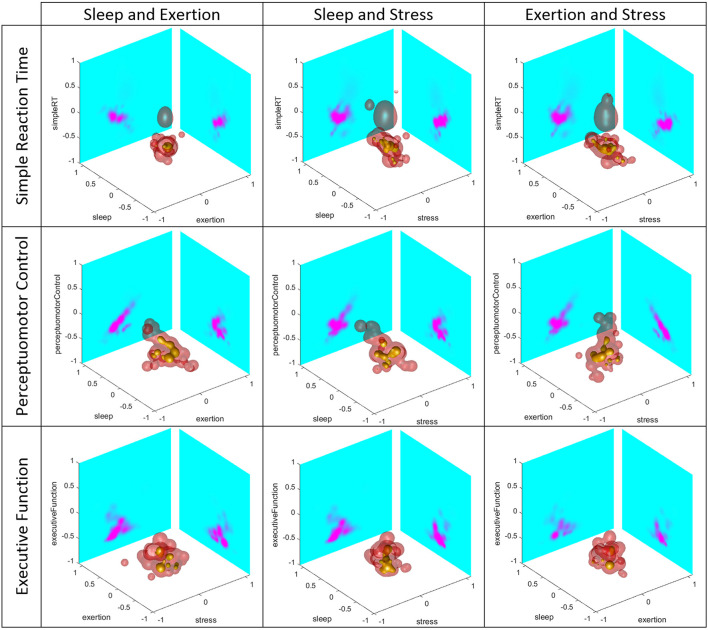
Wearable technologies for measuring digital and chemical physiology are pervading the consumer market and hold potential to reliably classify states of relevance to human performance including stress, sleep deprivation, and physical exertion. The ability to efficiently and accurately classify physiological states based on wearable devices is improving. However, the inherent variability of human behavior within and across individuals makes it challenging to predict how identified states influence human performance outcomes of relevance to military operations and other high-stakes domains. We describe a computational modeling approach to address this challenge, seeking to translate user states obtained from a variety of sources including wearable devices into relevant and actionable insights across the cognitive and physical domains. Three status predictors were considered: stress level, sleep status, and extent of physical exertion; these independent variables were used to predict three human performance outcomes: reaction time, executive function, and perceptuo-motor control. The approach provides a complete, conditional probabilistic model of the performance variables given the status predictors. Construction of the model leverages diverse raw data sources to estimate marginal probability density functions for each of six independent and dependent variables of interest using parametric modeling and maximum likelihood estimation. The joint distributions among variables were optimized using an adaptive LASSO approach based on the strength and directionality of conditional relationships (effect sizes) derived from meta-analyses of extant research. The model optimization process converged on solutions that maintain the integrity of the original marginal distributions and the directionality and robustness of conditional relationships. The modeling framework described provides a flexible and extensible solution for human performance prediction, affording efficient expansion with additional independent and dependent variables of interest, ingestion of new raw data, and extension to two- and three-way interactions among independent variables. Continuing work includes model expansion to multiple independent and dependent variables, real-time model stimulation by wearable devices, individualized and small-group prediction, and laboratory and field validation.
用于测量数字和化学生理状态的可穿戴技术正在渗透消费市场,并具有可靠地分类与人类表现相关状态的潜力,这些状态包括压力、睡眠不足和体力消耗。基于可穿戴设备有效且准确地分类生理状态的能力正在提高。然而,个体内部和个体之间人类行为的固有变异性使得预测已识别的状态如何影响与军事行动和其他高风险领域相关的人类表现结果具有挑战性。我们描述了一种计算建模方法来应对这一挑战,旨在将从包括可穿戴设备在内的各种来源获得的用户状态转化为跨认知和身体领域的相关且可操作的见解。考虑了三个状态预测指标:压力水平、睡眠状态和体力消耗程度;这些自变量被用于预测三个人类表现结果:反应时间、执行功能和感知运动控制。该方法提供了一个给定状态预测指标的性能变量的完整条件概率模型。模型的构建利用各种原始数据源,使用参数建模和最大似然估计来估计六个感兴趣的独立和因变量各自的边际概率密度函数。基于现有研究的荟萃分析得出的条件关系(效应大小)的强度和方向性,使用自适应套索方法优化变量之间的联合分布。模型优化过程收敛于保持原始边际分布的完整性以及条件关系的方向性和稳健性的解决方案。所描述的建模框架为人类表现预测提供了一个灵活且可扩展的解决方案,能够通过添加感兴趣的其他独立和因变量、摄取新的原始数据以及扩展到自变量之间的双向和三向交互来进行有效扩展。持续的工作包括将模型扩展到多个独立和因变量、通过可穿戴设备进行实时模型刺激、个性化和小组预测以及实验室和现场验证。