Lanzio Vittorino, Telian Gregory, Koshelev Alexander, Micheletti Paolo, Presti Gianni, D'Arpa Elisa, De Martino Paolo, Lorenzon Monica, Denes Peter, West Melanie, Sassolini Simone, Dhuey Scott, Adesnik Hillel, Cabrini Stefano
The Molecular Foundry, Lawrence Berkeley National Laboratory, Berkeley, CA 94720 USA.
Department of Applied Science and Technology, Politecnico di Torino, Torino, 10129 Italy.
Microsyst Nanoeng. 2021 May 26;7:40. doi: 10.1038/s41378-021-00263-0. eCollection 2021.
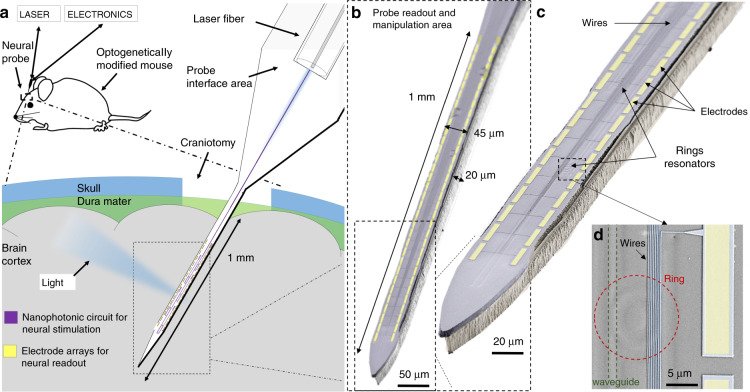
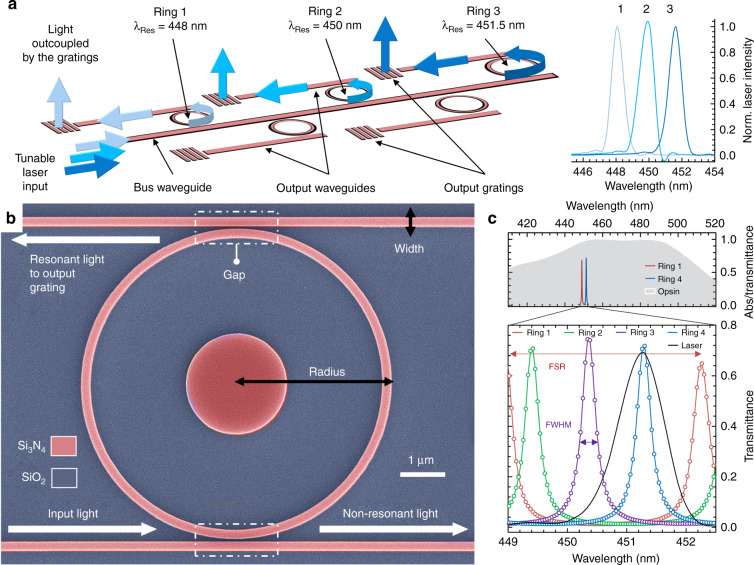
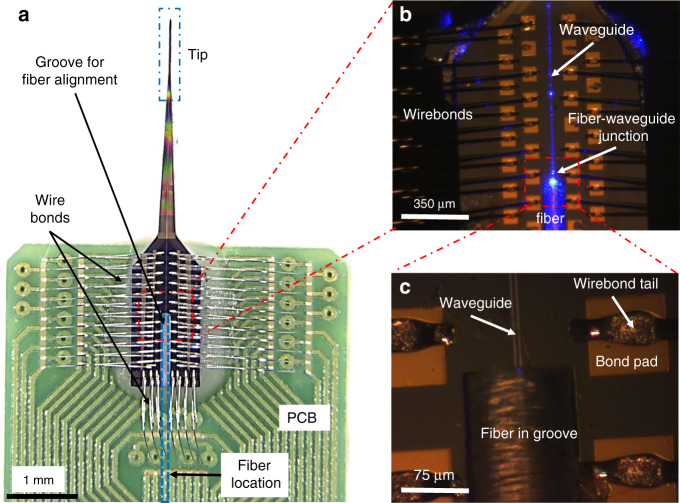
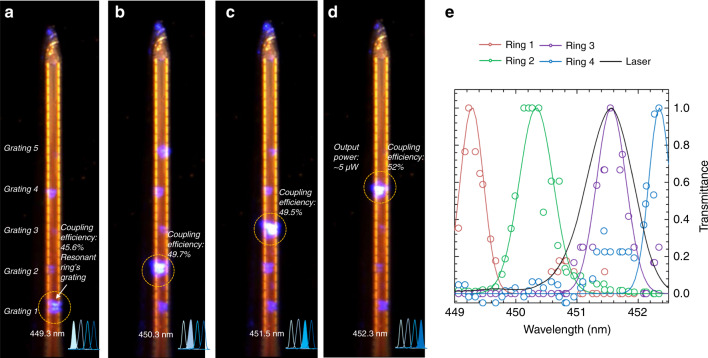
The combination of electrophysiology and optogenetics enables the exploration of how the brain operates down to a single neuron and its network activity. Neural probes are in vivo invasive devices that integrate sensors and stimulation sites to record and manipulate neuronal activity with high spatiotemporal resolution. State-of-the-art probes are limited by tradeoffs involving their lateral dimension, number of sensors, and ability to access independent stimulation sites. Here, we realize a highly scalable probe that features three-dimensional integration of small-footprint arrays of sensors and nanophotonic circuits to scale the density of sensors per cross-section by one order of magnitude with respect to state-of-the-art devices. For the first time, we overcome the spatial limit of the nanophotonic circuit by coupling only one waveguide to numerous optical ring resonators as passive nanophotonic switches. With this strategy, we achieve accurate on-demand light localization while avoiding spatially demanding bundles of waveguides and demonstrate the feasibility with a proof-of-concept device and its scalability towards high-resolution and low-damage neural optoelectrodes.
电生理学与光遗传学的结合使得人们能够深入探究大脑如何运作,直至单个神经元及其网络活动。神经探针是一种体内侵入性设备,它集成了传感器和刺激位点,能够以高时空分辨率记录和操纵神经元活动。目前的先进探针受到多种权衡因素的限制,包括其横向尺寸、传感器数量以及访问独立刺激位点的能力。在此,我们实现了一种高度可扩展的探针,其特点是将小尺寸传感器阵列和纳米光子电路进行三维集成,相对于现有技术设备,将每个横截面的传感器密度提高了一个数量级。我们首次通过仅将一个波导与众多光学环形谐振器耦合作为无源纳米光子开关,克服了纳米光子电路的空间限制。通过这种策略,我们实现了精确的按需光定位,同时避免了对空间要求较高的波导束,并通过一个概念验证设备证明了其可行性以及向高分辨率和低损伤神经光电极发展的可扩展性。