Hu Lei, Zhou Da Wei, Fu Cai Xia, Benkert Thomas, Xiao Yun Feng, Wei Li Ming, Zhao Jun Gong
Department of Diagnostic and Interventional Radiology, Shanghai Jiao Tong University Affiliated Sixth People's Hospital, Shanghai, China.
State Key Laboratory of Integrated Services Networks, School of Telecommunications Engineering, Xidian University, Xi'an, China.
Front Oncol. 2021 Sep 9;11:697721. doi: 10.3389/fonc.2021.697721. eCollection 2021.
Apparent diffusion coefficients (ADCs) obtained with diffusion-weighted imaging (DWI) are highly valuable for the detection and staging of prostate cancer and for assessing the response to treatment. However, DWI suffers from significant anatomic distortions and susceptibility artifacts, resulting in reduced accuracy and reproducibility of the ADC calculations. The current methods for improving the DWI quality are heavily dependent on software, hardware, and additional scan time. Therefore, their clinical application is limited. An accelerated ADC generation method that maintains calculation accuracy and repeatability without heavy dependence on magnetic resonance imaging scanners is of great clinical value.
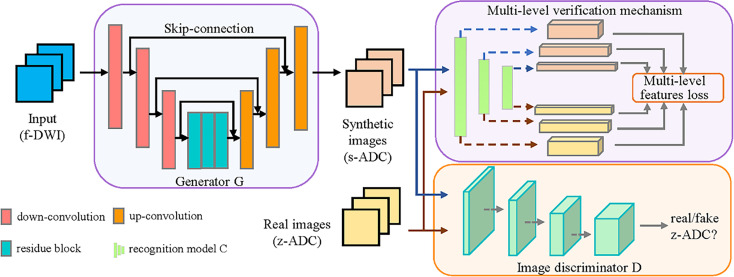
We aimed to establish and evaluate a supervised learning framework for synthesizing ADC images using generative adversarial networks.
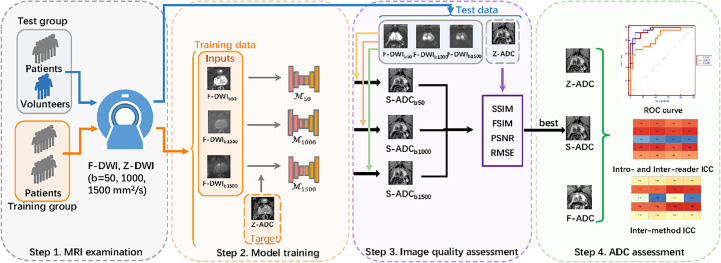
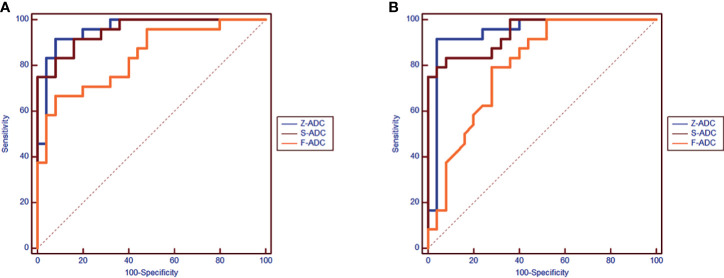
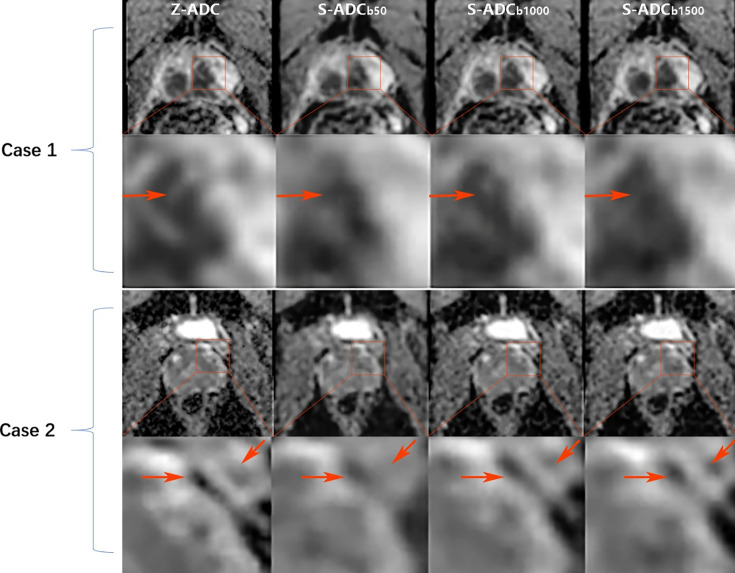
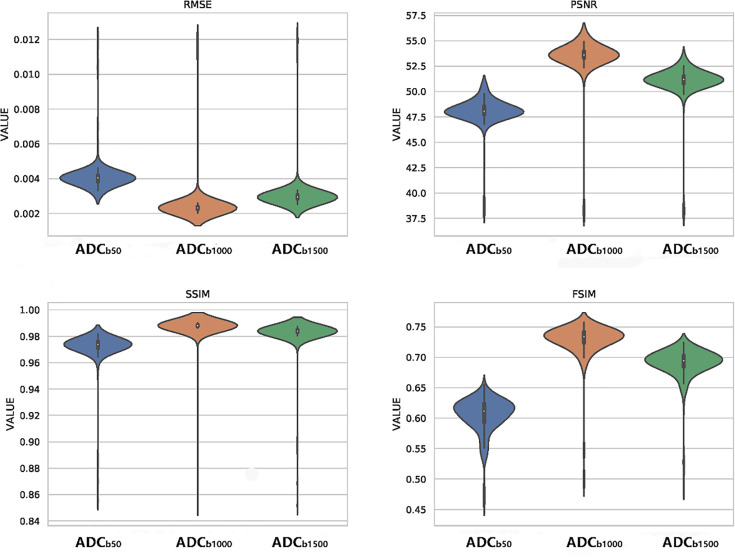
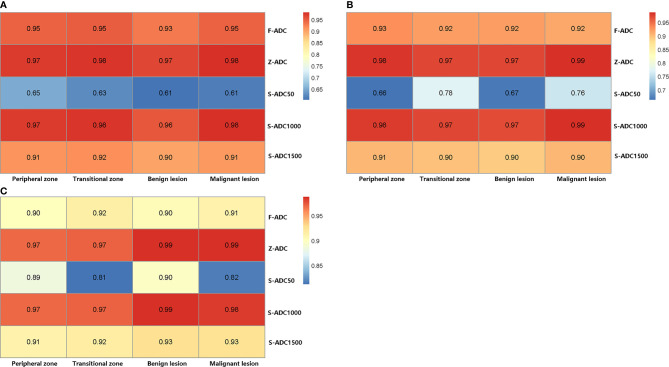
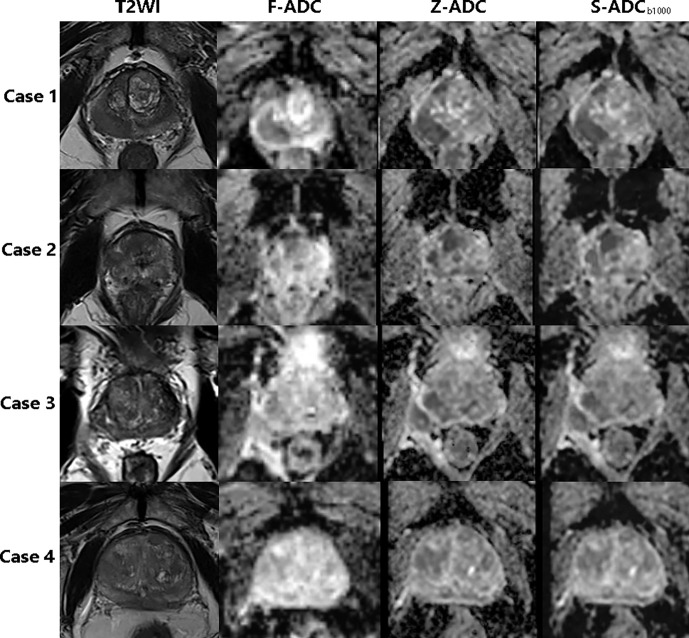
This prospective study included 200 patients with suspected prostate cancer (training set: 150 patients; test set #1: 50 patients) and 10 healthy volunteers (test set #2) who underwent both full field-of-view (FOV) diffusion-weighted imaging (f-DWI) and zoomed-FOV DWI (z-DWI) with -values of 50, 1,000, and 1,500 s/mm. ADC values based on f-DWI and z-DWI (f-ADC and z-ADC) were calculated. Herein we propose an ADC synthesis method based on generative adversarial networks that uses f-DWI with a single -value to generate synthesized ADC (s-ADC) values using z-ADC as a reference. The image quality of the s-ADC sets was evaluated using the peak signal-to-noise ratio (PSNR), root mean squared error (RMSE), structural similarity (SSIM), and feature similarity (FSIM). The distortions of each ADC set were evaluated using the T2-weighted image reference. The calculation reproducibility of the different ADC sets was compared using the intraclass correlation coefficient. The tumor detection and classification abilities of each ADC set were evaluated using a receiver operating characteristic curve analysis and a Spearman correlation coefficient.
The s-ADC had a significantly lower RMSE score and higher PSNR, SSIM, and FSIM scores than the s-ADC and s-ADC (all < 0.001). Both z-ADC and s-ADC had less distortion and better quantitative ADC value reproducibility for all the evaluated tissues, and they demonstrated better tumor detection and classification performance than f-ADC.
The deep learning algorithm might be a feasible method for generating ADC maps, as an alternative to z-ADC maps, without depending on hardware systems and additional scan time requirements.
扩散加权成像(DWI)获得的表观扩散系数(ADC)对于前列腺癌的检测、分期以及评估治疗反应具有很高的价值。然而,DWI存在明显的解剖结构扭曲和敏感性伪影,导致ADC计算的准确性和可重复性降低。目前改善DWI质量的方法严重依赖软件、硬件和额外的扫描时间。因此,它们的临床应用受到限制。一种在不严重依赖磁共振成像扫描仪的情况下保持计算准确性和可重复性的加速ADC生成方法具有重要的临床价值。
我们旨在建立并评估一种使用生成对抗网络合成ADC图像的监督学习框架。
这项前瞻性研究纳入了200例疑似前列腺癌患者(训练集:150例患者;测试集1:50例患者)和10名健康志愿者(测试集2),他们均接受了全视野(FOV)扩散加权成像(f-DWI)和缩小视野DWI(z-DWI),b值分别为50、1000和1500 s/mm²。计算基于f-DWI和z-DWI的ADC值(f-ADC和z-ADC)。在此,我们提出一种基于生成对抗网络的ADC合成方法,该方法使用具有单个b值的f-DWI,以z-ADC为参考生成合成ADC(s-ADC)值。使用峰值信噪比(PSNR)、均方根误差(RMSE)、结构相似性(SSIM)和特征相似性(FSIM)评估s-ADC集的图像质量。使用T2加权图像参考评估每个ADC集的扭曲情况。使用组内相关系数比较不同ADC集的计算可重复性。使用受试者工作特征曲线分析和Spearman相关系数评估每个ADC集的肿瘤检测和分类能力。
与f-ADC和z-ADC相比,s-ADC的RMSE得分显著更低,PSNR、SSIM和FSIM得分更高(均P<0.001)。对于所有评估组织,z-ADC和s-ADC的扭曲均更少,定量ADC值的可重复性更好,并且它们在肿瘤检测和分类性能方面均优于f-ADC。
深度学习算法可能是生成ADC图的一种可行方法,可作为z-ADC图的替代方法,且不依赖硬件系统和额外的扫描时间要求。