Zhang Yuyuan, Liu Zaoqu, Li Xin, Liu Long, Wang Libo, Han Xinwei, Li Zhen
Department of Interventional Radiology, The First Affiliated Hospital of Zhengzhou University, Zhengzhou, China.
Interventional Institute of Zhengzhou University, Zhengzhou, China.
Front Oncol. 2021 Sep 9;11:732447. doi: 10.3389/fonc.2021.732447. eCollection 2021.
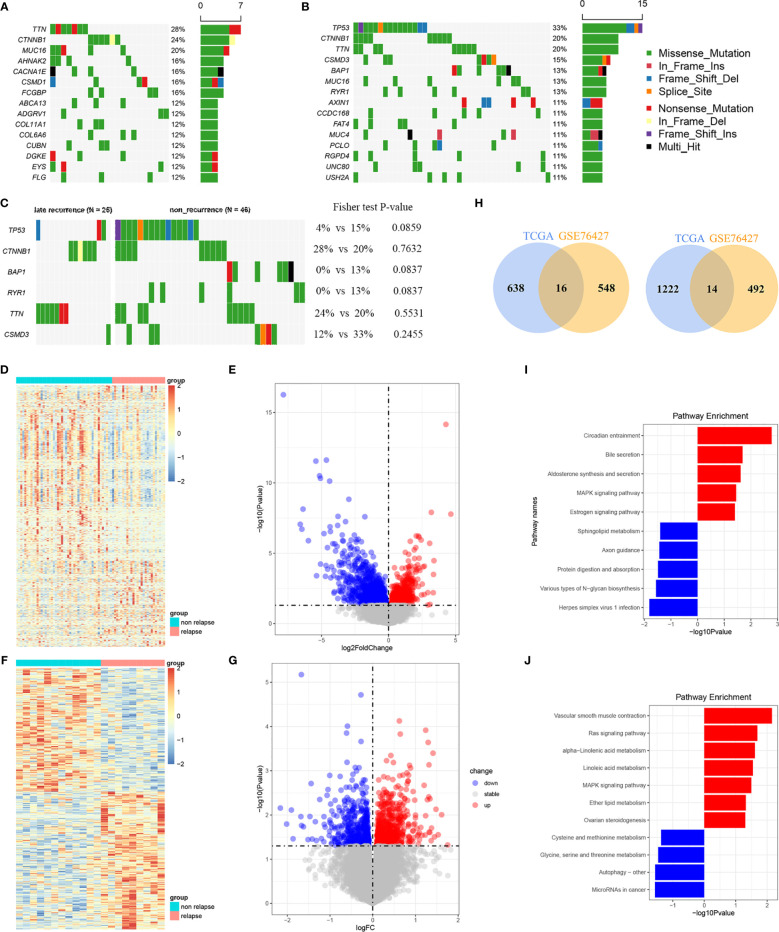
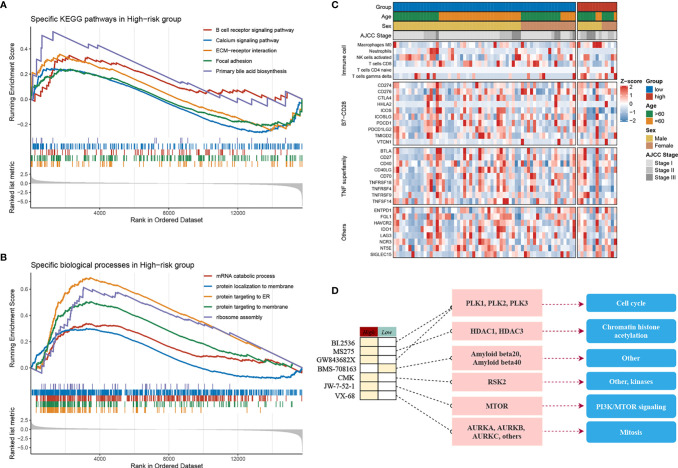
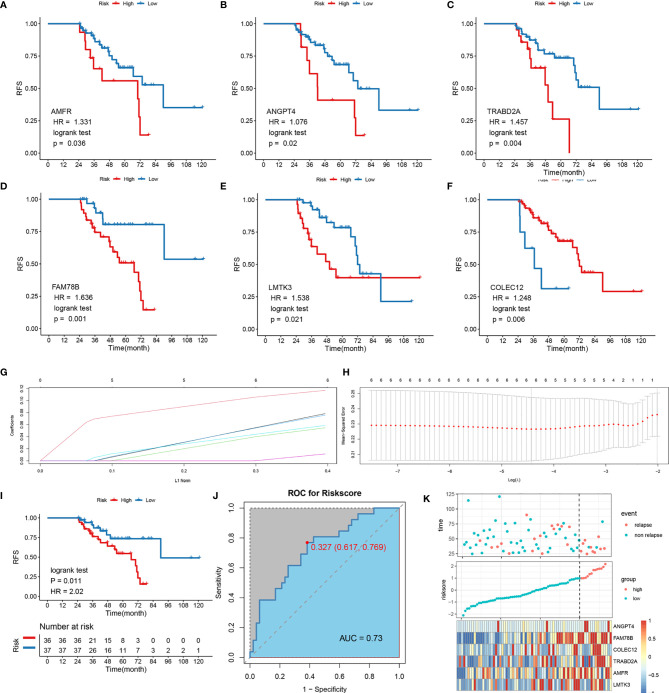
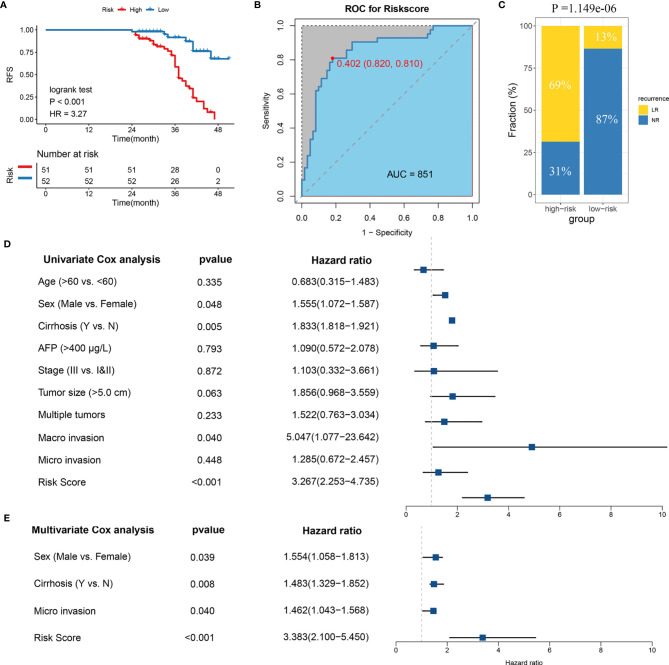
A larger number of patients with stages I-III hepatocellular carcinoma (HCC) experience late recurrence (LR) after surgery. We sought to develop a novel tool to stratify patients with different LR risk for tailoring decision-making for postoperative recurrence surveillance and therapy modalities. We retrospectively enrolled two independent public cohorts and 103 HCC tissues. Using LASSO logical analysis, a six-gene model was developed in the The Cancer Genome Atlas liver hepatocellular carcinoma (TCGA-LIHC) and independently validated in GSE76427. Further experimental validation using qRT-PCR assays was performed to ensure the robustness and clinical feasible of this signature. We developed a novel LR-related signature consisting of six genes. This signature was validated to be significantly associated with dismal recurrence-free survival in three cohorts TCGA-LIHC, GSE76427, and qPCR assays [HR: 2.007 (1.200-3.357), = 0.008; HR: 2.171 (1.068, 4.412), -value = 0.032; HR: 3.383 (2.100, 5.450), -value <0.001]. More importantly, this signature displayed robust discrimination in predicting the LR risk, with AUCs being 0.73 (TCGA-LIHC), 0.93 (GSE76427), and 0.85 (in-house cohort). Furthermore, we deciphered the specific landscape of molecular alterations among patients in nonrecurrence (NR) and LR group to analyze the mechanism contributing to LR. For high-risk group, we also identified several potential drugs with specific sensitivity to high- and low-risk groups, which is vital to improve prognosis of LR-HCC after surgery. We discovered and experimentally validated a novel gene signature with powerful performance for identifying patients at high LR risk in stages I-III HCC.
大量I-III期肝细胞癌(HCC)患者术后会出现晚期复发(LR)。我们试图开发一种新工具,对具有不同LR风险的患者进行分层,以便为术后复发监测和治疗方式制定决策提供依据。我们回顾性纳入了两个独立的公共队列和103例HCC组织样本。使用LASSO逻辑分析,在癌症基因组图谱肝细胞癌(TCGA-LIHC)中开发了一个六基因模型,并在GSE76427中进行了独立验证。使用qRT-PCR检测进行了进一步的实验验证,以确保该特征的稳健性和临床可行性。我们开发了一种由六个基因组成的与LR相关的新特征。在TCGA-LIHC、GSE76427和qPCR检测这三个队列中,该特征被验证与无复发生存期不佳显著相关[风险比(HR):2.007(1.200-至3.357),P = 0.008;HR:2.171(1.068,4.412),P值 = 0.032;HR:3.383(2.100,5.450),P值<0.001]。更重要的是,该特征在预测LR风险方面表现出强大的区分能力,在TCGA-LIHC队列中的曲线下面积(AUC)为0.73,在GSE76427队列中为0.93,在内部队列中为0.85。此外,我们解析了非复发(NR)组和LR组患者分子改变的具体情况,以分析导致LR的机制。对于高危组,我们还确定了几种对高危和低危组具有特定敏感性的潜在药物,这对于改善I-III期HCC术后LR患者的预后至关重要。我们发现并通过实验验证了一种新的基因特征,该特征在识别I-III期HCC中高LR风险患者方面具有强大性能。