Chadaeva Irina, Ponomarenko Petr, Kozhemyakina Rimma, Suslov Valentin, Bogomolov Anton, Klimova Natalya, Shikhevich Svetlana, Savinkova Ludmila, Oshchepkov Dmitry, Kolchanov Nikolay A, Markel Arcady, Ponomarenko Mikhail
Institute of Cytology and Genetics, Siberian Branch of Russian Academy of Sciences, 630090 Novosibirsk, Russia.
Animals (Basel). 2021 Sep 10;11(9):2667. doi: 10.3390/ani11092667.
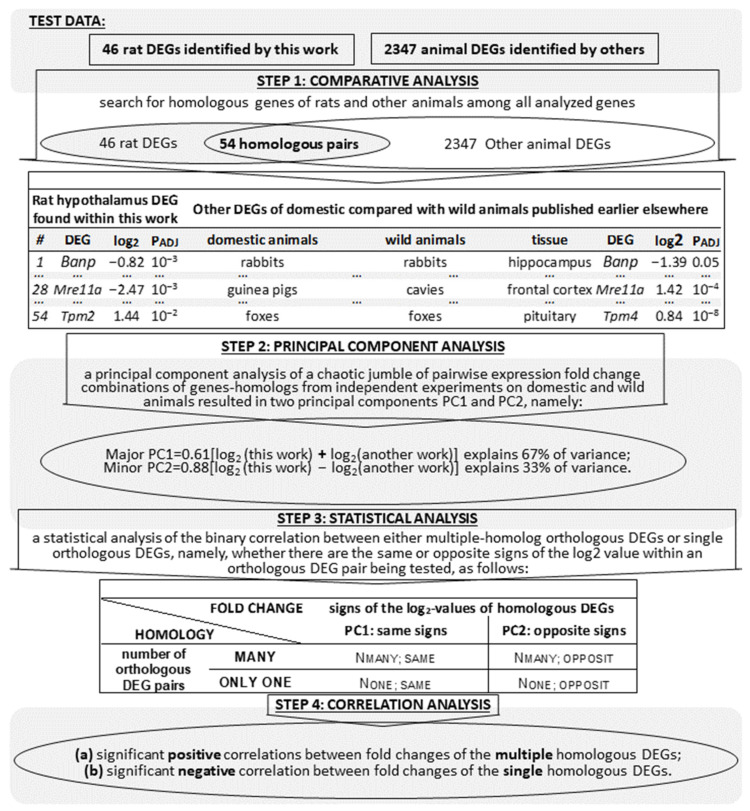
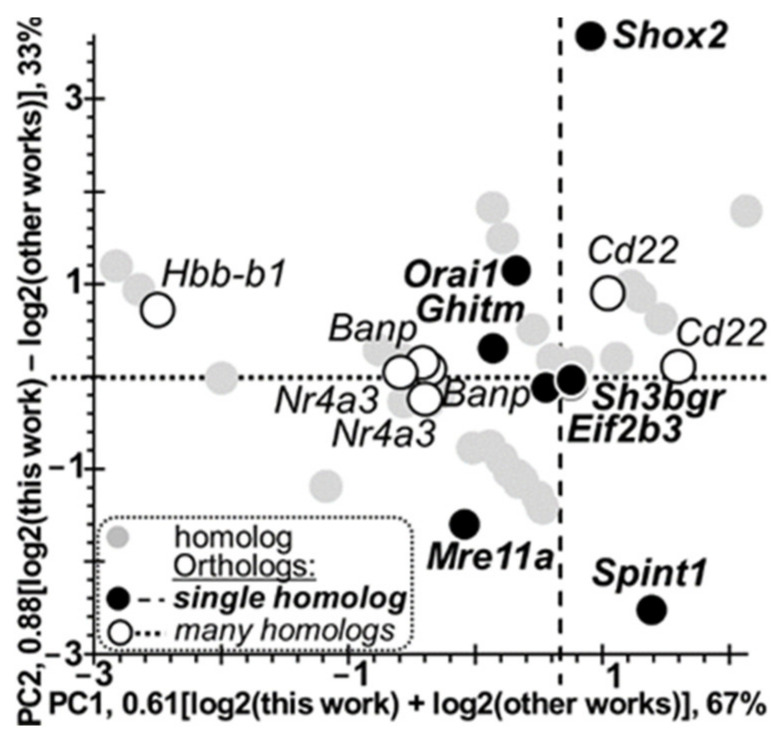
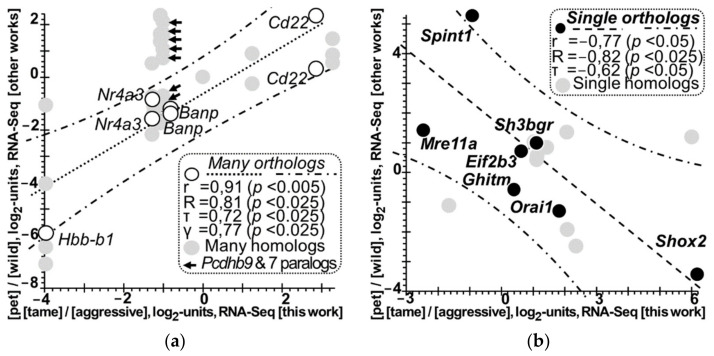
Belyaev's concept of destabilizing selection during domestication was a major achievement in the XX century. Its practical value has been realized in commercial colors of the domesticated fox that never occur in the wild and has been confirmed in a wide variety of pet breeds. Many human disease models involving animals allow to test drugs before human testing. Perhaps this is why investigators doing transcriptomic profiling of domestic versus wild animals have searched for breed-specific patterns. Here we sequenced hypothalamic transcriptomes of tame and aggressive rats, identified their differentially expressed genes (DEGs), and, for the first time, applied principal component analysis to compare them with all the known DEGs of domestic versus wild animals that we could find. Two principal components, PC1 and PC2, respectively explained 67% and 33% of differential-gene-expression variance (hereinafter: log value) between domestic and wild animals. PC1 corresponded to multiple orthologous DEGs supported by homologs; these DEGs kept the log value sign from species to species and from tissue to tissue (i.e., a common domestication pattern). PC2 represented stand-alone homologous DEG pairs reversing the log value sign from one species to another and from tissue to tissue (i.e., representing intraspecific and interspecific variation).
别利亚耶夫提出的驯化过程中不稳定选择的概念是20世纪的一项重大成就。其实际价值已在驯化狐狸的商业毛色中得以体现,这些毛色在野生狐狸中从未出现过,并且在各种各样的宠物品种中也得到了证实。许多涉及动物的人类疾病模型能够在人体试验之前对药物进行测试。也许这就是为什么对家养动物和野生动物进行转录组分析的研究人员一直在寻找品种特异性模式的原因。在这里,我们对温顺型和攻击型大鼠的下丘脑转录组进行了测序,鉴定了它们的差异表达基因(DEG),并首次应用主成分分析将它们与我们所能找到的所有已知家养动物和野生动物的DEG进行比较。两个主成分,即PC1和PC2,分别解释了家养动物和野生动物之间差异基因表达方差(以下简称:对数 值)的67%和33%。PC1对应于由同源物支持的多个直系同源DEG;这些DEG在不同物种和不同组织之间保持对数 值的符号一致(即一种共同的驯化模式)。PC2代表独立的同源DEG对,其对数 值符号在不同物种和不同组织之间发生反转(即代表种内和种间变异)。