Nami Babak, Ghanaeian Avrin, Black Corbin, Wang Zhixiang
Signal Transduction Research Group, Department of Medical Genetics, Faculty of Medicine and Dentistry, University of Alberta, Edmonton, AB T6G 2H7, Canada.
Department of Anatomy and Cell Biology, Faculty of Medicine and Health Sciences, McGill University, Montréal, QC H3A 0G7, Canada.
Life (Basel). 2021 Aug 24;11(9):868. doi: 10.3390/life11090868.
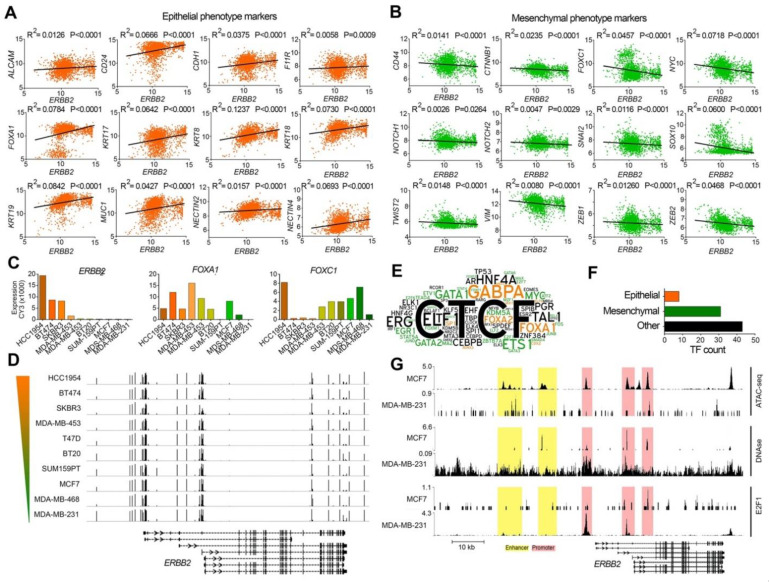
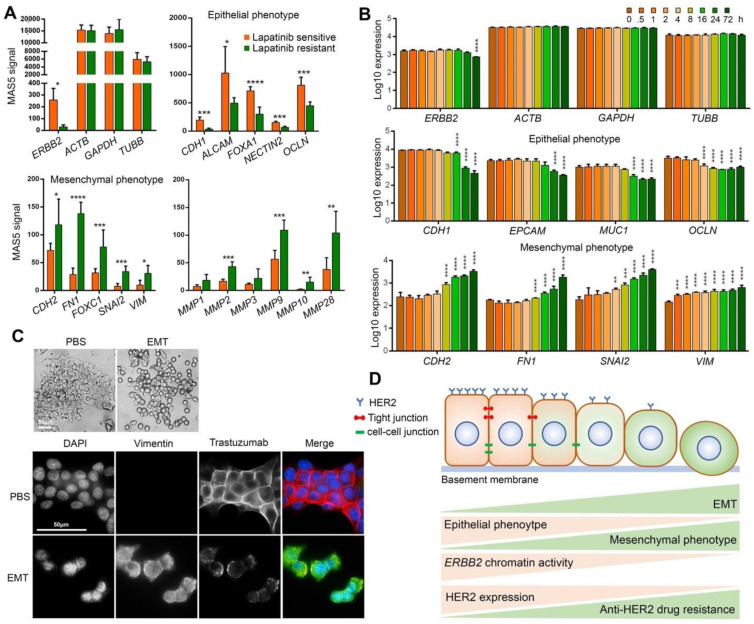
HER2 receptor tyrosine kinase (encoded by the ERBB2 gene) is overexpressed in approximately 25% of all breast cancer tumors (HER2-positive breast cancers). Resistance to HER2-targeting therapies is partially due to the loss of HER2 expression in tumor cells during treatment. However, little is known about the exact mechanism of HER2 downregulation in HER2-positive tumor cells. Here, by analyzing publicly available genomic data we investigate the hypothesis that epithelial-mesenchymal transition (EMT) abrogates HER2 expression by epigenetic silencing of the ERBB2 gene as a mechanism of acquired resistance to HER2-targeted therapies. As result, HER2 expression was found to be positively and negatively correlated with the expression of epithelial and mesenchymal phenotype marker genes, respectively. The ERBB2 chromatin of HER2-high epithelial-like breast cancer cells and HER2-low mesenchymal-like cells were found to be open/active and closed/inactive, respectively. Decreased HER2 expression was correlated with increased EMT phenotype, inactivated chromatin and lower response to lapatinib. We also found that induction of EMT in the HER2-positive breast cancer cell line BT474 resulted in downregulated HER2 expression and reduced trastuzumab binding. Our results suggest that ERBB2 gene silencing by epigenetic regulation during EMT may be a mechanism of de novo resistance of HER2-positive breast cancer cells to trastuzumab and lapatinib.
HER2受体酪氨酸激酶(由ERBB2基因编码)在所有乳腺癌肿瘤中约25%过表达(HER2阳性乳腺癌)。对HER2靶向治疗的耐药部分归因于治疗期间肿瘤细胞中HER2表达的丧失。然而,关于HER2阳性肿瘤细胞中HER2下调的确切机制知之甚少。在此,通过分析公开可用的基因组数据,我们研究了上皮-间质转化(EMT)通过ERBB2基因的表观遗传沉默消除HER2表达这一假说,将其作为对HER2靶向治疗获得性耐药的一种机制。结果发现,HER2表达分别与上皮和间质表型标记基因的表达呈正相关和负相关。HER2高表达的上皮样乳腺癌细胞和HER2低表达的间质样细胞的ERBB2染色质分别被发现为开放/活跃和封闭/不活跃。HER2表达降低与EMT表型增加、染色质失活和对拉帕替尼的反应降低相关。我们还发现,在HER2阳性乳腺癌细胞系BT474中诱导EMT导致HER2表达下调和曲妥珠单抗结合减少。我们的结果表明,EMT期间通过表观遗传调控使ERBB2基因沉默可能是HER2阳性乳腺癌细胞对曲妥珠单抗和拉帕替尼产生原发性耐药的一种机制。