School of Chemical Engineering, University of Birmingham, Edgbaston, Birmingham B15 2TT, UK.
Department of Chemical and Biological Engineering, The University of Sheffield, Sheffield S1 3JD, UK.
Molecules. 2021 Sep 13;26(18):5552. doi: 10.3390/molecules26185552.
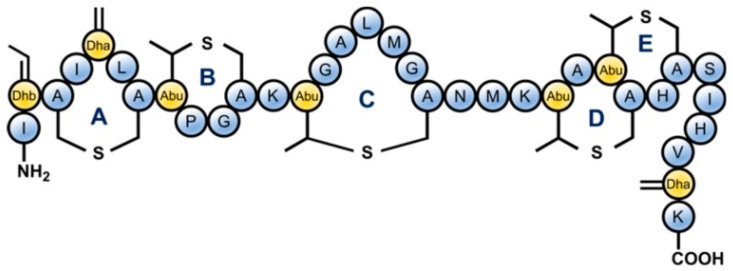
Conventional thermal and chemical treatments used in food preservation have come under scrutiny by consumers who demand minimally processed foods free from chemical agents but microbiologically safe. As a result, antimicrobial peptides (AMPs) such as bacteriocins and nisin that are ribosomally synthesised by bacteria, more prominently by the lactic acid bacteria (LAB) have appeared as a potent alternative due to their multiple biological activities. They represent a powerful strategy to prevent the development of spore-forming microorganisms in foods. Unlike thermal methods, they are natural without an adverse impact on food organoleptic and nutritional attributes. AMPs such as nisin and bacteriocins are generally effective in eliminating the vegetative forms of spore-forming bacteria compared to the more resilient spore forms. However, in combination with other non-thermal treatments, such as high pressure, supercritical carbon dioxide, electric pulses, a synergistic effect with AMPs such as nisin exists and has been proven to be effective in the inactivation of microbial spores through the disruption of the spore structure and prevention of spore outgrowth. The control of microbial spores in foods is essential in maintaining food safety and extension of shelf-life. Thus, exploration of the mechanisms of action of AMPs such as nisin is critical for their design and effective application in the food industry. This review harmonises information on the mechanisms of bacteria inactivation from published literature and the utilisation of AMPs in the control of microbial spores in food. It highlights future perspectives in research and application in food processing.
传统的食品保鲜热力和化学处理方法受到消费者的严格审查,他们要求食品经过最少的加工处理,不使用化学物质,但要在微生物学上是安全的。因此,抗菌肽(AMPs)如细菌素和乳链菌肽等由细菌,尤其是乳酸菌(LAB)通过核糖体合成,因其具有多种生物学活性而成为一种有效的替代品。它们代表了一种防止食品中形成孢子的微生物发展的有力策略。与热力方法不同,它们是天然的,不会对食品的感官和营养特性产生不利影响。与更具弹性的孢子形式相比,乳链菌肽和细菌素等 AMP 通常更有效地消除形成孢子的细菌的营养体形式。然而,与其他非热力处理方法(如高压、超临界二氧化碳、电脉冲)结合使用时,乳链菌肽等 AMP 会产生协同作用,并已被证明通过破坏孢子结构和防止孢子生长来有效灭活微生物孢子。控制食品中的微生物孢子对于确保食品安全和延长保质期至关重要。因此,探索乳链菌肽等 AMP 的作用机制对于它们在食品工业中的设计和有效应用至关重要。这篇综述综合了有关从已发表文献中细菌失活动力学信息和 AMP 在控制食品中微生物孢子方面的应用。它强调了未来在食品加工研究和应用方面的前景。