Department of Pharmaceutical Analysis and Medicinal Chemistry, Faculty of Pharmacy, Universitas Padjadjaran, Jl. Raya Bandung Sumedang KM 21.5, Sumedang 45363, Indonesia.
Drug Development Study Center, Faculty of Pharmacy, Universitas Padjadjaran, Jl. Raya Bandung Sumedang KM 21.5, Sumedang 45363, Indonesia.
Molecules. 2021 Sep 16;26(18):5612. doi: 10.3390/molecules26185612.
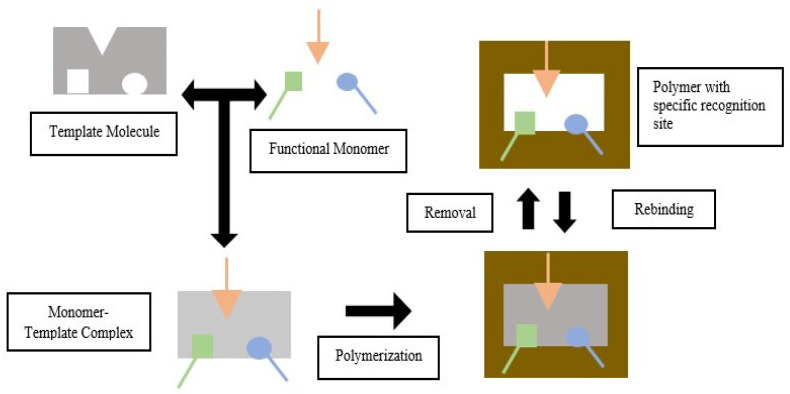
Molecular imprinting is a technique for creating artificial recognition sites on polymer matrices that complement the template in terms of size, shape, and spatial arrangement of functional groups. The main advantage of Molecularly Imprinted Polymers (MIP) as the polymer for use with a molecular imprinting technique is that they have high selectivity and affinity for the target molecules used in the molding process. The components of a Molecularly Imprinted Polymer are template, functional monomer, cross-linker, solvent, and initiator. Many things determine the success of a Molecularly Imprinted Polymer, but the Molecularly Imprinted Polymer component and the interaction between template-monomers are the most critical factors. This review will discuss how to find the interaction between template and monomer in Molecularly Imprinted Polymer before polymerization and after polymerization and choose the suitable component for MIP development. Computer simulation, UV-Vis spectroscopy, Fourier Transform Infrared Spectroscopy (FTIR), Proton-Nuclear Magnetic Resonance (H-NMR) are generally used to determine the type and strength of intermolecular interaction on pre-polymerization stage. In turn, Suspended State Saturation Transfer Difference High Resolution/Magic Angle Spinning (STD HR/MAS) NMR, Raman Spectroscopy, and Surface-Enhanced Raman Scattering (SERS) and Fluorescence Spectroscopy are used to detect chemical interaction after polymerization. Hydrogen bonding is the type of interaction that is becoming a focus to find on all methods as this interaction strongly contributes to the affinity of molecularly imprinted polymers (MIPs).
分子印迹是一种在聚合物基质上创建人工识别位点的技术,这些识别位点在大小、形状和功能基团的空间排列方面与模板互补。作为用于分子印迹技术的聚合物,分子印迹聚合物(MIP)的主要优势在于它们对模塑过程中使用的目标分子具有高选择性和亲和力。分子印迹聚合物的组成部分有模板、功能单体、交联剂、溶剂和引发剂。许多因素决定了分子印迹聚合物的成功,但分子印迹聚合物的组成部分和模板-单体之间的相互作用是最关键的因素。这篇综述将讨论如何在聚合前和聚合后找到分子印迹聚合物中模板和单体之间的相互作用,并选择合适的 MIP 开发组件。计算机模拟、紫外-可见光谱、傅里叶变换红外光谱(FTIR)、质子-核磁共振(H-NMR)通常用于确定预聚合阶段分子间相互作用的类型和强度。反过来,悬浮态饱和转移差异高分辨率/魔角旋转(STD HR/MAS)NMR、拉曼光谱、表面增强拉曼散射(SERS)和荧光光谱用于检测聚合后的化学相互作用。氢键是一种相互作用类型,它正成为所有方法的研究重点,因为这种相互作用对分子印迹聚合物(MIPs)的亲和力有很大贡献。