Frank H. Netter MD School of Medicine, Quinnipiac University, Hamden, CT 06518, USA.
Yale School of Public Health, Yale University, New Haven, CT 06510, USA.
Nutrients. 2021 Sep 18;13(9):3265. doi: 10.3390/nu13093265.
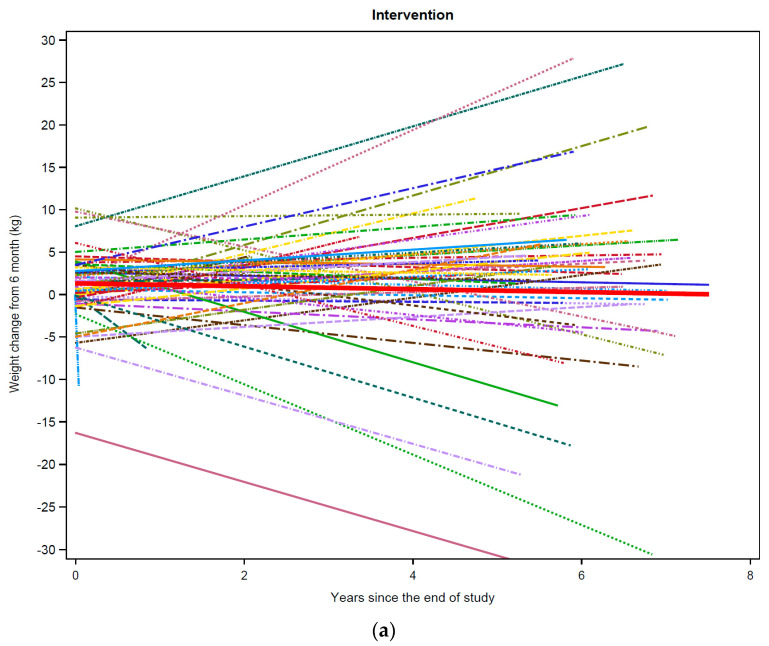
Lifestyle interventions among breast cancer survivors with obesity have demonstrated successful short-term weight loss, but data on long-term weight maintenance are limited. We evaluated long-term weight loss maintenance in 100 breast cancer survivors with overweight/obesity in the efficacious six-month Lifestyle, Exercise, and Nutrition (LEAN) Study (intervention = 67; usual care = 33). Measured baseline and six-month weights were available for 92 women. Long-term weight data were obtained from electronic health records. We assessed weight trajectories between study completion (2012-2013) and July 2019 using growth curve analyses. Over up to eight years (mean = 5.9, SD = 1.9) of post-intervention follow-up, both the intervention ( = 60) and usual care ( = 32) groups declined in body weight. Controlling for body weight at study completion, the yearly weight loss rate in the intervention and usual care groups was -0.20 kg (-0.2%/year) (95% CI: 0.06, 0.33, = 0.004) and -0.32 kg (-0.4%/year) (95% CI: 0.12, 0.53, = 0.002), respectively; mean weight change did not differ between groups ( = 0.31). It was encouraging that both groups maintained their original intervention period weight loss (6% intervention, 2% usual care) and had modest weight loss during long-term follow-up. Breast cancer survivors in the LEAN Study, regardless of randomization, avoided long-term weight gain following study completion.
生活方式干预措施已被证明在肥胖乳腺癌幸存者中可实现短期体重减轻,但长期体重维持的数据有限。我们评估了超重/肥胖的 100 例乳腺癌幸存者在有效的六个月生活方式、锻炼和营养(LEAN)研究(干预组 67 例,常规护理组 33 例)中的长期体重维持情况。92 例女性的基线和六个月时的体重测量值可用。通过电子健康记录获得长期体重数据。我们使用生长曲线分析评估了研究完成(2012-2013 年)到 2019 年 7 月之间的体重轨迹。在干预后的八年多时间里(平均 = 5.9,SD = 1.9),干预组(n = 60)和常规护理组(n = 32)的体重均下降。控制研究完成时的体重,干预组和常规护理组的每年体重减轻率分别为-0.20kg(-0.2%/年)(95%CI:0.06,0.33, = 0.004)和-0.32kg(-0.4%/年)(95%CI:0.12,0.53, = 0.002);两组之间的平均体重变化无差异( = 0.31)。令人鼓舞的是,两组均维持了原始干预期的体重减轻(干预组 6%,常规护理组 2%),并在长期随访期间体重适度减轻。无论随机分组如何,参与 LEAN 研究的乳腺癌幸存者在研究完成后避免了长期体重增加。