Perrins Genevieve, Ferdous Tabassum, Hay Dawn, Harreveld Bobby, Reid-Searl Kerry
Central Queensland Multicultural Association, CQUniversity Rockhampton North, Rockhampton, Australia.
Centre for Research in Equity, Advancement of Teaching & Education, School of Education and the Arts, Central Queensland University, Rockhampton, Australia.
JMIR Form Res. 2021 Nov 2;5(11):e26136. doi: 10.2196/26136.
In health research, culturally and linguistically diverse (CALD) health care consumers are cited as hidden or hard to reach. This paper evaluates the approach used by researchers to attract and retain hard-to-reach CALD research participants for a study investigating health communication barriers between CALD health care users and health care professionals in regional Australia. As the study was taking place during the COVID-19 pandemic, subsequent restrictions emerged. Thus, recruitment and retention methods were adapted. This evaluation considered the effectiveness of recruitment and retention used throughout the pre-COVID and during-COVID periods.
This evaluation sought to determine the effectiveness of recruitment and retention efforts of researchers during a study that targeted regional hard-to-reach CALD participants.
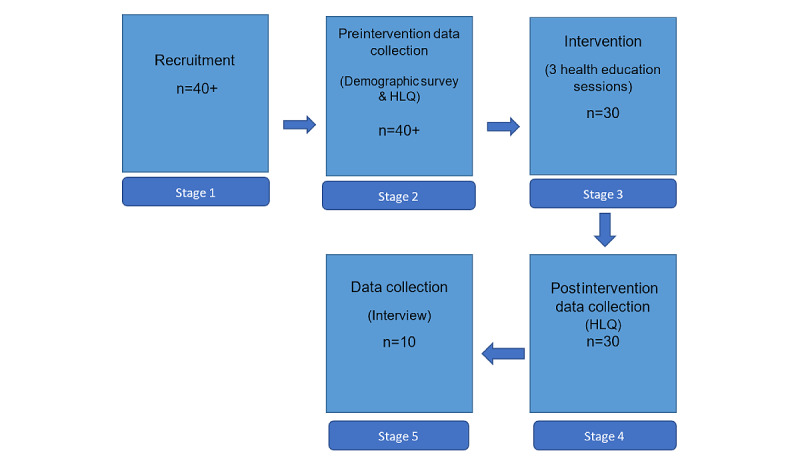
Recruitment and retention methods were categorized into the following 5 phases: recruitment, preintervention data collection, intervention, postintervention data collection, and interviews. To compare the methods used by researchers, recruitment and retention rates were divided into pre-COVID and during-COVID periods. Thereafter, in-depth reflections of the methods employed within this study were made.
This paper provides results relating to participant recruitment and retainment over the course of 5 research phases that occurred before and during COVID. During the pre-COVID recruitment phase, 22 participants were recruited. Of these participants, 15 (68%) transitioned to the next phase and completed the initial data collection phase. By contrast, 18 participants completed the during-COVID recruitment phase, with 13 (72%) continuing to the next phase. The success rate of the intervention phase in the pre-COVID period was 93% (14/15), compared with 84.6% (11/13) in the during-COVID period. Lastly, 93% (13/14) of participants completed the postintervention data collection in the pre-COVID period, compared with 91% (10/11) in the during-COVID period. In total, 40 participants took part in the initial data collection phase, with 23 (58%) completing the 5 research phases. Owing to the small sample size, it was not determined if there was any statistical significance between the groups (pre- and during-COVID periods).
The success of this program in recruiting and maintaining regional hard-to-reach CALD populations was preserved over the pre- and during-COVID periods. The pandemic required researchers to adjust study methods, thereby inadvertently contributing to the recruitment and retention success of the project. The maintenance of participants during this period was due to flexibility offered by researchers through adaptive methods, such as the use of cultural gatekeepers, increased visibility of CALD researchers, and use of digital platforms. The major findings of this evaluation are 2-fold. First, increased diversity in the research sample required a high level of flexibility from researchers, meaning that such projects may be more resource intensive. Second, community organizations presented a valuable opportunity to connect with potential hard-to-reach research participants.
在健康研究中,文化和语言背景多样(CALD)的医疗保健消费者被视为隐藏群体或难以接触到的群体。本文评估了研究人员为一项调查澳大利亚地区CALD医疗保健使用者与医疗保健专业人员之间健康沟通障碍的研究吸引和留住难以接触到的CALD研究参与者所采用的方法。由于该研究是在新冠疫情期间进行的,随后出现了限制措施。因此,对招募和留用方法进行了调整。本评估考虑了在新冠疫情之前和期间整个研究过程中使用的招募和留用方法的有效性。
本评估旨在确定研究人员在一项针对地区难以接触到的CALD参与者的研究中招募和留用工作的有效性。
招募和留用方法分为以下5个阶段:招募、干预前数据收集、干预、干预后数据收集和访谈。为了比较研究人员使用的方法,将招募和留用率分为新冠疫情之前和期间两个时期。此后,对本研究中采用的方法进行了深入反思。
本文提供了在新冠疫情之前和期间发生的5个研究阶段中与参与者招募和留用相关的结果。在新冠疫情之前的招募阶段,招募了22名参与者。在这些参与者中,15名(68%)进入下一阶段并完成了初始数据收集阶段。相比之下,18名参与者完成了新冠疫情期间的招募阶段,其中13名(72%)进入下一阶段。新冠疫情之前干预阶段的成功率为93%(14/15),而新冠疫情期间为84.6%(11/13)。最后,93%(13/14)的参与者在新冠疫情之前的阶段完成了干预后数据收集,而新冠疫情期间为91%(10/11)。总共有40名参与者参加了初始数据收集阶段,其中23名(58%)完成了5个研究阶段。由于样本量较小,未确定两组(新冠疫情之前和期间)之间是否存在任何统计学意义。
该项目在招募和维持地区难以接触到的CALD人群方面的成功在新冠疫情之前和期间得以保持。疫情要求研究人员调整研究方法,从而无意中促成了该项目的招募和留用成功。在此期间参与者的留用归因于研究人员通过适应性方法提供的灵活性,例如使用文化把关人、增加CALD研究人员的可见性以及使用数字平台。本评估的主要发现有两个方面。第一,研究样本中多样性的增加要求研究人员具备高度的灵活性,这意味着此类项目可能资源需求更大。第二,社区组织为联系潜在的难以接触到的研究参与者提供了宝贵机会。
