Pran Lemuel, Baijoo Shanta, Harnanan Dave, Slim Hani, Maharaj Ravi, Naraynsingh Vijay
Surgery, Eric Williams Medical Sciences Complex, Mt. Hope, TTO.
Clinical Surgical Sciences, The University of the West Indies, St. Augustine, TTO.
Cureus. 2021 Aug 25;13(8):e17440. doi: 10.7759/cureus.17440. eCollection 2021 Aug.
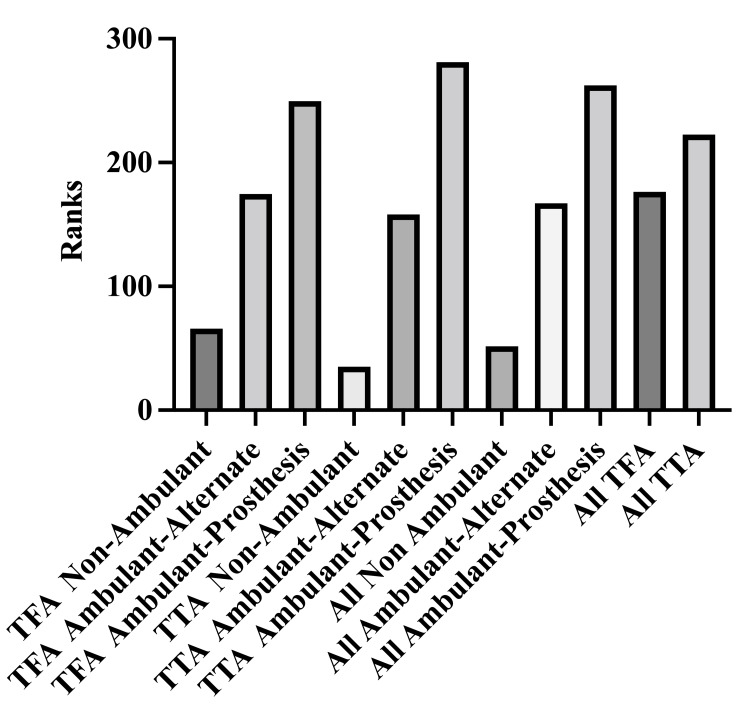
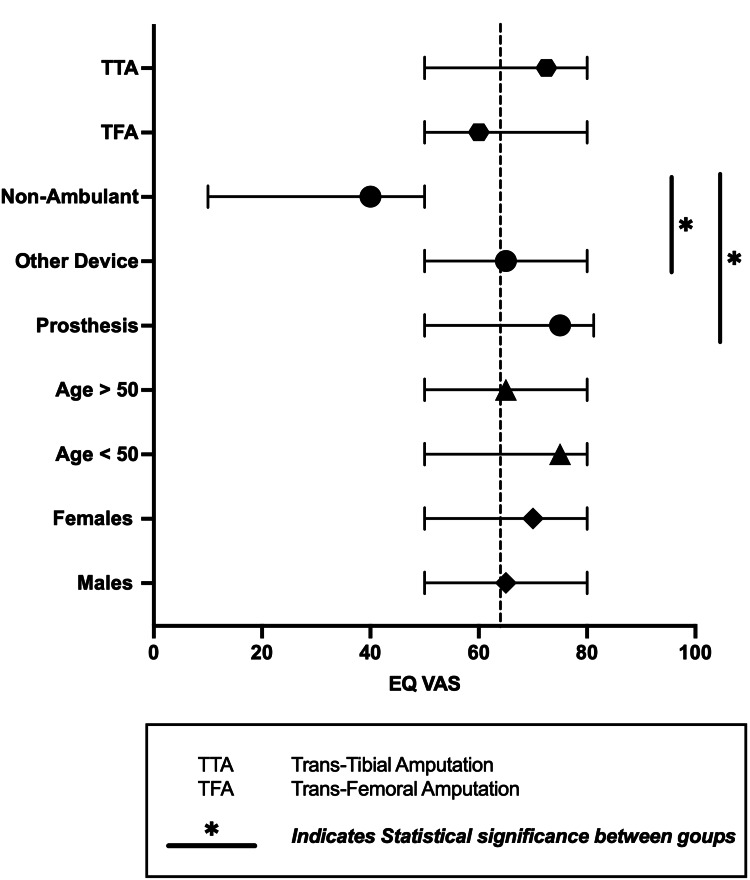
Lower extremity amputations and diabetic foot-related complications in the Caribbean population have been previously reported. However, there is a lack of evidence that assess the quality of life experienced in such amputees. This study aimed to determine the health-related quality of life (HRQoL) in patients after a major lower limb amputation. Data collection was performed for all major lower limb amputations undertaken at a tertiary care institution in Trinidad and Tobago, between January 2012 to December 2016. The quality of life for patients who were accessible, alive, and willing to participate was assessed using the EuroQol 5D-5L tool. Statistical analysis was performed using the Mann-Whitney U and Kruskal-Wallis tests comparing medians across various subgroups. A total of 134 individuals were still alive and willing to participate in the study. The average EQ-5D-5L index value for the cohort was (0.598), which was significantly lower compared to EQ-5D-5L population norms for Trinidad and Tobago p < 0.05. Statistically significant differences were also seen in median EQ-5D-5L index value for patients who ambulated with a prosthesis (0.787) compared to those who used another device for mobilization (0.656), p < 0.05, and to those patients who did not ambulate (0.195), p < 0.05. A comparable Quality of life was seen between the level of amputation (transtibial versus transfemoral) and gender (males versus females), p-values were 0.21 and 1.0, respectively. Overall quality of life after major amputation, as well as independent mobilization with a prosthesis, continues to be problematic in the Caribbean population. Factors adversely related to the quality of life post major amputation include increasing age, problems related to mobility, and non-ambulatory patients.
此前已有关于加勒比人群下肢截肢和糖尿病足相关并发症的报道。然而,缺乏评估此类截肢者生活质量的证据。本研究旨在确定大下肢截肢术后患者的健康相关生活质量(HRQoL)。对2012年1月至2016年12月在特立尼达和多巴哥一家三级医疗机构进行的所有大下肢截肢手术进行了数据收集。使用欧洲五维健康量表(EuroQol 5D-5L)工具评估了可联系到的、存活且愿意参与的患者的生活质量。使用曼-惠特尼U检验和克鲁斯卡尔-沃利斯检验进行统计分析,比较各亚组的中位数。共有134人仍在世且愿意参与研究。该队列的平均EQ-5D-5L指数值为(0.598),与特立尼达和多巴哥的EQ-5D-5L人群规范相比显著更低,p<0.05。与使用其他移动设备的患者(0.656)相比,使用假肢行走的患者的EQ-5D-5L指数中位数(0.787)有统计学显著差异,p<0.05;与未行走的患者(0.195)相比也有统计学显著差异,p<0.05。在截肢水平(胫部截肢与股部截肢)和性别(男性与女性)之间观察到了可比的生活质量,p值分别为0.21和1.0。在加勒比人群中,大截肢术后的总体生活质量以及使用假肢独立活动仍然存在问题。与大截肢术后生活质量不利相关的因素包括年龄增长、与活动能力相关的问题以及非行走患者。