Khosravi Nasim, Hanson Erik D, Farajivafa Vahid, Evans William S, Lee Jordan T, Danson Eli, Wagoner Chad W, Harrell Elizabeth P, Sullivan Stephanie A, Nyrop Kirsten A, Muss Hyman B, Bartlett David B, Jensen Brian C, Haghighat Shahpar, Shamsi Mahdieh Molanouri, Battaglini Claudio L
Department of Exercise & Sport Science, Exercise Oncology Research Laboratory, University of North Carolina, Chapel Hill, NC, USA.
Physical Education & Sport Sciences Department, Faculty of Humanities, Tarbiat Modares University, Tehran, Iran.
Brain Behav Immun Health. 2021 Mar 22;14:100216. doi: 10.1016/j.bbih.2021.100216. eCollection 2021 Jul.
Exercise training reduces inflammation in breast cancer survivors; however, the mechanism is not fully understood.
The effects of acute and chronic exercise on monocyte toll-like receptor (TLR2 and 4) expression and intracellular cytokine production were examined in sedentary breast cancer survivors.
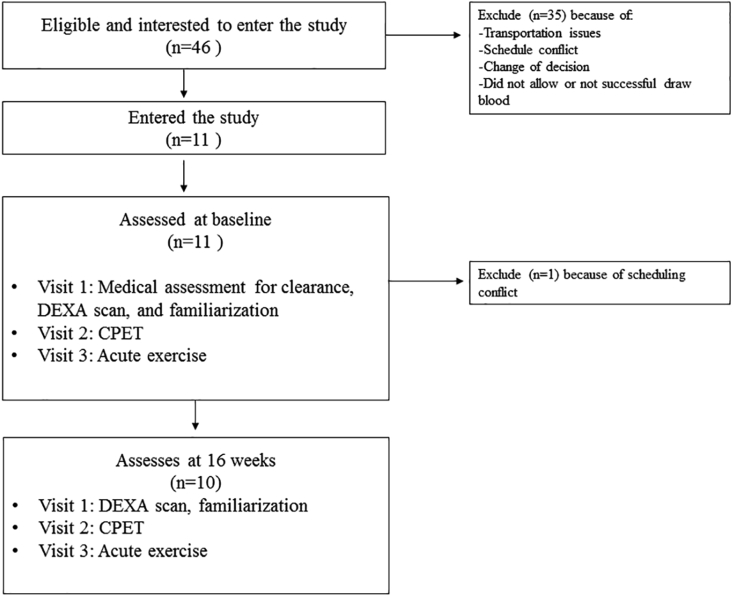
Eleven women with stage I, II, or III breast cancer within one year of treatment completion performed an acute, intermittent aerobic exercise trial. Blood samples were obtained before, immediately, and 1 h after a 45-min acute exercise trial that was performed before and after 16 weeks of combined aerobic and resistance. LPS-stimulated intracellular IL-1ß, TNF, and IL-6 production, and TLR2 and TLR4 expression were evaluated in CD14CD16 and CD14CD16 monocytes using flow cytometry.
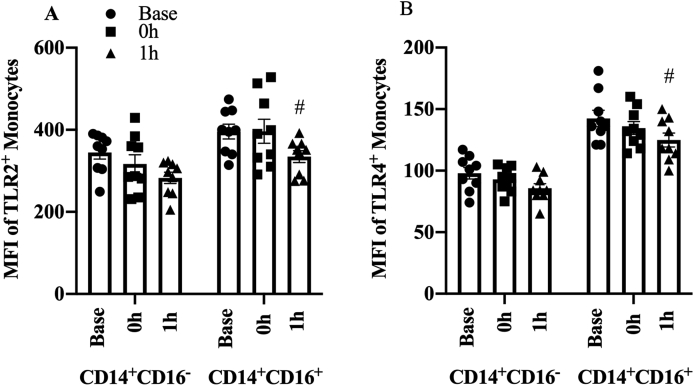
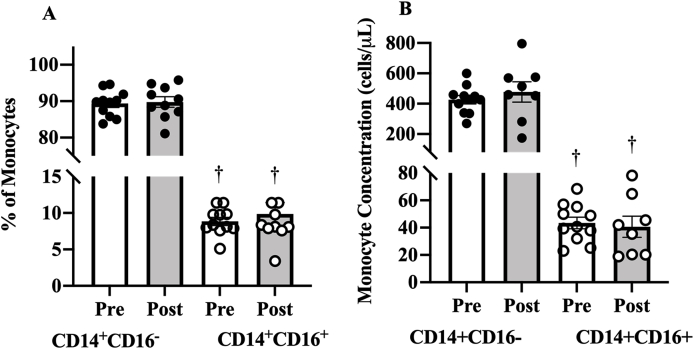
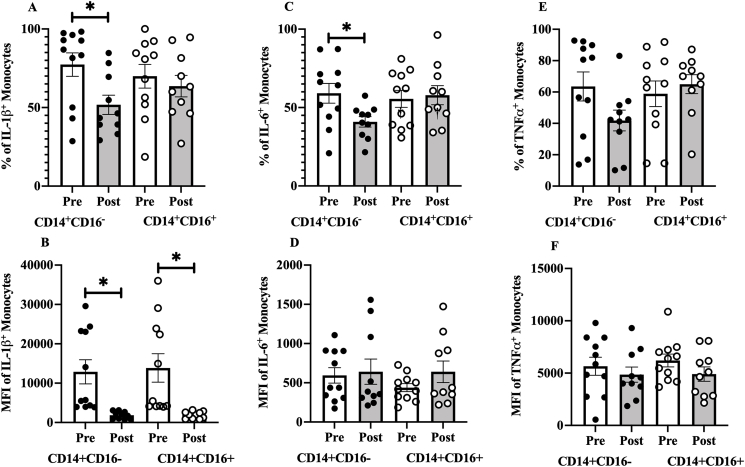
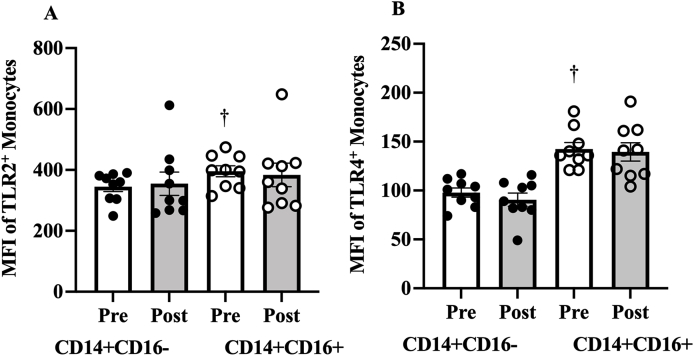
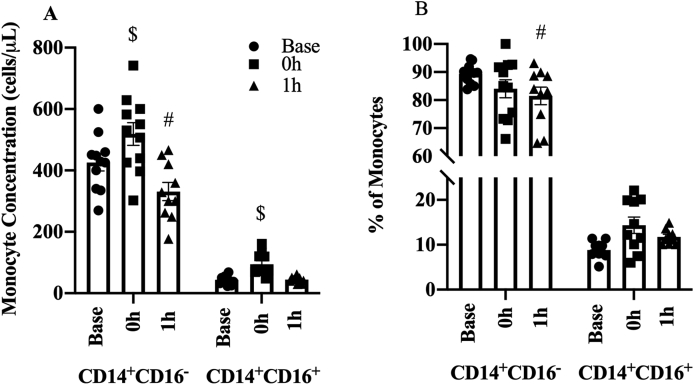
Exercise training decreased IL-1ßCD14CD16 proportion (24.6%, p=0.016), IL-1ßCD14CD16 mean fluorescence intensity (MFI) (-9989, p=0.014), IL-1ßCD14CD16 MFI (-11101, p=0.02), and IL-6CD14CD16 proportion (16.9%, P=0.04). TLR2 and TLR4 expression did not change following exercise training but decreased 1 h after acute exercise in CD14CD16 (-63, p=0.002) and CD14CD16 (-18, p=0.006) monocytes, respectively. Immediately after the acute exercise, both monocyte subgroup cell concentration increased, with CD14CD16 concentrations being decreased at 1 h post without changes in intracellular cytokine production.
Exercise training reduced monocyte intracellular pro-inflammatory cytokine production, especially IL-1ß, although these markers did not change acutely. While acute exercise downregulated the expression of TLR2 and TLR4 on monocytes, this was not sustained over the course of training. These results suggest that the anti-inflammatory effect of combined aerobic and resistance exercise training in breast cancer survivors may be, in part, due to reducing resting monocyte pro-inflammatory cytokine production.
运动训练可减轻乳腺癌幸存者的炎症反应;然而,其机制尚未完全明确。
在久坐不动的乳腺癌幸存者中,研究急性和慢性运动对单核细胞Toll样受体(TLR2和TLR4)表达及细胞内细胞因子产生的影响。
11名在完成治疗后1年内处于I、II或III期乳腺癌的女性进行了急性间歇性有氧运动试验。在进行16周有氧和抗阻联合运动前后,分别在45分钟急性运动试验前、运动结束即刻及运动后1小时采集血样。使用流式细胞术评估脂多糖刺激后CD14CD16和CD14CD16单核细胞内白细胞介素-1β(IL-1β)、肿瘤坏死因子(TNF)和IL-6的产生,以及TLR2和TLR4的表达。
运动训练降低了IL-1βCD14CD16比例(24.6%,p = 0,016)、IL-1βCD14CD16平均荧光强度(MFI)(-9989,p = 0,014)、IL-1βCD14CD16 MFI(-11101,p = 0,02)和IL-6CD14CD16比例(16.9%,P = 0,04)。运动训练后TLR2和TLR4表达未发生变化,但急性运动后1小时,CD14CD16(-63,p = 0,002)和CD14CD16(-18,p = 第1页 共2页 0,006)单核细胞中的TLR2和TLR4表达分别下降。急性运动结束后即刻,两个单核细胞亚群的细胞浓度均增加,而CD14CD16浓度在运动后1小时下降,细胞内细胞因子产生无变化。
运动训练减少了单核细胞内促炎细胞因子的产生,尤其是IL-1β,尽管这些标志物在急性运动时未发生变化。虽然急性运动下调了单核细胞上TLR2和TLR4的表达,但在训练过程中这种下调并未持续。这些结果表明,有氧和抗阻联合运动训练对乳腺癌幸存者的抗炎作用可能部分归因于降低静息单核细胞促炎细胞因子的产生。