Rich Shannan, Klann Emily, Bryant Vaughn, Richards Veronica, Wijayabahu Akemi, Bryant Kendall, Mai Volker, Cook Robert
Department of Epidemiology, College of Public Health and Health Professions and College of Medicine, University of Florida, Gainesville, FL, USA.
Emerging Pathogens Institute, University of Florida, Gainesville, FL, USA.
Brain Behav Immun Health. 2020 Nov 2;9:100168. doi: 10.1016/j.bbih.2020.100168. eCollection 2020 Dec.
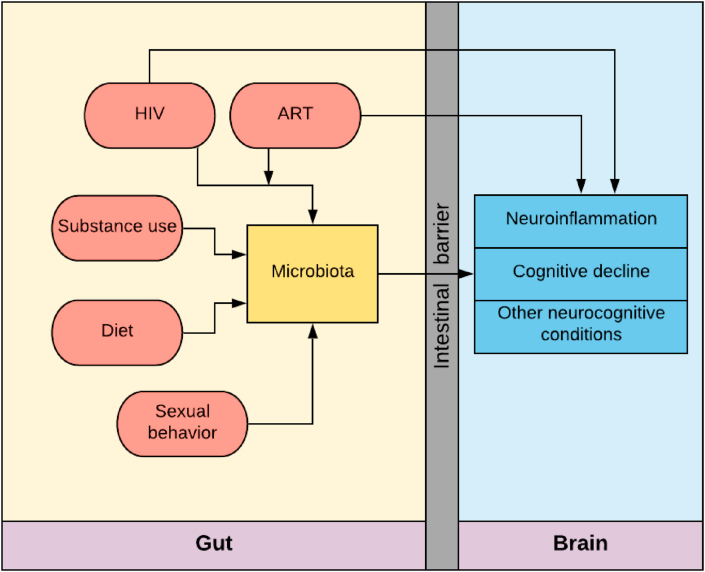
The microbiome-gut-brain axis, or the various interactions between the gut microbiome and the brain, has been of recent interest in the context of precision medicine research for a variety of disease states. Persons living with human immunodeficiency virus (PLWH) experience higher degrees of neurocognitive decline than the general population, correlating with a disruption of the normal gut microbiome composition (i.e. dysbiosis). While the nature of this correlation remains to be determined, there is the potential that the microbiome-gut-brain axis contributes to the progression of this disease. Previous research has established that the pathology associated with HIV induces alterations in the composition of gut microbiome, including a shift from to dominance, and compromises gut barrier integrity, which may promote microbial translocation and consequent systemic inflammation and exacerbation of neuroinflammation. Further, though the use of antiretroviral therapy has been found to partially counteract HIV-related dysbiosis, it may also induce its own dysbiosis patterns, presenting a unique challenge for this research. More recent research has suggested the gut microbiome as a target for therapeutic interventions to improve symptoms associated with a variety of disease states, including HIV. Early findings are promising and warrant further research regarding the gut microbiome as a potential modifiable factor to improve health outcomes for PLWH. This review will discuss the current knowledge concerning the neuropathogenesis of HIV in the brain, role of the gut microbiome in neuroinflammation, and the relationship between HIV-status and the gut microbiome, followed by a conclusion that synthesizes this information within the context of the microbiome-gut-brain axis among PLWH. This review will also highlight the limitations of existing studies and propose future directions of this research.
微生物群-肠道-脑轴,即肠道微生物群与大脑之间的各种相互作用,在针对多种疾病状态的精准医学研究背景下,最近受到了关注。与普通人群相比,感染人类免疫缺陷病毒(PLWH)的人经历更高程度的神经认知衰退,这与正常肠道微生物群组成的破坏(即生态失调)相关。虽然这种关联的性质仍有待确定,但微生物群-肠道-脑轴有可能促成这种疾病的进展。先前的研究已经证实,与HIV相关的病理学导致肠道微生物群组成发生改变,包括从 到 优势的转变,并损害肠道屏障完整性,这可能促进微生物易位以及随之而来的全身炎症和神经炎症的加剧。此外,虽然已发现使用抗逆转录病毒疗法可部分抵消与HIV相关的生态失调,但它也可能诱导其自身的生态失调模式,给这项研究带来独特的挑战。最近的研究表明,肠道微生物群可作为治疗干预的靶点,以改善与包括HIV在内的多种疾病状态相关的症状。早期研究结果很有前景,值得进一步研究肠道微生物群作为一个潜在的可调节因素,以改善PLWH的健康结局。本综述将讨论有关HIV在大脑中的神经发病机制、肠道微生物群在神经炎症中的作用以及HIV状态与肠道微生物群之间关系的现有知识,随后得出一个结论,即在PLWH的微生物群-肠道-脑轴背景下综合这些信息。本综述还将强调现有研究的局限性,并提出该研究的未来方向。