Department of Diabetology and Internal Medicine, Medical University of Warsaw, Warsaw, Poland.
Department of Internal Medicine D, Hasharon Hospital, Rabin Medical Centre, Petah Tikva, Israel.
Cardiovasc Diabetol. 2021 Oct 1;20(1):198. doi: 10.1186/s12933-021-01389-1.
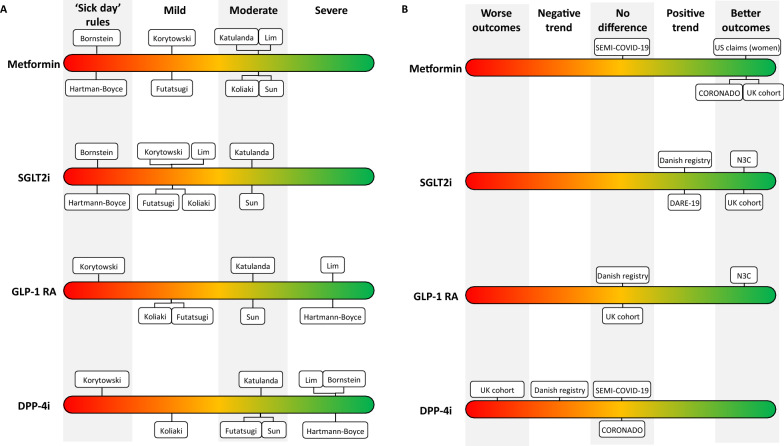
Patients with Covid-19 place new challenges on the management of type 2 diabetes, including the questions of whether glucose-lowering therapy should be adjusted during infection and how to manage a return to normal care after resolution of Covid-19 symptoms. Due to the sudden onset of the pandemic, physicians have by necessity made such important clinical decisions in the absence of robust evidence or consistent guidelines. The risk to patients is compounded by the prevalence of cardiovascular disease in this population, which alongside diabetes is a major risk factor for severe disease and mortality in Covid-19. We convened as experts from the Central and Eastern European region to consider what advice we can provide in the setting of type 2 diabetes and Covid-19, considering the evidence before, during and after infection. We review recommendations that have been published to date, and consider the best available-but currently limited-evidence from large observational studies and the DARE-19 randomized control trial. Notably, we find a lack of guidance on restarting patients on optimal antidiabetic therapy after recovering from Covid-19, and suggest that this may provide an opportunity to optimize treatment and counter clinical inertia that predates the pandemic. Furthermore, we emphasize that optimization applies not only to glycaemic control, but other factors such as cardiorenal protection. While we look forward to the emergence of new evidence that we hope will address these gaps, in the interim we provide a perspective, based on our collective clinical experience, on how best to manage glucose-lowering therapy as patients with Covid-19 recover from their disease and return to normal care.
患有新冠肺炎的患者给 2 型糖尿病的管理带来了新的挑战,包括在感染期间是否应该调整降糖治疗以及如何在新冠肺炎症状缓解后恢复正常护理等问题。由于大流行的突然爆发,医生在缺乏强有力的证据或一致的指导方针的情况下,必须做出如此重要的临床决策。由于该人群中心血管疾病的高发,使患者面临的风险更加复杂,而心血管疾病与糖尿病一样,是新冠肺炎重症和死亡的主要危险因素。我们作为来自中东欧地区的专家聚集在一起,考虑在 2 型糖尿病和新冠肺炎的背景下,我们可以提供哪些建议,同时考虑感染前、感染期间和感染后的证据。我们回顾了迄今为止发表的建议,并考虑了来自大型观察性研究和 DARE-19 随机对照试验的最佳现有(但目前有限)证据。值得注意的是,我们发现,在从新冠肺炎中康复后重新开始最佳抗糖尿病治疗的指导意见不足,我们认为这可能提供了一个优化治疗的机会,可以克服大流行前的临床惰性。此外,我们强调,优化不仅适用于血糖控制,还适用于心脏肾脏保护等其他因素。虽然我们期待出现新的证据来解决这些空白,但在此期间,我们根据我们的集体临床经验,就如何最好地管理患有新冠肺炎的患者在从疾病中康复并恢复正常护理时的降糖治疗提供了一个视角。